

Best phones under 40000 in India now give you a 144Hz AMOLED screen, huge batteries, fast charging and near-flagship performance without crossing the ₹40K mark. This guide ranks the best phones under 40000 based on real-world value, battery life, gaming performance, display quality, software support and current Indian pricing.
₹40,000 used to buy you a compromise. In 2026, it can buy you a phone that feels close to flagship level if you choose carefully. The problem is that this segment changes fast, so the best phones under 40000 today may move above budget after one price hike.
The less good news: this list changes fast. Two phones I was ready to recommend got repriced above ₹40K in the same week I was writing this, thanks to a global memory chip shortage that’s been quietly taxing every smartphone maker since late 2025. More on that below — it explains a lot about why your favourite phone suddenly costs ₹5,000 more than it did in March.
Here’s my final list of the best phones under 40000 in India right now, verified against live listings as of July 9, 2026.
This isn’t a list built from press releases and spec sheets alone. Every price below was cross-checked against at least two live retail listings — Amazon, Flipkart, or the brand’s own India store — because launch-day pricing and what you’ll actually pay a month later are often two different numbers, as you’ll see with the Redmi Turbo 5 and Realme GT 7 below.
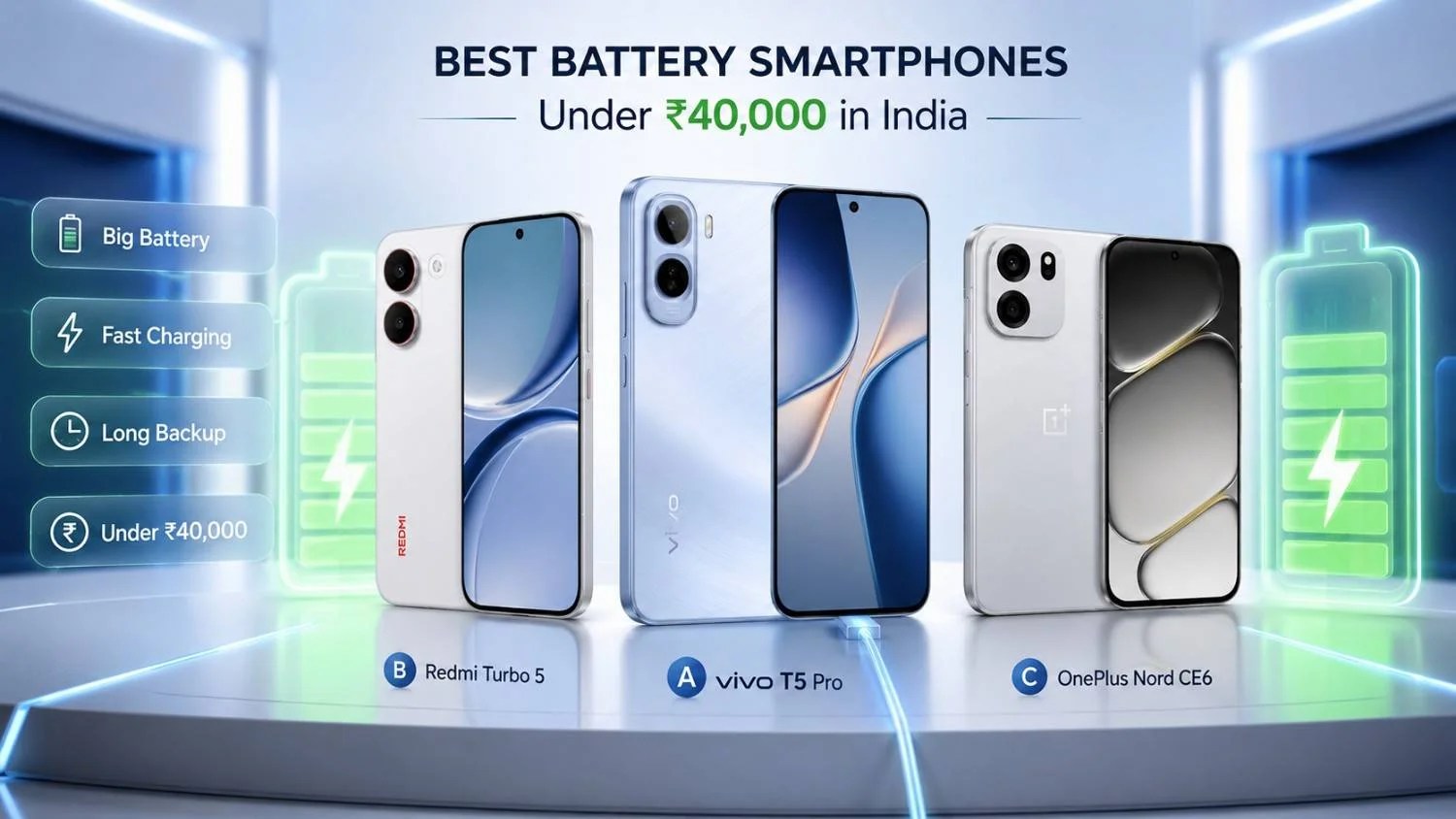
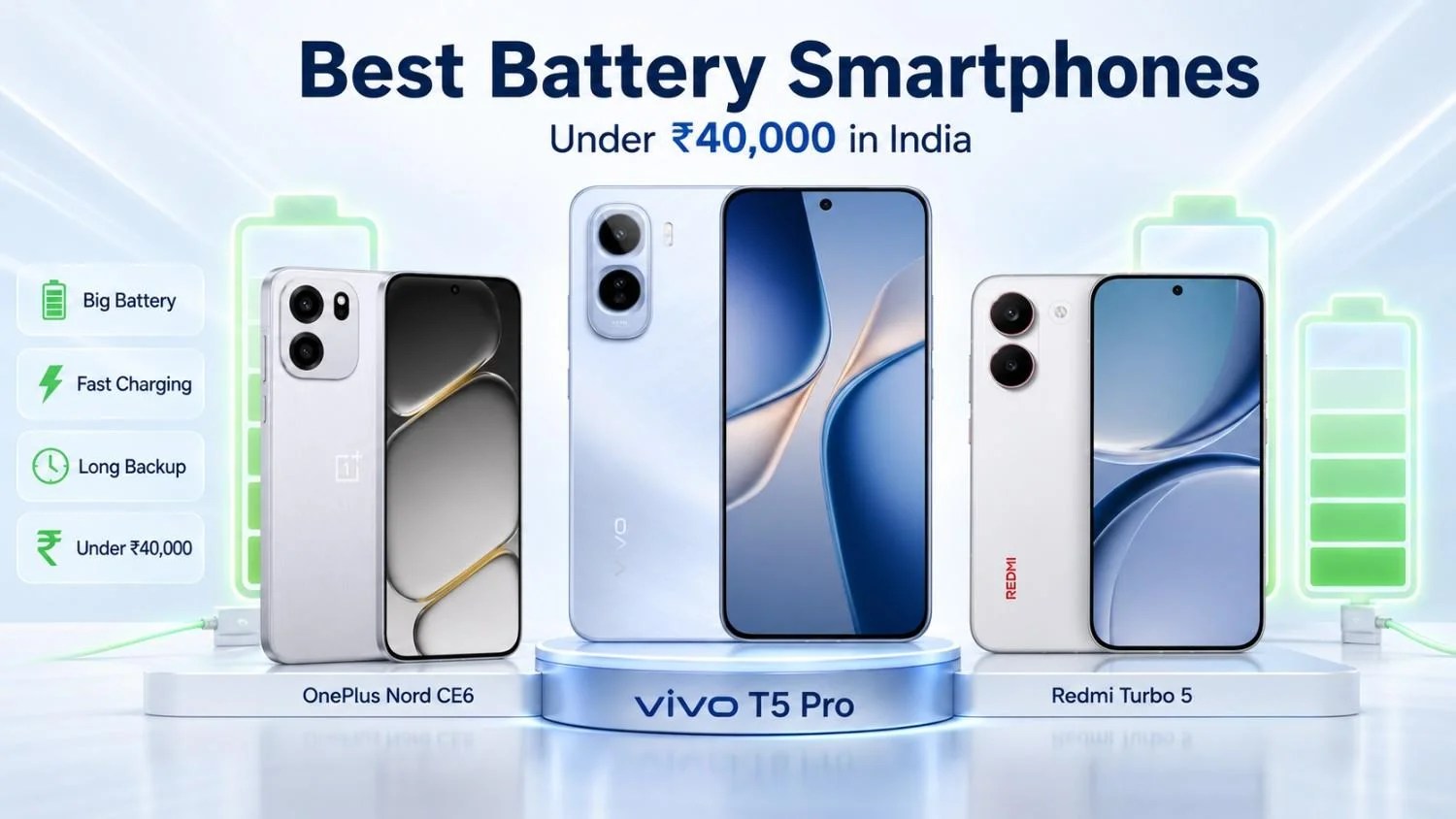
Quick answer: The vivo T5 Pro tops our list of the best phones under 40000 for most buyers, thanks to its 9,020mAh battery and 144Hz AMOLED display at ₹29,999–₹39,999. If gaming performance matters more than anything else, the Redmi Turbo 5’s Dimensity 8500 Ultra chipset is hard to beat.
Why Isn’t the Oppo Reno 16c on This List?
Short answer: it doesn’t qualify anymore. The Reno 16c launched on July 9 starting at ₹46,999 for the base 8GB/128GB model, climbing to ₹55,999 for the top variant.
Even the older Reno 14, which launched under ₹40K, got hiked to ₹42,999 the same week the Reno 16 series arrived. Oppo simply doesn’t have a Reno phone under 40000 in India right now.
If you were specifically hunting for a Reno at this price, the realme GT 7 below is the closest thing — same design-forward mid-range positioning, similar camera ambitions, and it still (barely) clears the ₹40K bar.
1. vivo T5 Pro — One of the Best Phones Under 40000 Overall
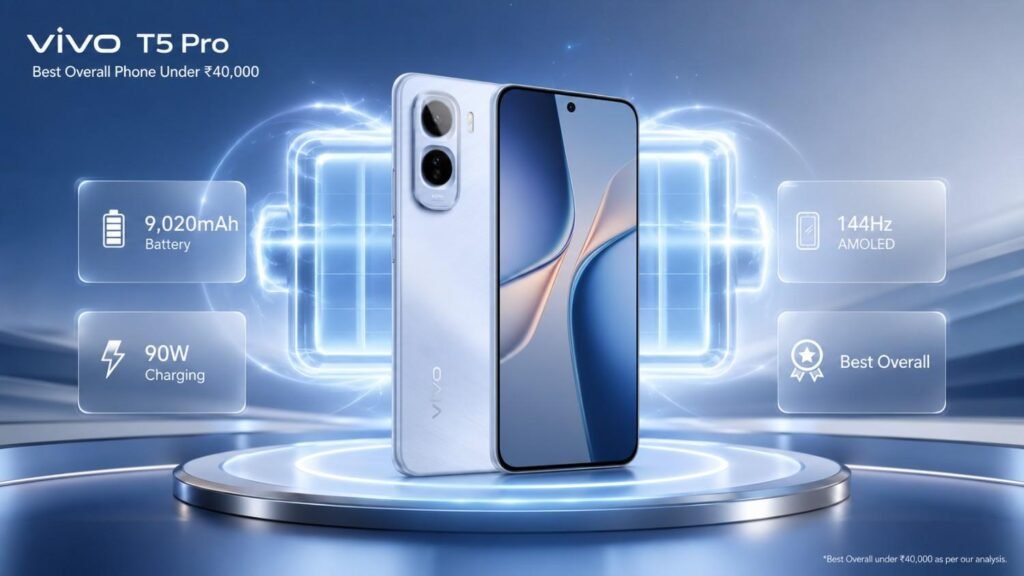
The vivo T5 Pro is the pick if you want one phone that does everything well without a single glaring weakness. It starts at ₹29,999 and tops out at ₹39,999 for the 12GB/256GB variant.
What sells it is the 9,020mAh battery — genuinely one of the largest in any mainstream phone sold in India today. Pair that with 90W fast charging and you’re looking at 0-50% in about 37 minutes, according to vivo’s own claims.
The 6.83-inch 1.5K AMOLED display runs at 144Hz with up to 5,000 nits peak brightness, which sounds like marketing fluff until you’re trying to read your screen at noon in Chennai in June. It works.
I’d stop short of calling the camera exceptional — a 50MP main sensor paired with just a 2MP depth sensor means there’s no proper ultrawide here. If photography is your priority, skip ahead to the realme GT 7.
Best for: Buyers who want the biggest battery and best display for the money and don’t obsess over camera versatility.
2. Redmi Turbo 5 — One of the Best Phones Under 40000 for Gaming Performance

If your phone’s job is to survive four hours of BGMI without thermal throttling, the Redmi Turbo 5 is your answer. It launched at ₹35,999 for the 8GB/256GB model; the current street price sits closer to ₹37,999–₹40,999 after a couple of quiet price bumps.
The MediaTek Dimensity 8500 Ultra chipset, paired with a 5,300mm² vapour chamber, is the real story here. Xiaomi claims AnTuTu scores north of 20 lakh — high enough to outrun most rivals in this bracket, including the OnePlus Nord CE6.
It also packs a 7,540mAh silicon-carbon battery with 100W HyperCharge, so battery anxiety isn’t really a concern either. You even get 27W reverse charging, handy for topping up your earbuds or a friend’s phone.
The trade-off is camera hardware — a 50MP main plus 8MP ultrawide, competent but unremarkable next to the vivo T5 Pro or realme GT 7. Xiaomi also loads it with more pre-installed apps than most rivals, which is an easy first-day cleanup job.
Best for: Mobile gamers and anyone who runs their phone hard all day and hates carrying a charger.
3. Nothing Phone (4b) — Best for Design and Clean Software
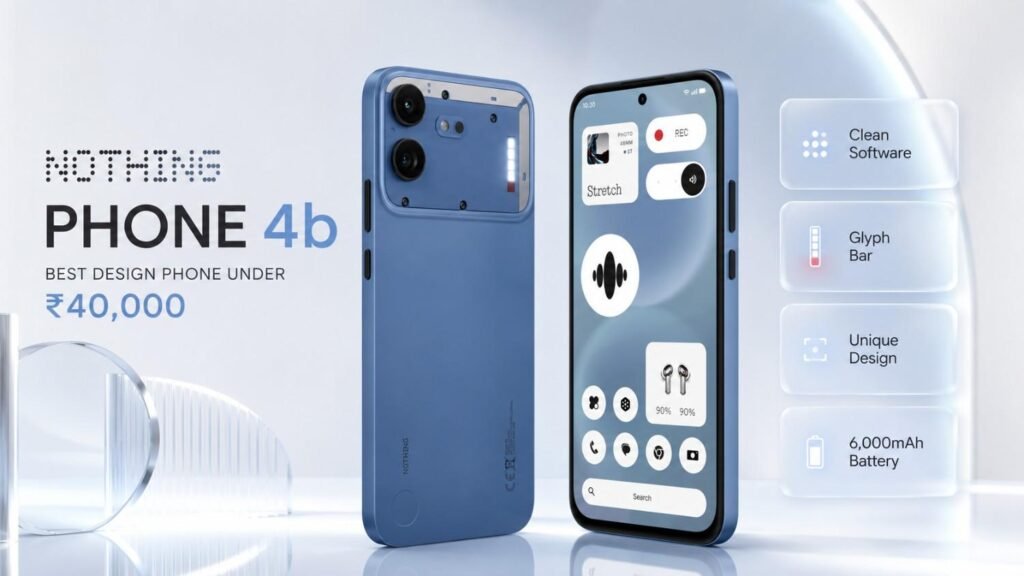
This is the freshest phone on the list — it launched on July 7 and goes on sale July 14, priced at ₹34,999 for 8GB/128GB and ₹38,699 for 8GB/256GB.
Nothing built the (4b) to slot below the now-pricier Phone (4a), which got hiked to ₹39,999 amid the same memory shortage affecting the rest of the industry. The (4b) resets Nothing’s India entry point by roughly ₹10,000 if you factor in launch bank offers.
The standout here is the Glyph Bar — 45 mini-LEDs on the back panel that can show call alerts, charging progress, and live delivery updates from apps like Zomato and Uber. It’s genuinely useful, not just a party trick.
India gets a specifically upsized 6,000mAh battery versus the 5,200mAh cell sold globally — Nothing’s biggest battery yet on any of its phones. Snapdragon 6 Gen 4 keeps things running smoothly for everyday use, though it’s not a chip built for heavy gaming.
Best for: Buyers who care about how their phone looks and feels using it as much as raw benchmarks.
4. Motorola Edge 70 Fusion — Best Value for Money

Nobody talks about the Edge 70 Fusion enough, and that’s a shame, because at ₹26,999 it’s arguably the best-value phone on this entire list.
You get a 6.78-inch 144Hz AMOLED display, Snapdragon 7s Gen 4, a 7,000mAh battery, and — this is the part that impresses me — IP68, IP69, and full MIL-STD-810H military-grade durability certification at a price where most rivals skip half of that.
The Sony LYT-710 camera sensor handles daylight shots well, and Motorola’s near-stock Android with “moto ai” tools like Playlist Studio and Next Move adds some genuinely practical AI features rather than gimmicks nobody asked for.
At ₹26,999 for the base model and ₹32,999 for the top 12GB/256GB variant, this stays comfortably under ₹40K even with future price hikes factored in.
Best for: Budget-conscious buyers who still want flagship-tier durability and display quality.
5. OnePlus Nord CE6 — Best for Battery-First Buyers
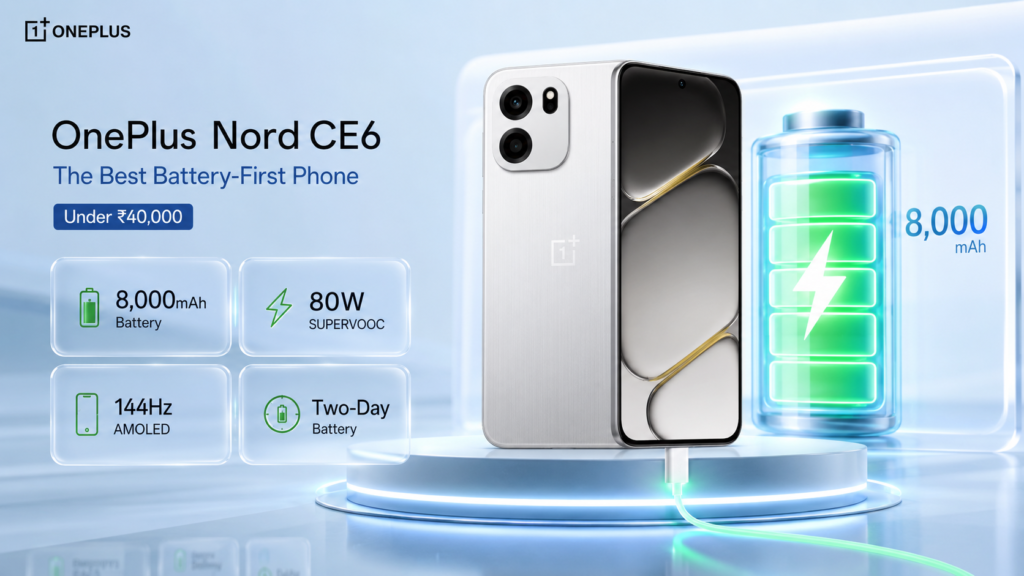
OnePlus pivoted the Nord CE line hard toward battery and durability with the CE6, and it shows. Starting at ₹33,999, it packs an 8,000mAh battery — a genuine multi-day phone for light users.
The Snapdragon 7s Gen 4 chipset is shared with the vivo T5 Pro, so real-world performance lands in similar territory. What sets the CE6 apart is the in-box 80W SUPERVOOC charger — no separate purchase needed, unlike some rivals that quietly drop the charger from the box.
A 144Hz AMOLED display, stereo speakers, and an X-axis linear motor round out a package that feels more premium than the price suggests. This is a genuine shift from the CE5’s more chipset-focused approach.
Best for: Buyers who want two-day battery life without switching to a dedicated “battery phone” brand.
6. Samsung Galaxy A56 — Best for Long-Term Software Support
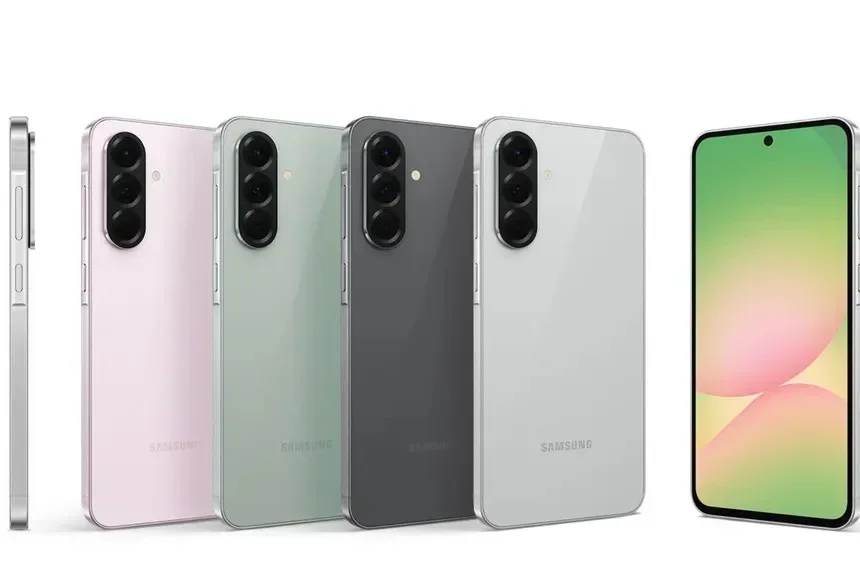
The Galaxy A56 is the phone to buy if you plan to keep it for four-plus years. It starts at ₹31,999 for 8GB/128GB and ₹35,999 for 8GB/256GB, running the in-house Samsung Exynos 1580 chipset.
Samsung’s A-series has become the safe, sensible pick for buyers who prioritise software updates over spec-sheet bragging rights. One UI is polished, and Samsung’s update commitments on the A-series consistently outlast rivals in this price bracket.
It’s not the phone for gamers or camera enthusiasts — performance and low-light photography both trail the vivo T5 Pro and Redmi Turbo 5. But for someone who wants a dependable daily driver with minimal surprises, it’s a solid, low-drama choice.
Best for: Buyers who value software longevity and a clean UI over benchmark scores.
7. realme GT 7 — Best Flagship-Grade Specs Under 40000

The realme GT 7 barely squeezes under our budget cap at ₹39,890–₹39,999, and I mean barely — a single price bump could push it over ₹40K by the time you read this.
That said, it’s worth the risk. The MediaTek Dimensity 9400e is a genuine flagship-tier chipset, paired with a 7,000mAh battery and 120W charging that gets you from empty to full faster than you can finish a coffee.
The 6.78-inch 1.5K LTPO AMOLED display hits up to 6,000 nits peak brightness — realme calls it a “Pro-Esports Display,” and for once the marketing isn’t too far off. IP69 rating adds real-world durability most phones this size skip.
Camera-wise, a 50MP Sony IMX906 main sensor does the heavy lifting, though the ultrawide lens is the weak link reviewers consistently flag.
Best for: Buyers chasing flagship performance who are willing to move fast before the price crosses ₹40K.
Quick Comparison: Best Phones Under 40000 (July 2026)
| Phone | Starting Price | Best For | Key Highlight |
|---|---|---|---|
| vivo T5 Pro | ₹29,999 | Overall value | 9,020mAh battery, 144Hz AMOLED |
| Redmi Turbo 5 | ₹35,999 | Gaming & performance | Dimensity 8500 Ultra, 100W charging |
| Nothing Phone (4b) | ₹34,999 | Design & software | Glyph Bar, 6,000mAh battery |
| Motorola Edge 70 Fusion | ₹26,999 | Budget durability | IP68/IP69, MIL-STD-810H |
| OnePlus Nord CE6 | ₹33,999 | Battery life | 8,000mAh, 80W SUPERVOOC |
| Samsung Galaxy A56 | ₹31,999 | Software updates | One UI, long-term support |
| realme GT 7 | ₹39,999 | Flagship-grade specs | Dimensity 9400e, 120W charging |
Prices are for base variants and change frequently — check the live price before you buy using our phone spec finder.
Can You Get These Phones on EMI?
Yes — every phone on this list is available on no-cost EMI through Amazon, Flipkart, or the brand’s own site, typically spread across 3, 6, or 9 months depending on your bank.
The Redmi Turbo 5, for instance, launched with a 9-month no-cost EMI option alongside instant bank discounts of up to ₹2,000 on SBI, ICICI, and Axis cards. Similar bank tie-ins show up on the Nothing Phone (4b) and OnePlus Nord CE6 during their respective launch windows.
Worth noting: “no-cost EMI” isn’t always what it sounds like — the interest is often baked into the sticker price rather than genuinely waived. Run the numbers before assuming EMI is automatically cheaper than paying upfront using our smartphone EMI calculator, which breaks down the real interest and total repayment for you.
What About Warranty and After-Sales Support?
All seven phones here carry the standard 1-year manufacturer warranty on the device and 6 months on in-box accessories, which is fairly standard across the Indian market regardless of brand.
Where things differ is software support length. Samsung’s Galaxy A56 leads the pack here, with Samsung’s A-series typically getting more OS upgrade cycles than Chinese rivals at the same price. Nothing promises three years of Android updates and six years of security patches on the Phone (4b) — genuinely competitive for a phone under ₹35,000.
If you’re buying second-hand or want to double-check remaining warranty on any of these before purchase, our free phone warranty checker works across Samsung, Xiaomi, OnePlus, vivo, Oppo, realme, Motorola, and Google Pixel devices.
Why Are Phone Prices Under 40000 Rising in 2026?
If it feels like every phone in this bracket costs more than it did six months ago, that’s not your imagination. A global DRAM and NAND memory shortage — driven largely by AI data centre demand from companies buying up chip capacity — has pushed nearly every smartphone maker to raise prices since late 2025.
Xiaomi warned in late 2025 that DRAM costs alone could push 2026 phone prices up by roughly 25%. We’re now seeing exactly that play out: the OnePlus Nord 6 jumped from ₹38,999 to ₹42,999, the Redmi Note 15 got a ₹2,000 hike, and even budget POCO models saw ₹1,000–₹2,500 increases.
This is exactly why phones like the Reno 16c and Reno 14 slipped out of the sub-₹40K bracket this month, and why the realme GT 7’s spot on this list isn’t guaranteed to last. We track these shifts in detail in our full breakdown of why smartphone prices are rising in 2026.
Practical takeaway: if a phone on this list appeals to you, buying sooner rather than later is the safer bet. Waiting for a better deal in this market usually backfires.
How to Choose the Right Phone Under 40000 for You
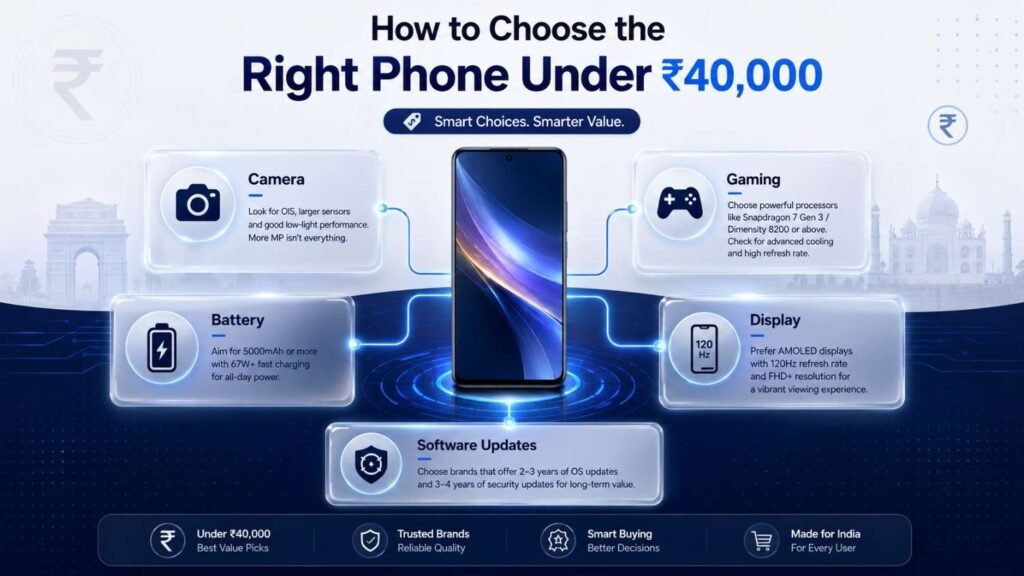
Start by figuring out what you’ll actually use daily — not what looks impressive on a spec sheet. A student who mostly browses, streams, and occasionally games needs a very different phone from someone editing reels for work.
If battery anxiety is your biggest pain point, the vivo T5 Pro and OnePlus Nord CE6 both solve it decisively with batteries at or above 8,000mAh. Gamers should default to the Redmi Turbo 5’s cooling and chipset advantage.
For camera-first buyers, none of these seven phones will match a true camera flagship — but the realme GT 7 and vivo T5 Pro come closest within this budget. And if you just want a phone that ages well over three to four years without slowing down, the Samsung Galaxy A56’s software support is the safer long-term bet.
Not sure which spec actually matters for your use case? Our phone specification finder lets you compare every model side by side in seconds, and the smartphone EMI calculator can help you work out monthly payments before you commit.
Whichever of these best phones under 40000 you land on, matching it to your actual daily habits matters more than chasing the highest spec sheet.
Frequently Asked Questions
Quick answers about the best phones under ₹40,000 in India.
The vivo T5 Pro is the best overall pick among phones under 40000 as of July 2026, offering a 9,020mAh battery, a 144Hz AMOLED display, and pricing starting at ₹29,999. It balances battery life, display quality, and performance better than most rivals in this bracket.
The Redmi Turbo 5 wins on raw gaming performance thanks to its Dimensity 8500 Ultra chipset and vapour chamber cooling. The Nothing Phone (4b) wins on design, software polish, and the Glyph Bar’s practical notification features. Pick based on whether performance or design matters more to you.
The Reno 16c launched in India on July 9, 2026 starting at ₹46,999, which puts it above the ₹40,000 budget this list covers. The Reno 14, its predecessor, also crossed ₹40,000 after a recent price hike, leaving no current Oppo Reno model under ₹40K.
Likely, yes. An ongoing global memory chip shortage has already pushed prices up across nearly every brand since late 2025, and industry warnings suggest this pressure could continue through 2026. Buying sooner rather than waiting is generally the safer move right now.
The realme GT 7 and vivo T5 Pro offer the strongest camera hardware in this price bracket, though neither matches a dedicated camera flagship. The realme GT 7’s 50MP Sony IMX906 sensor is the standout, with its main weakness being the ultrawide lens.
This list of the best phones under 40000 will keep shifting — prices and availability change weekly in this segment. Bookmark our Best Phones section or check our upcoming phone launches timeline to stay ahead of the next price shuffle. If you’re stretching your budget slightly, our guide to phones under ₹20,000 and student picks under ₹15K/₹25K/₹35K cover the tiers just below this one.










4 thoughts on “7 Best Phones Under ₹40,000 in India (July 2026 Edition)”