
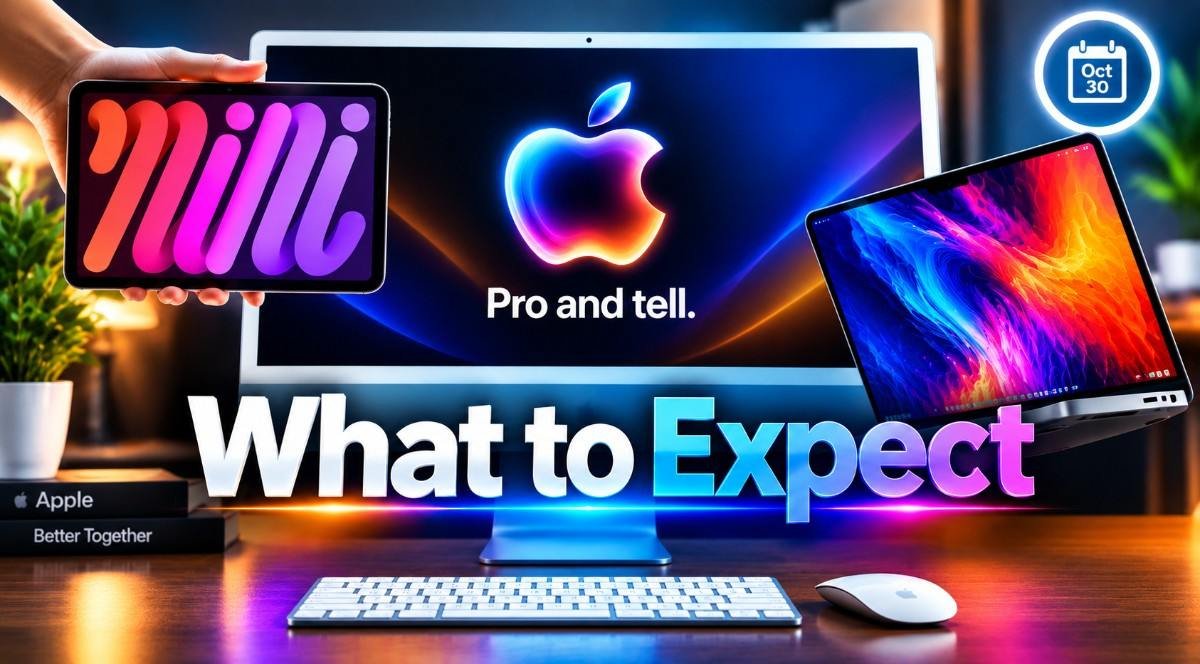

Apple just wrapped one of the busiest product years in its history. It launched the iPhone 18 Pro, the iPhone Duo foldable, a new HomeView smart display, the HomePod mini 2, and an updated Apple TV 4K — all within the last three months. Most companies would stop there. Apple is holding a second October event.
The event is called “Pro and Tell”, and it is scheduled for October 28, 2026, at 10:00 AM Pacific Time in Los Angeles. Apple’s Senior Vice President of Marketing, Greg Joswiak, teased it on X with the line “Can’t wait to pro and tell next week” — a hint that this event is about professional-grade hardware, not consumer gadgets.
What makes this event unusual is its format. Unlike Apple’s traditional keynote livestreams, Pro and Tell is being billed as an in-person media experience. Invited journalists will get hands-on time with the products, and Apple is expected to publish press releases and product videos rather than stage a theatrical presentation. That format suggests Apple wants the products to speak for themselves — which is exactly what you do when the hardware is genuinely impressive.
Four products are widely expected: an OLED iPad mini, a standard 14-inch MacBook Pro with the M6 chip, a redesigned OLED MacBook Pro with touchscreen support, and a refreshed 24-inch iMac with the M6 chip and new colors. Here is everything we know about each one, sourced and clearly labelled by confidence level.
Why this matters right now: If you are planning to buy an iPad mini, a MacBook Pro, or an iMac in the next few weeks, do not buy before October 28. Apple is expected to announce significant updates to all three product lines, and buying the current model now means missing out on an OLED display, a newer chip, or a completely redesigned chassis. The new devices could hit stores as early as November 6, with pre-orders likely opening immediately after the event.
Key Takeaways
- Event date: October 28, 2026, 10:00 AM PT, Los Angeles — no traditional keynote livestream announced
- OLED iPad mini: First OLED display on an iPad mini, A20 Pro chip, IP68 water resistance, landscape front camera
- M6 14-inch MacBook Pro: Same mini-LED design as current model, but with the new 2nm M6 chip
- OLED MacBook Pro: First touchscreen Mac, tandem OLED display, Dynamic Island, M5 Pro/Max chips, thinner and lighter
- M6 iMac: 24-inch model gets the M6 chip and a refreshed color palette, but no major design change
- On-sale date: Devices could reach stores as early as November 6, 2026
The Event: What to Know Before October 28
Apple has not announced a public livestream for Pro and Tell. Based on the company’s October 13 “Welcome Home” event, which used the same format, expect Apple to publish newsroom posts and product videos at or around 10:00 AM PT, while invited journalists publish hands-on impressions separately.
| Detail | Information |
|---|---|
| Event name | Pro and Tell |
| Date | October 28, 2026 |
| Time | 10:00 AM PT / 1:00 PM ET |
| Location | Los Angeles, California |
| Format | In-person media experience, no public keynote announced |
| Teased by | Greg Joswiak, SVP Worldwide Marketing |
Event details from Gigazine, MacSales, and TechRepublic.
OLED iPad mini: The Biggest Upgrade in Five Years
The iPad mini has been stuck on LCD since its introduction. That changes this month. The eighth-generation iPad mini is expected to be the first iPad mini with an OLED display, and the upgrade is more than just a panel swap.
What to Expect
- ✦ OLED display — likely a tandem OLED panel for higher brightness and longer lifespan
- ✦ A20 Pro chip — the same class of silicon used in the iPhone 18 Pro
- ✦ IP68 water and dust resistance — a first for any iPad
- ✦ Landscape front camera — better for video calls in horizontal orientation
- ✦ Redesigned speaker system — vibration-based audio with no speaker holes, improving water resistance
The OLED iPad mini is expected to start at around $799 in the US, roughly $200 more than the current $599 model. That is a significant increase, but it reflects the cost of the OLED panel and the A20 Pro chip. For anyone who uses the iPad mini as a primary reading, note-taking, or travel device, the display upgrade alone may justify the price.
iPad mini details from Kursiv Media, PCPOP, and Digit.

M6 14-inch MacBook Pro: A Chip Refresh, Not a Redesign
Not every Mac at this event is getting a dramatic overhaul. The standard 14-inch MacBook Pro is expected to keep the current design, the current mini-LED display, and the current port layout — but gain the M6 chip.
The M6 is significant because it is Apple’s first Mac chip built on a 2-nanometer process, which should deliver better performance-per-watt than the M4 and M5 generations. It is the same chip already used in the latest Mac mini, and it represents a meaningful efficiency upgrade even if the outside of the laptop looks identical.
| Feature | Expected Specification |
|---|---|
| Chip | Apple M6 (2nm) |
| Display | 14.2-inch mini-LED, ProMotion |
| Design | Unchanged from current model |
| Ports | Unchanged (HDMI, SDXC, MagSafe, Thunderbolt) |
| Target buyer | Users who want the latest chip without paying for OLED |
This is the MacBook Pro for people who need a reliable, fast laptop and do not care about having the thinnest body or the most advanced display. It will likely be the most affordable new MacBook Pro announced at the event.
M6 MacBook Pro details from Digital Trends, MacSales, and Digit.
OLED Touchscreen MacBook Pro: The Main Event
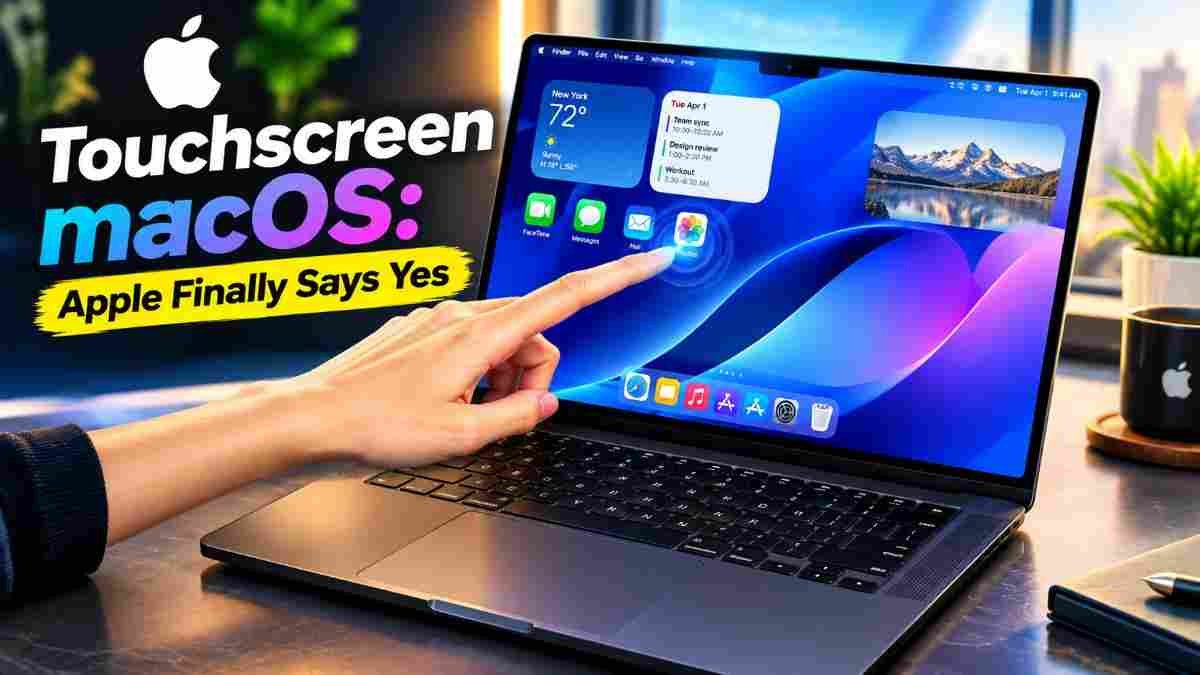
This is the product everyone is waiting for. After years of rumours and denials, Apple is expected to announce its first touchscreen MacBook Pro — and it will also be the first Mac with an OLED display.
Supply-chain leaker Instant Digital has described a touchscreen MacBook as “100% confirmed”, and Bloomberg’s Mark Gurman has corroborated it. Code discovered in macOS 27.2 contains multiple references to touch gestures in Safari, Photos, Notes, and Quick Look, plus a new MacBook screen protector icon and a Dock animation where icons respond to touch for a few seconds to simulate a right-click.
Apple is reportedly positioning touch as “touch-friendly, not touch-first” — a supplementary input method alongside the keyboard and trackpad rather than a replacement. The hinge is being reinforced so the display does not wobble when tapped, which is the kind of physical engineering that separates a real touchscreen laptop from a panel bolted onto an existing chassis.
Tandem OLED: The Display Upgrade
The OLED MacBook Pro is expected to come in 14-inch and 16-inch sizes, with a tandem OLED display that delivers true blacks, higher contrast, and better power efficiency than the current mini-LED panels. The notch is being replaced by a Dynamic Island-style pill-shaped cutout, and the body is expected to be thinner and lighter, aided by the removal of the mini-LED backlight layer.
| Feature | Current MacBook Pro | OLED MacBook Pro (Rumoured) |
|---|---|---|
| Display | Mini-LED | Tandem OLED |
| Touchscreen | No | Yes — first Mac with touch |
| Camera cutout | Notch | Dynamic Island (pill-shaped) |
| Chip | M5 Pro / M5 Max | M5 Pro / M5 Max (unchanged) |
| Design | 15.5mm / 16.8mm thick | Thinner and lighter |
| Hinge | Standard | Reinforced for touch stability |
| Cellular | No | Possible C2 modem / eSIM (unconfirmed) |

Under the hood, reports indicate Apple will use the existing M5 Pro and M5 Max chips, not the M6 Pro or M6 Max. Apple reportedly plans to skip high-end M6 silicon entirely and fast-track M7 Pro and M7 Max for future models. For most professional workflows — video editing, 3D rendering, software development — the M5 Pro and M5 Max are still extremely capable, so this is unlikely to be a dealbreaker for buyers who care more about the display and the touchscreen than the chip name.
On cellular connectivity: Some reports suggest the OLED MacBook Pro could include a C2 modem with eSIM support, allowing built-in 5G without tethering to an iPhone. However, Bloomberg’s Mark Gurman has not included cellular in his 2026-2027 Mac roadmap, and Apple has not confirmed it. Treat built-in 5G as a possibility, not a certainty.
OLED MacBook Pro details from Digital Trends, Trusted Reviews, Business Times China, and Kursiv Media.
M6 24-inch iMac: New Chip, New Colors, Same Design
The 24-inch iMac has not been updated since the M4 generation. Apple skipped the M5 entirely for the iMac, which makes the M6 a double-generation leap for the all-in-one.
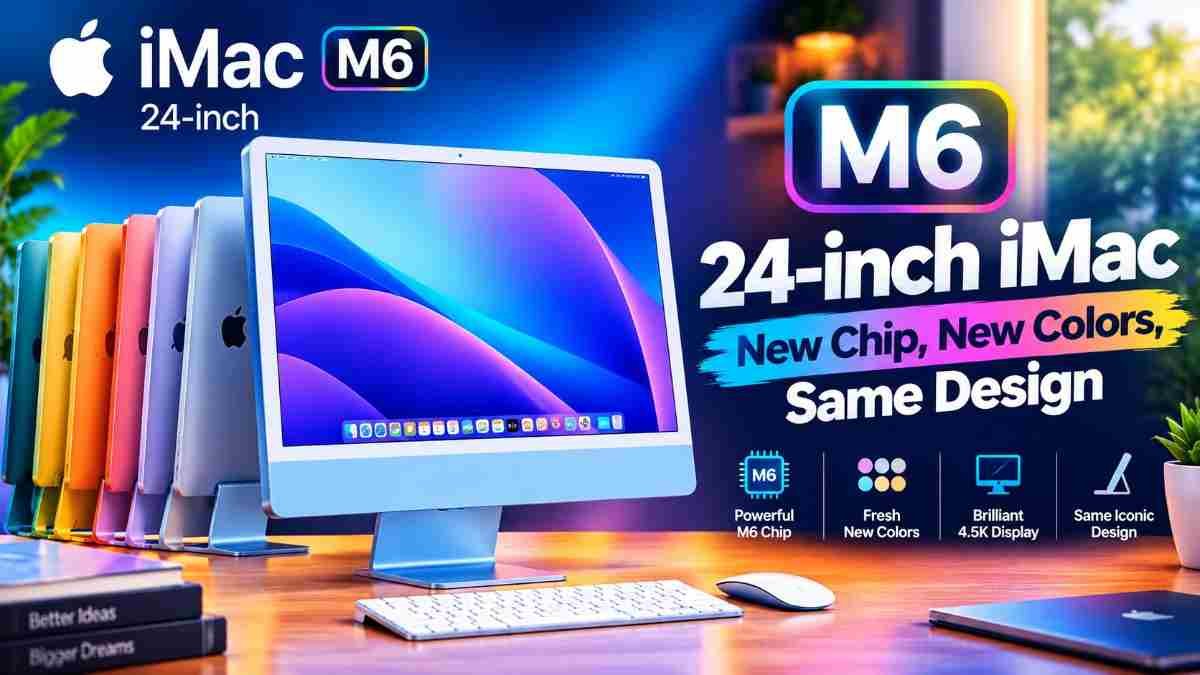
The design is expected to stay the same — same 24-inch 4.5K display, same thin profile, same stand options. What changes is the chip and the colors. Bloomberg’s Mark Gurman has reported that Apple is preparing a refreshed color palette for the M6 iMac, with new shades expected to join or replace the current blue, purple, pink, orange, yellow, green, and silver options.
| Feature | Current iMac (M4) | M6 iMac (Rumoured) |
|---|---|---|
| Chip | M4 | M6 (2nm) |
| Display | 24-inch 4.5K Retina | 24-inch 4.5K Retina (unchanged) |
| Design | Thin profile, color-matched accessories | Unchanged |
| Colors | 7 options | Refreshed palette |
| Starting price | $1,299 | Similar (M6 is a spec bump) |
The M6 iMac is the least dramatic product at this event, but it is still meaningful for anyone who wants a clean, powerful all-in-one for home or office use. The 2nm M6 chip should run cooler and more efficiently than the M4, and the new colors give buyers a reason to upgrade beyond raw performance.
iMac details from Yahoo Tech, Macwelt, and Stuff.
Full Rumoured Specifications: All 4 Products
Specifications compiled from Digit, Digital Trends, Trusted Reviews, Yahoo Tech, and Kursiv Media. All specifications are pre-launch and subject to change.
Should You Wait for the Pro and Tell Event?
Wait If You Are Buying:
- An iPad mini — the OLED upgrade is a generational leap
- A MacBook Pro — the OLED touchscreen model is a completely new tier
- An iMac — the M6 is a double-generation chip jump
- Any Mac — prices on current models may drop after the event
Buy Now If:
- You need a device immediately for work or school
- You are buying a discounted current-generation model
- You do not need OLED or touchscreen features
- You are shopping for a Mac Studio or Mac Pro (not expected at this event)
The practical move: Wait until October 28. Even if you decide to buy the current model, prices are likely to drop after the new products are announced. Apple rarely discounts current-generation hardware before an event, but retailers often do in the days that follow. If you are in the market for an iPad mini or a MacBook Pro, the next week is the best time to make an informed decision.
Frequently Asked Questions
Apple’s Pro and Tell event is scheduled for October 28, 2026, at 10:00 AM Pacific Time. It will be held in Los Angeles as an in-person media experience rather than a traditional keynote with a public livestream.
Four products are widely expected: an OLED iPad mini with the A20 Pro chip, a standard 14-inch MacBook Pro with the M6 chip, a redesigned OLED MacBook Pro with touchscreen and M5 Pro/Max chips, and a refreshed 24-inch iMac with the M6 chip and new colors.
Yes. Bloomberg’s Mark Gurman and multiple supply-chain sources indicate that the redesigned 14-inch and 16-inch MacBook Pro models will be the first Macs with touchscreen support. macOS 27.2 code references touch gestures in Safari, Photos, Notes and Quick Look.
Contrary to earlier rumors of M6 Pro or M6 Max, the redesigned OLED MacBook Pro is expected to use the existing M5 Pro and M5 Max chips. Apple reportedly plans to skip high-end M6 chips and fast-track M7 Pro and M7 Max for future models.
Reports suggest Apple is exploring built-in cellular with a C1X or C2 modem and eSIM support, but this has not been confirmed. Bloomberg’s Mark Gurman has not included cellular in his 2026-2027 Mac roadmap, so treat it as a possibility rather than a certainty.
The eighth-generation iPad mini is expected to feature an OLED display for the first time, the A20 Pro chip, a landscape front camera, a redesigned speaker system without speaker holes, and IP68 water and dust resistance.
No major design change is expected. The 24-inch iMac will reportedly keep its current chassis but gain the M6 chip and a refreshed color palette. Bloomberg’s Mark Gurman flagged new color options as early as March 2026.
Reports suggest the new devices could hit stores as early as November 6, 2026, with pre-orders likely opening immediately after the October 28 event.
The OLED iPad mini is expected to start at around $799 in the US, roughly $200 more than the current $599 starting price, reflecting the cost of the OLED panel and new chip.
If you are considering an iPad mini or a MacBook Pro, waiting until October 28 is sensible. Apple is expected to announce significant updates, and buying the current model in the last week of October may mean missing out on an OLED display or a newer chip.
Final Thoughts
Apple’s Pro and Tell event is shaping up to be one of the most significant hardware showcases of 2026. The OLED iPad mini brings a long-overdue display upgrade to Apple’s smallest tablet. The M6 MacBook Pro and iMac deliver the first 2nm Mac chips to mainstream buyers. And the OLED touchscreen MacBook Pro represents the biggest change to Apple’s laptop lineup in years — a product that combines a tandem OLED display, touch input, a Dynamic Island, and a thinner design into something genuinely new.
The event format is unusual, the product mix is broad, and the timing — just before the holiday shopping season — is deliberate. If you are in the market for any of these devices, the next seven days are worth the wait. Apple will publish details on October 28, and the products could be on shelves by November 6.
We will update this guide after the event with confirmed specifications, US pricing, and availability. For now, treat everything above as the most credible pre-launch picture available.
Found This Preview Helpful?
Explore more Apple news, product guides, and launch coverage on PhonePrice360.
Explore Apple CoverageRead More: