
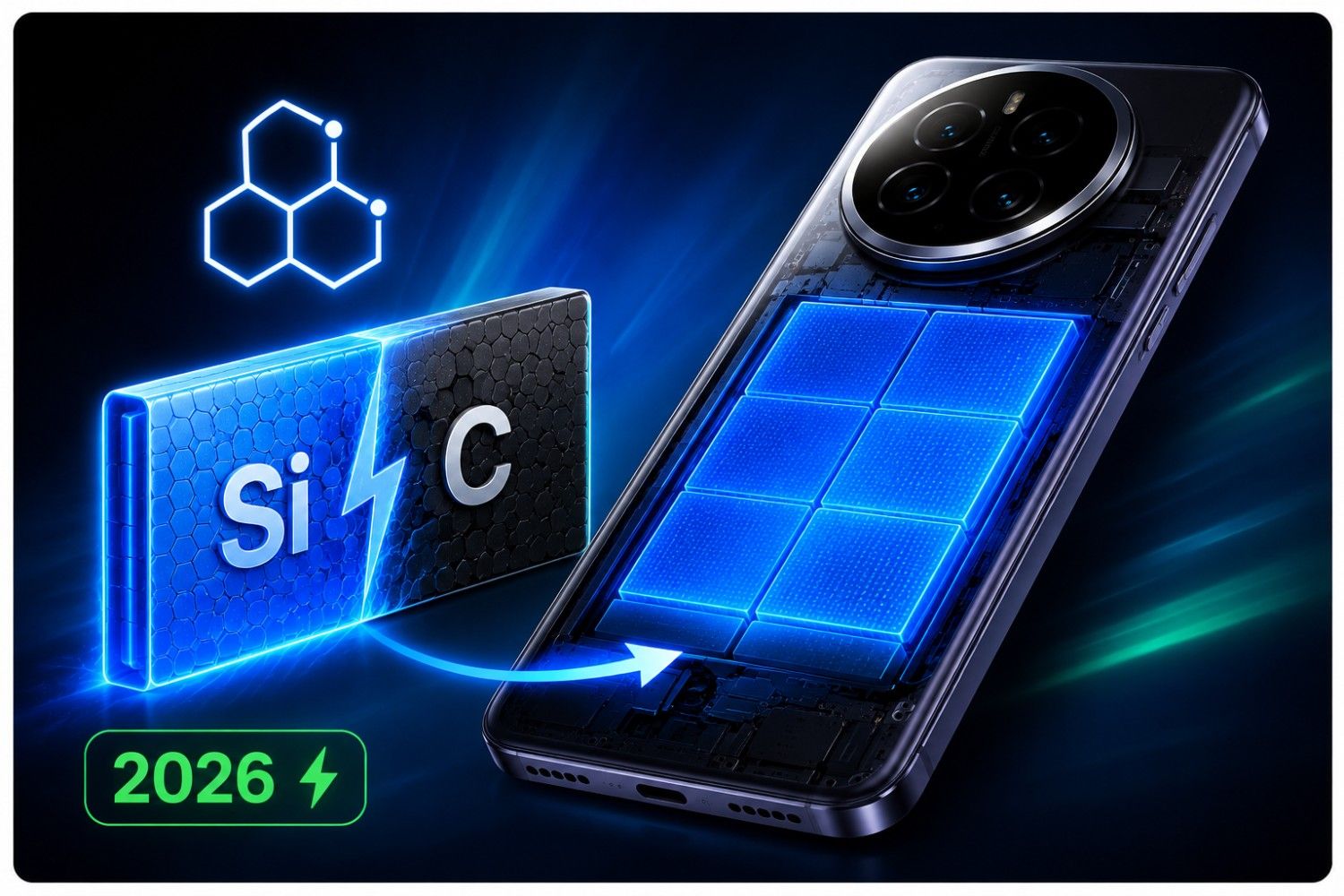
What Is a Silicon-Carbon Battery Phone? Best Phones in 2026
Phone makers spent years increasing charging speed while battery life barely moved. Silicon-carbon batteries changed that fast.
A modern silicon-carbon battery phone can fit a larger battery into the same space, run cooler under heavy use, and keep better endurance without making phones thicker.
What Is a Silicon-Carbon Battery Phone?
A silicon-carbon battery phone uses a battery with a silicon-based anode instead of relying mostly on graphite.
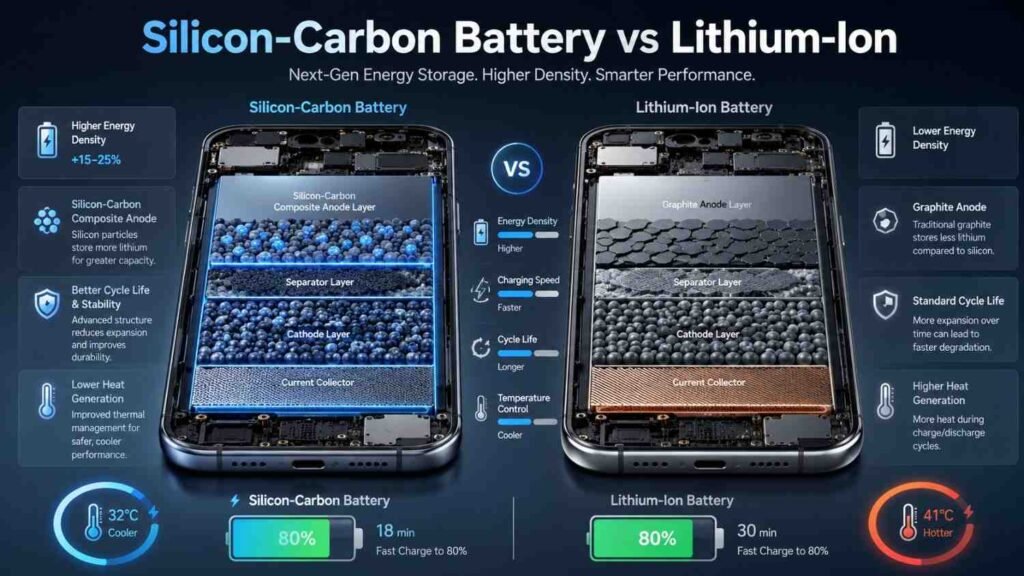
Traditional lithium-ion batteries use graphite to store lithium ions during charging. Silicon can store significantly more lithium ions than graphite, which increases energy density.
That means manufacturers can:
- fit larger batteries into thinner phones
- improve battery life
- increase charging efficiency
- reduce battery size without reducing capacity
Featured Snippet Answer
A silicon-carbon battery phone uses a silicon-enhanced anode that stores more energy than traditional graphite lithium-ion batteries. This allows smartphones to offer larger battery capacity, longer battery life, and faster charging without increasing phone thickness.
How Silicon-Carbon Batteries Work
The biggest change happens inside the anode layer.
Traditional batteries:
- use graphite
- store fewer lithium ions
- need more physical space
Silicon-carbon batteries:
- mix silicon with carbon materials
- increase ion storage density
- improve energy capacity per cubic millimeter
Simple Analogy
Think of graphite like a parking lot with fixed spaces.
Silicon acts more like a multi-level parking garage. More lithium ions fit into the same footprint.
Why Carbon Is Added
Pure silicon expands too much during charging cycles. That expansion damages the battery.
Carbon helps stabilize the structure and reduce swelling.
| Component | Purpose |
|---|---|
| Silicon | Higher energy storage |
| Carbon matrix | Structural stability |
| Electrolyte | Ion transfer |
| Cathode | Energy release |
Silicon-Carbon vs Lithium-Ion Batteries
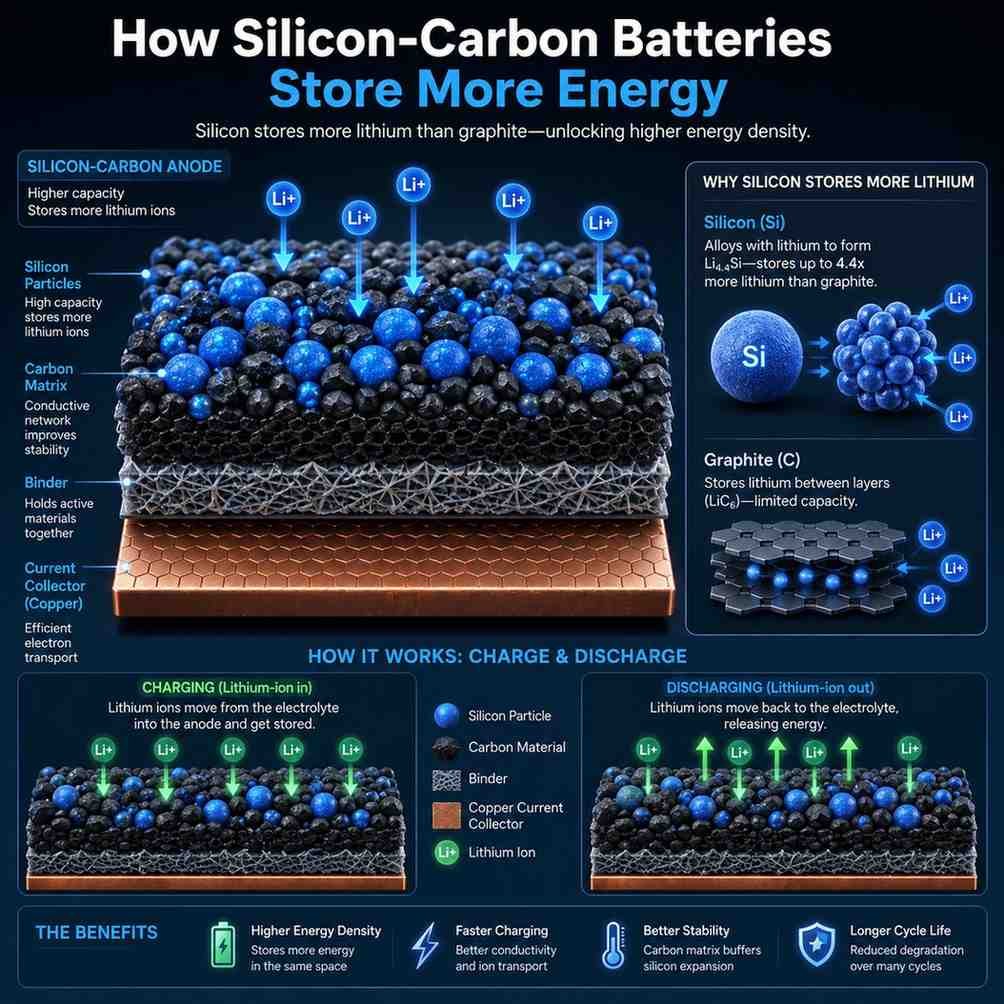
Most articles stop at “better battery life.” That misses the practical differences users actually notice.
| Feature | Silicon-Carbon | Traditional Lithium-Ion |
|---|---|---|
| Energy density | Higher | Lower |
| Battery capacity | Larger in same size | Limited |
| Charging speed | Faster potential | Moderate |
| Heat management | Better in newer designs | More heat buildup |
| Thin phone design | Easier | Harder |
| Battery aging | Improving rapidly | Mature and predictable |
| Manufacturing cost | Higher | Lower |
| Availability | Mostly premium phones | All phones |
Real-World Difference
A 5,500mAh silicon-carbon battery can fit into the same space where older phones could only fit around 4,800mAh to 5,000mAh batteries.
That difference matters:
- longer gaming sessions
- better camera endurance
- less battery anxiety during travel
- improved standby time
Why Phone Brands Are Switching to Silicon-Carbon
Several factors pushed brands toward this technology.
1. AI Features Drain Batteries Fast
On-device AI processing consumes more power:
- live translation
- AI image editing
- generative wallpaper tools
- AI assistants
Larger batteries became necessary.
2. Slim Phones Still Sell
Consumers want:
- thin phones
- lighter phones
- bigger batteries
Traditional battery designs struggled to deliver all three.
3. Fast Charging Needs Better Thermal Control
High-speed charging creates heat.
Silicon-carbon designs paired with vapor cooling systems help reduce thermal stress.
Biggest Advantages of Silicon-Carbon Battery Phones
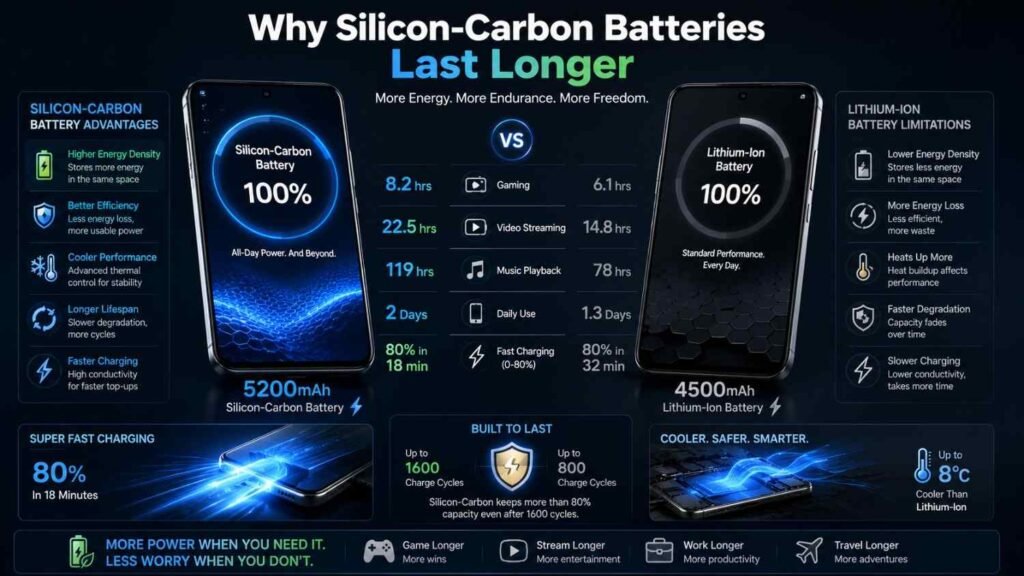
Longer Battery Life
This is the main benefit users notice immediately.
| Usage Type | Traditional Flagship | Silicon-Carbon Flagship |
|---|---|---|
| Video streaming | 8–10 hours | 11–14 hours |
| Gaming | 4–6 hours | 6–8 hours |
| Camera recording | Moderate drain | Improved endurance |
| Standby | 1–2 days | Up to 3 days |
Better Battery Capacity Without Thick Phones
Many 2026 flagship phones now exceed:
- 5,500mAh
- 6,000mAh
- even 6,500mAh
Yet they remain under 9mm thick.
Faster Charging
Silicon-carbon batteries often support:
- 80W charging
- 100W charging
- 120W charging
Some phones charge from 0% to 50% in under 15 minutes.
Better Cold Weather Performance
Silicon-carbon chemistry tends to perform better in colder conditions compared to older lithium-ion designs.
This matters in:
- Canada
- northern US states
- colder Australian mountain regions
- northern India during winter
Drawbacks and Limitations
The technology still has tradeoffs.
| Drawback | Details |
|---|---|
| Higher manufacturing cost | Mostly premium phones currently |
| Long-term degradation still evolving | Fewer 5+ year studies |
| Repair cost | More expensive battery replacements |
| Supply chain limitations | Limited mass production |
| Heat expansion challenges | Requires advanced engineering |
Important Reality Check
Some brands market “silicon-carbon” aggressively even when silicon content is relatively small.
Not every phone using the term delivers dramatic battery improvements.
Battery optimization still matters:
- chipset efficiency
- software tuning
- thermal design
- display refresh rate
Best Silicon-Carbon Battery Phones in 2026
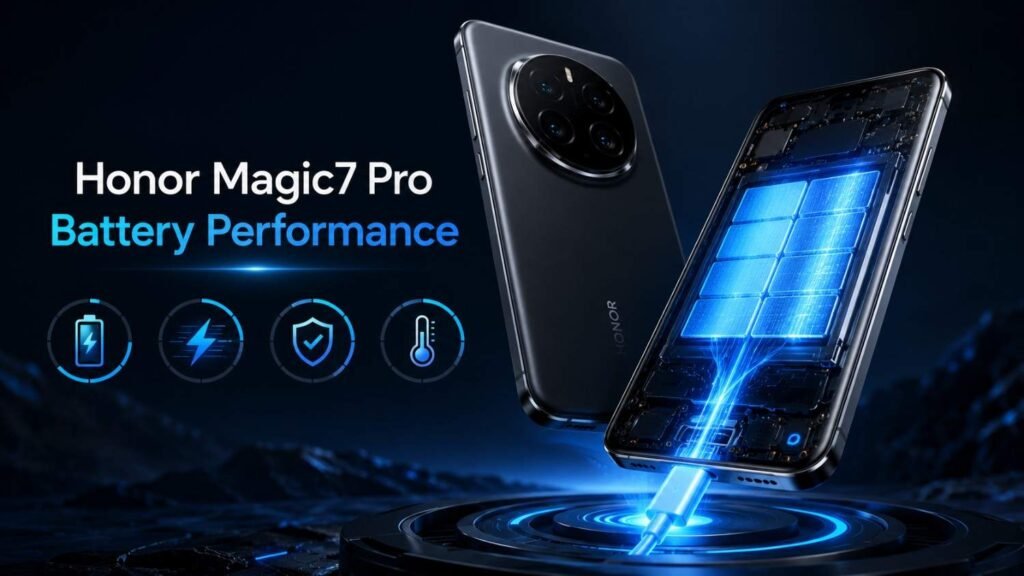
1. Honor Magic7 Pro
One of the strongest battery flagships available.
Why It Stands Out
- Massive battery capacity
- Excellent standby performance
- Strong thermal control
- Reliable camera endurance
| Feature | Specification |
|---|---|
| Battery | 5,800mAh silicon-carbon |
| Charging | 100W wired |
| Wireless charging | Yes |
| Best for | Power users |
Best Use Cases
- heavy gaming
- frequent travel
- content creators
- mobile photography
2. Xiaomi 15 Ultra
Xiaomi pushed battery density aggressively while maintaining camera hardware.
| Feature | Specification |
|---|---|
| Battery | 6,000mAh |
| Charging | 120W |
| Focus | Camera + endurance |
| Best for | Photography enthusiasts |
Strengths
- exceptional fast charging
- large battery
- premium display efficiency
Weakness
- charging heat under extreme load
3. vivo X200 Pro
Strong battery tuning with efficient thermal management.
| Feature | Specification |
|---|---|
| Battery | 5,700mAh |
| Charging | 90W |
| Best feature | Consistent endurance |
| Best for | Everyday flagship users |
Why Reviewers Like It
Battery drain remains stable even during:
- 4K recording
- GPS navigation
- mobile gaming
4. OnePlus 14
OnePlus balanced charging speed with battery longevity better than many rivals.
| Feature | Specification |
|---|---|
| Battery | 5,600mAh |
| Charging | 100W |
| Best for | Fast charging fans |
Key Advantage
Less aggressive thermal spikes during rapid charging.
5. RedMagic 11 Pro
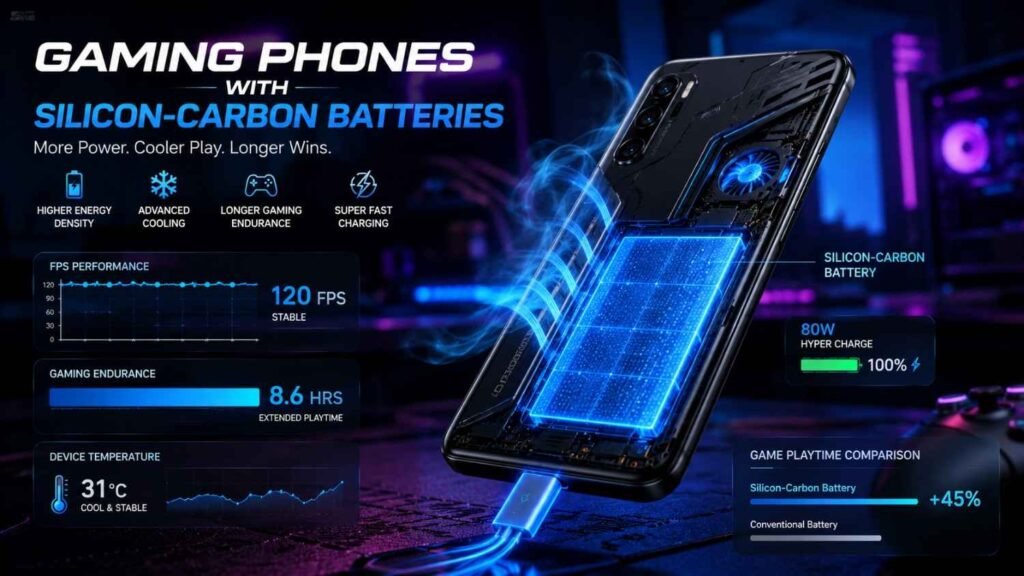
Gaming phones benefit heavily from silicon-carbon batteries because of sustained power draw.
| Feature | Specification |
|---|---|
| Battery | 6,500mAh |
| Cooling | Active cooling fan |
| Best for | Competitive gaming |
Real Advantage
Maintains higher frame rates longer before thermal throttling starts.
Best Phone by Use Case
| Use Case | Best Choice |
|---|---|
| Gaming | RedMagic 11 Pro |
| Photography | Xiaomi 15 Ultra |
| Business travel | Honor Magic7 Pro |
| Everyday reliability | vivo X200 Pro |
| Fast charging | OnePlus 14 |
Real-World Battery Performance
Synthetic battery tests rarely match actual usage.
Here is what matters more.
| Activity | Battery Impact |
|---|---|
| 5G hotspot usage | Very high |
| 4K video recording | High |
| Mobile gaming | Very high |
| AI editing tools | Moderate to high |
| GPS navigation | High |
| Social media scrolling | Moderate |
Observation From Early Silicon-Carbon Phones
Users consistently report:
- less overnight drain
- cooler charging
- better sustained gaming
- slower battery drop below 20%
That last point matters because older batteries often drain rapidly near low percentages
Charging Speeds Explained
Fast charging sounds impressive, but thermal management matters more long term.
| Charging Speed | Typical Experience |
|---|---|
| 45W | Good balance |
| 80W | Excellent for most users |
| 100W+ | Extremely fast but warmer |
| 120W+ | Best for heavy users |
Practical Recommendation
For long battery lifespan:
- avoid charging to 100% constantly
- keep battery between 20% and 85% when possible
- avoid gaming while charging
Battery Health and Lifespan
A major question users ask:
Do silicon-carbon batteries degrade faster?
Current evidence suggests:
- early generations degraded quickly
- modern versions improved significantly
- software battery management matters heavily
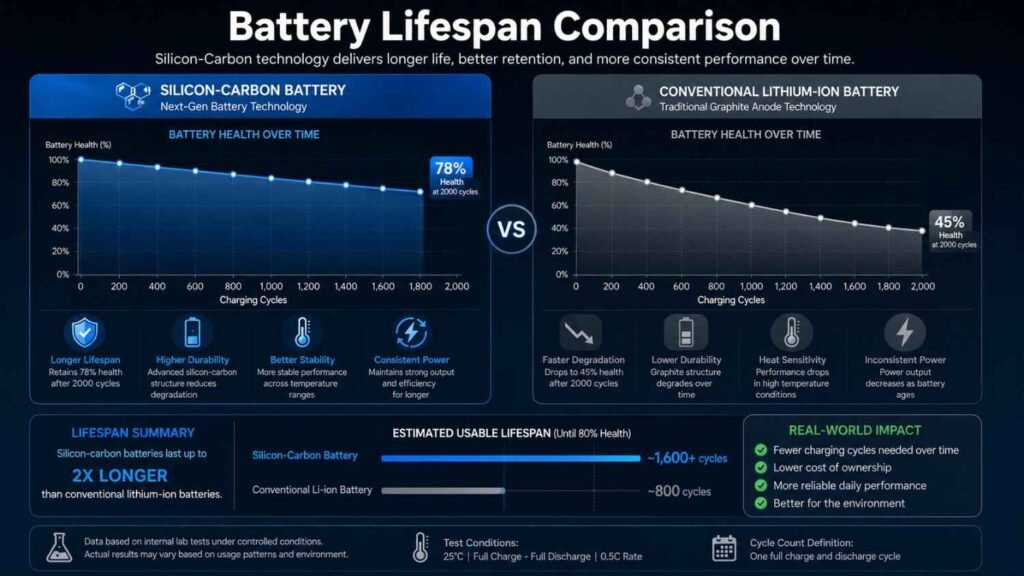
Estimated Lifespan
| Battery Type | Estimated Healthy Cycles |
|---|---|
| Older lithium-ion | 800–1,000 |
| Modern silicon-carbon | 1,000–1,400 |
Manufacturers improved:
- silicon stabilization
- heat control
- charging algorithms
Are Silicon-Carbon Batteries Safe?
Yes, when designed properly.
Modern flagship phones include:
- temperature sensors
- charging protection circuits
- battery isolation layers
- AI charging management
Safety Risks Still Exist
Extreme fast charging can:
- increase heat
- stress battery materials
- shorten lifespan if poorly managed
Cheap phones with weak thermal engineering remain the biggest concern.
Who Should Buy a Silicon-Carbon Battery Phone?
Best For
- gamers
- travelers
- content creators
- heavy multitaskers
- users keeping phones for 3–5 years
Less Important For
- light users
- people upgrading yearly
- users prioritizing compact phones only
Buying Checklist
| Question | Why It Matters |
|---|---|
| Does the phone have vapor cooling? | Helps charging stability |
| Is charging above 100W? | May increase heat |
| Is battery replacement available locally? | Important for long-term ownership |
| How efficient is the chipset? | Battery life depends on both |
| Is software optimization strong? | Prevents idle drain |
Future of Smartphone Batteries
Silicon-carbon batteries are likely a transition step rather than the final form of smartphone batteries.
Next developments may include:
- solid-state batteries
- graphene-assisted cooling
- stacked battery architecture
- AI-controlled charging systems
Still, silicon-carbon batteries are currently the biggest practical leap smartphone batteries have seen in years.
FAQ Schema Section
What is a silicon-carbon battery phone?
A silicon-carbon battery phone uses a silicon-enhanced anode that stores more energy than traditional graphite lithium-ion batteries.
Are silicon-carbon batteries better?
Yes for most users. They provide higher battery capacity, longer endurance, and faster charging in thinner phones.
Which phones use silicon-carbon batteries in 2026?
Major examples include the Honor Magic7 Pro, Xiaomi 15 Ultra, vivo X200 Pro, OnePlus 14, and RedMagic 11 Pro.
Do silicon-carbon batteries last longer?
They generally provide better battery health retention and higher charging cycle durability than older lithium-ion designs.
Are silicon-carbon batteries safe?
Yes. Modern phones include thermal sensors, charging protection systems, and battery management software.
Why are Chinese phone brands adopting silicon-carbon batteries first?
Chinese manufacturers moved faster because of aggressive battery R&D investment and fewer supply chain limitations.
Read More:
Does Your Phone Support Starlink Direct-to-Cell? Full Compatible Devices List (2026)




3 thoughts on “What Is a Silicon-Carbon Battery Phone? Best Phones Using It in 2026”