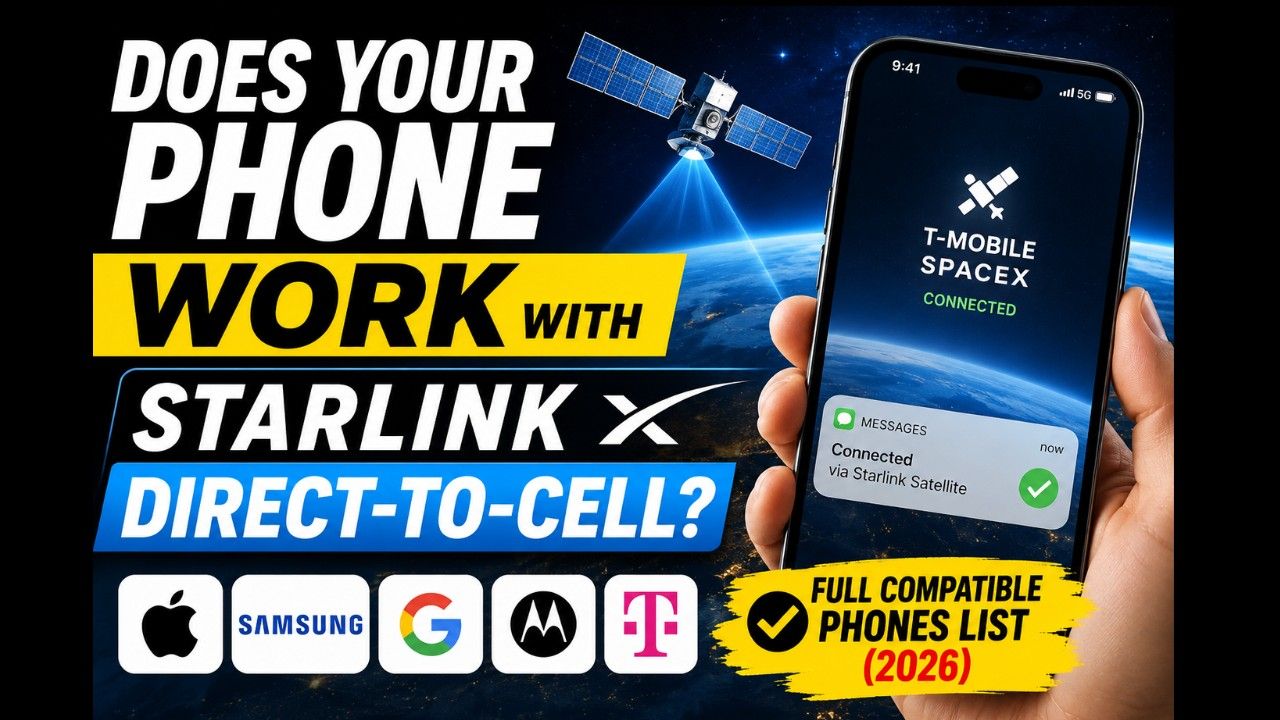
You’re hiking in the middle of nowhere. Zero bars. Your family has no idea where you are. Then your phone buzzes – a text from your kid. No cell tower in sight. That’s Starlink Direct-to-Cell doing its thing in real life.
This isn’t science fiction anymore. As of 2026, over 10 million people connect to Starlink’s satellite network through their regular phones every month — no special device, no satellite dish, no $1,000 clunky satellite handset. Just the phone in your pocket.
But the big question people keep asking is: does my specific phone actually support it?
Let’s answer that properly, with real data.
Quick Answer
Most modern smartphones including iPhone 13+, Samsung Galaxy S21+, Pixel 9 series, and newer Motorola phones support Starlink Direct-to-Cell satellite connectivity.
What Is Starlink Direct-to-Cell, Really?
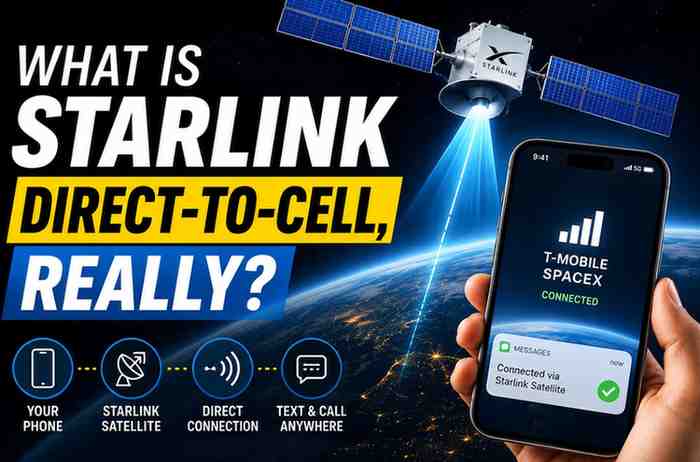
Starlink Direct-to-Cell (now also being rebranded as Starlink Mobile) puts LTE modems on SpaceX satellites orbiting about 550 km above the Earth. Your phone sees each satellite exactly the same way it sees a regular ground cell tower — just a very, very tall one.
No hardware changes. No app to download. No special SIM (except a T-Mobile eSIM if you’re on another carrier). When your phone loses terrestrial coverage, it automatically connects to the satellite and shows “T-Mobile SpaceX” or “T-Sat+Starlink” at the top of your screen.
According to SpaceX’s official Direct-to-Cell page, the satellites use phased-array antennas and connect to each other through laser interlinks, routing messages around the globe without depending on ground relays.
More than 50% of the world’s land mass has zero terrestrial cell coverage. Direct-to-Cell is built specifically for that gap.
How Does It Work Without Special Hardware?
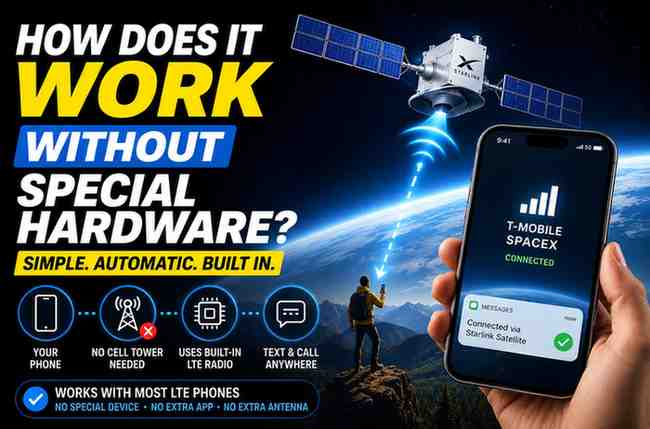
The smart part of this system is that it uses the same LTE frequency bands your phone already uses. In the US, SpaceX uses T-Mobile’s mid-band PCS spectrum at 1900 MHz (LTE Band 25). The FCC granted SpaceX a historic Supplemental Coverage from Space (SCS) license to make this legal.
Because your phone’s radio already speaks this frequency, compatibility is broad. The technical requirement is:
- LTE support (CAT-1, CAT-1 Bis, or CAT-4 modem)
- 3GPP compliant Release 10 or newer
- Support for LTE Band 25 / Band 2
Almost every phone sold in the US since 2014 meets this. The practical limit right now isn’t your phone’s hardware — it’s which phones T-Mobile and SpaceX have officially certified and optimized for the service.
As of January 2026, about 60 phone models are officially certified.
Full Compatible Phones List (2026)
Here’s the breakdown by brand, sourced from T-Mobile’s official support page and verified by SatelliteInternet.com as of January 2026.
Apple iPhone
| Model | Status |
|---|---|
| iPhone 13 | Compatible |
| iPhone 14 / 14 Plus / 14 Pro / 14 Pro Max | Compatible |
| iPhone 15 / 15 Plus / 15 Pro / 15 Pro Max | Compatible |
| iPhone 16 / 16 Plus / 16 Pro / 16 Pro Max | Compatible |
| iPhone 17 / 17 Pro / 17 Pro Max / iPhone Air | Compatible |
Source: SatelliteInternet.com compatible phones list
Samsung Galaxy
| Series | Models |
|---|---|
| Galaxy S Series | S21, S22, S23, S24, S25 — all standard, Plus, Ultra, and Fan Edition variants |
| Galaxy A Series | A14, A15 5G, A16 5G SE, A25 SE, A35, A36, A36 SE, A53, A54, A56 5G SE |
| Galaxy Z Fold | Z Fold 3, 4, 5, 6, 7 |
| Galaxy Z Flip | Z Flip 3, 4, 5, 6, 7 |
| Galaxy XCover | XCover 6 Pro, XCover 7 Pro |
Motorola
| Model | Notes |
|---|---|
| Moto Razr 2024 / Razr+ 2024 | Compatible |
| Moto Razr 2025 / Razr+ 2025 / Razr Ultra 2025 | Compatible |
| Moto Edge 2022 / Edge 2024 / Edge 2025 | Compatible |
| Moto G 2024 / Moto G 5G 2024 / Moto G 5G 2025 | Compatible |
| Moto G Power 5G 2024 / 2025 | Compatible |
| Moto G Stylus 2024 / G Stylus 5G 2024 | Compatible |
| Moto G Play 2026 | Compatible |
Source: SatelliteInternet.com
Google Pixel
| Model | Status |
|---|---|
| Pixel 9 | Compatible |
| Pixel 9a | Compatible |
| Pixel 9 Pro | Compatible |
| Pixel 9 Pro XL | Compatible |
| Pixel 9 Pro Fold | Compatible |
Note: Pixel 8 series and older Pixel A-series are not yet on the official list as of January 2026, per Android Authority’s reporting.
T-Mobile REVVL
| Model | Status |
|---|---|
| REVVL 7 5G | Compatible |
| REVVL 7 Pro 5G | Compatible |
Is Your Phone Not on the List? Here’s the Truth.
T-Mobile and Starlink both say that technically, older phones capable of LTE Band 25 can connect to the satellite network. The hardware works. The bottleneck is FCC certification — each device needs official approval to be listed.
Both companies sent a letter to the FCC asking for a waiver to expand coverage to more devices faster, specifically citing emergency use cases like the Southeast US hurricanes of 2024, where the satellite network delivered connectivity when towers were destroyed.
According to US Mobile’s full guide on the topic, virtually any LTE-capable phone from 2014 onward should theoretically connect — including iPhones from the iPhone 6 onward. But “theoretically” and “officially supported” are two different things.
Stick to the certified list for reliable performance. Older phones may connect but with weaker signal, slower messages, and no official support if something goes wrong.
What Can You Actually Do With It Right Now?
Here’s the honest breakdown of what works in 2026:
| Feature | Status |
|---|---|
| SMS Text Messaging | Fully live in the US |
| MMS / Picture Messaging | Live (some Android devices first) |
| Location Sharing | Live |
| WhatsApp Voice and Video | Live (satellite-optimized) |
| Text to 911 Emergency | Live |
| Satellite Data (select apps) | Limited — live since October 2025 |
| Native Voice Calls | Rolling out in 2026 |
| Full Broadband Data | Planned with next-gen satellites |
The connection is automatic. You can’t switch to satellite manually when cell service is available — the system handles it in the background to conserve bandwidth for people who genuinely need it.
Who Carries It — US and Global Partners
In the US, T-Mobile is the exclusive launch partner. If you’re on T-Mobile’s Experience Beyond plan, T-Satellite is already included. For everyone else — including AT&T and Verizon customers — it’s a $10/month add-on through T-Mobile, and your phone needs to be unlocked with an open eSIM slot.
You don’t need to switch carriers. You just add a T-Mobile eSIM for satellite coverage. You can sign up at T-Mobile.com, by calling 1-800-T-MOBILE, or at any T-Mobile retail store.
Globally, SpaceX has signed carrier partnerships across multiple countries:
| Country | Partner Carrier |
|---|---|
| USA | T-Mobile |
| Australia | Optus, Telstra |
| Canada | Rogers |
| New Zealand | One NZ |
| Japan | KDDI |
| Switzerland | Salt |
| Chile and Peru | Entel |
| Ukraine | Kyivstar |
| UK | VMO2 |
| Nigeria | Airtel Africa |
Source: Starlink’s official Direct-to-Cell business page
As of 2026, T-Satellite also works when roaming in Canada and New Zealand — useful if you travel there and end up in dead zones.
Tips for the Best Connection
The system works automatically, but a few things help it work better.
Go outside. The service works in outdoor areas with a clear sky view. It won’t work reliably inside buildings or in valleys with heavy obstructions.
Keep your OS updated. iOS and Android need to be on the latest version for satellite optimization to function properly.
Be patient with messages. Texts may take a bit longer to arrive — satellites move overhead, so your phone hops between them. That’s normal behavior, not a bug.
Check your eSIM. If you’re not on T-Mobile, make sure your phone is unlocked and has an open eSIM slot before signing up.
Look for the indicator. On Android, you’ll see a satellite icon. On both platforms, the carrier name changes to “T-Mobile SpaceX” or “T-Sat+Starlink” when you’re connected via satellite.
What’s Coming Next
SpaceX has officially rebranded Direct-to-Cell as Starlink Mobile, signaling they’re treating this as a full commercial product. According to Basenor’s analysis of Starlink’s 2026 roadmap, the service currently reaches roughly 10 million active users per month, with a target of 25 million by end of 2026.
Next-generation V2 satellites, to be launched via Starship from mid-2027, promise a 20x improvement in link performance and 100x more data capacity per user. That step turns this from emergency messaging into something approaching a real data connection anywhere on Earth.
Deutsche Telekom has also signed on to bring the service to 10 European countries by 2028.
SpaceX filed a trademark for “Starlink Mobile” in late 2025, which suggests a standalone service offering — one that doesn’t require a carrier partnership — may come at some point.
Quick Check: Is Your Phone Compatible?
| Your Phone | Compatible? |
|---|---|
| iPhone 13 or newer | Yes |
| iPhone 12 or older | Technically possible, not officially certified |
| Samsung Galaxy S21 or newer | Yes |
| Samsung Galaxy A14 / A15 / A35 / A53 / A54 | Yes |
| Google Pixel 9 series | Yes |
| Google Pixel 8 or older | Not on official list yet |
| Motorola Razr 2024 or newer | Yes |
| Moto G / Edge 2024 or newer | Yes |
| OnePlus devices | Not on official list yet |
| T-Mobile REVVL 7 / 7 Pro | Yes |
| Any phone without LTE Band 25 | Not compatible |
Bottom Line
Starlink Direct-to-Cell is real, it’s live, and it works. If you have an iPhone 13 or newer, a Samsung Galaxy S21 or newer, a Pixel 9, or a Motorola from 2024 onward — you’re already compatible.
The service costs nothing extra if you’re on T-Mobile’s top plan. For everyone else, $10/month adds a satellite safety net to whatever carrier you’re already on.
This is the first time in history that a regular phone in your pocket can send a message from a place with no cell tower anywhere nearby. That’s worth knowing about — and probably worth the $10.
Frequently Asked Questions
Does Starlink Direct-to-Cell work on any phone?
Not every phone, but most phones made after 2021. Around 60 models are officially certified right now. iPhone 13 and newer, Samsung Galaxy S21 and newer, Pixel 9 series, and most Motorola models from 2024 — all good to go.
Do I need a new phone or special hardware?
No. If your phone is on the list, you’re done. Nothing to buy, nothing to attach, nothing to install.
How much does it cost?
Free if you’re on T-Mobile’s Experience Beyond plan. For everyone else, $10 a month through a T-Mobile eSIM. You don’t have to switch carriers.
Can I make calls with it right now?
Not standard voice calls yet. Texts, MMS, WhatsApp, and emergency 911 texts are all live. Regular voice calls are rolling out through 2026.
Does it work indoors?
No. You need open sky. Inside buildings or in deep valleys, the signal won’t reach you.
Is the iPhone 12 compatible?
Not officially. iPhone 13 is the first Apple model on the certified list. The 12 might technically connect, but you’re on your own if something goes wrong.
What about Google Pixel 8?
Not on the list. Only the Pixel 9 series is officially certified as of January 2026.
How do I know when I’m on satellite?
Your carrier name changes to “T-Mobile SpaceX” or “T-Sat+Starlink” at the top of your screen. On Android, a satellite icon shows up too.
Does it work outside the US?
Yes, in select countries — Australia, Canada, UK, Japan, New Zealand, Switzerland, Ukraine, Nigeria, Chile, and Peru. More countries are coming through 2026 and beyond.
Is this the same as Apple Emergency SOS satellite?
No. Apple’s system is emergency-only, on Apple’s own satellite network. Starlink Direct-to-Cell handles regular texts, WhatsApp, and eventually voice calls — across multiple phone brands. Two completely different things.
Sources used in this article:
- Starlink Direct-to-Cell Official Page — SpaceX
- T-Mobile T-Satellite Service Page
- T-Mobile T-Satellite Support and Device Eligibility
- SatelliteInternet.com — Compatible Phones List (Jan 2026)
- SatelliteInternet.com — Direct-to-Cell Guide 2026
- US Mobile — Complete Starlink Satellite Calls Guide 2026
- Android Authority — T-Mobile Starlink Compatible Phones
- Basenor — Starlink 2026: What’s Changing
Read More:
Which Mobile Processor is Fastest in 2026? Snapdragon vs Apple vs Dimensity Ranked