
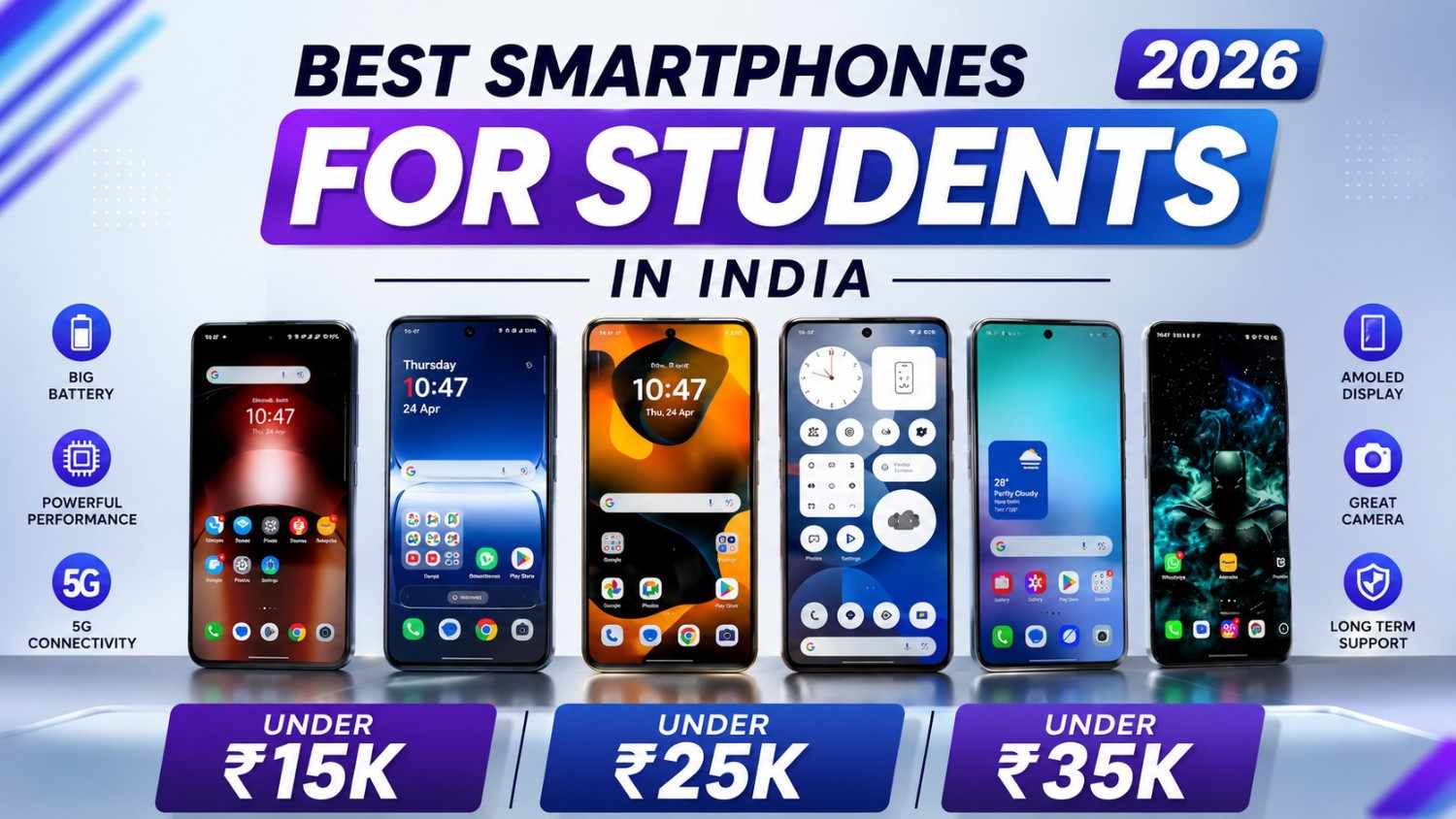
Best Smartphones for Students in India 2026: Top Picks Under ₹15,000, ₹25,000 and ₹40,000
Featured Snippet Answer
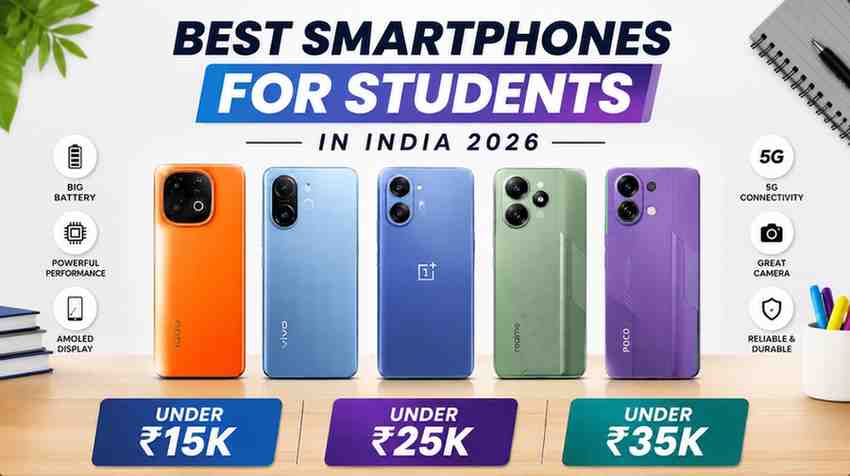
The best smartphones for students in India in 2026 are the Redmi Note 14 SE 5G (under ₹15,000), the Motorola Edge 70 Fusion (under ₹25,000), and the OnePlus Nord CE 6 5G (under ₹35,000). All three offer 5G connectivity, AMOLED displays, 5,000 mAh or larger batteries, and verified India availability as of May 2026.
Quick Picks
| Budget | Best Pick | Approximate Price |
|---|---|---|
| Under ₹15,000 | Redmi Note 14 SE 5G | ~₹13,999 |
| Under ₹20,000 | OnePlus Nord CE 6 Lite 5G | ~₹18,999 |
| ₹15K–₹25K | Motorola Edge 70 Fusion | ~₹24,999 |
| ₹25K–₹35K | OnePlus Nord CE 6 5G | ₹29,999 |
| ₹35K–₹45K | Samsung Galaxy A37 5G | ~₹34,899 |
| Best Long-Term | Samsung Galaxy A37 5G | ~₹34,899 |
| Best Battery Life | OnePlus Nord CE 6 5G | ₹29,999 |
| Best for Engineering | OnePlus Nord CE 6 5G | ₹29,999 |
| Best for Medical | Samsung Galaxy A37 5G | ~₹34,899 |
| Best for Content Creation | Motorola Edge 70 Fusion | ~₹24,999 |
“The best student smartphone is not the most expensive one. It is the one that reliably gets you through a 14-hour campus day, never slows down during online exams, and does not cost two months of pocket money.”
Who Should Buy What?
| If You Are | Recommended Phone | Why |
|---|---|---|
| First-Year Student | Redmi Note 14 SE 5G | Reliable all-rounder on a tight budget |
| Engineering Student | OnePlus Nord CE 6 5G | Battery + clean multitasking |
| Medical Student | Samsung Galaxy A37 5G | 6-year updates + Knox security |
| Content Creator | Motorola Edge 70 Fusion | Best camera + display in midrange |
| Heavy Gamer | iQOO Z10x 5G | Dimensity 7300 + 6,500 mAh |
| Tight Budget | iQOO Z10x 5G | Best performance under ₹12,000 |
| Long-Term Buyer | Samsung Galaxy A37 5G | Software support until 2031–32 |
Why This Guide Exists
Every admission season, millions of Indian students — from IITs and NITs to state colleges and private universities — spend ₹15,000 to ₹50,000 on a smartphone based on a YouTube video or a friend’s WhatsApp message. Many of those purchases are driven by outdated information, brand-sponsored reviews, or spec comparisons that mean nothing in real-world use.
This guide is built differently. Every phone recommended here is a verified, currently available device in the Indian market as of May 2026, with prices cross-checked across Flipkart, Amazon India, 91mobiles, and Smartprix. No speculative specs. No imaginary chipsets. No inflated claims.
How We Selected These Phones
Every recommendation in this guide was evaluated against the following criteria:
Battery life: Minimum 5,000 mAh capacity. Priority given to phones verified to last a full 12–14 hour campus day in independent reviews.
Performance: Only phones with Snapdragon 6s Gen 3, Snapdragon 7s Gen 4, Dimensity 7300, or better were considered. Older chips (Helio G85, Unisoc) were excluded due to documented performance degradation within 12–18 months.
Display quality: AMOLED preferred over LCD. 120Hz minimum for the ₹20,000+ segment. Eye-care certifications (TUV Rheinland, SGS) noted where applicable.
Software support: Update commitment verified against manufacturer announcements. Phones with fewer than 2 years of promised OS updates were deprioritised.
Camera practicality: Evaluated for real student use cases — lecture whiteboard shots, note documentation, and video calls — not megapixel counts alone.
Value for money: Price cross-checked on both Amazon India and Flipkart at time of writing. Prices fluctuate; always verify before purchasing.
Durability: IP ratings and build quality factored in, especially for students who carry phones in bags and use them outdoors.
Specification data sourced from GSMArena, 91mobiles, and Smartprix. Review scores referenced from Digit and 91mobiles where stated.
What Every Student Needs in 2026: The Non-Negotiables
Before the recommendations, here is the framework. These are the features that separate a phone that serves you well for three years from one that frustrates you by Year 2.
5G connectivity is now mandatory. The price gap between 4G and 5G phones has collapsed to ₹1,000–₹2,000 in most segments. Jio and Airtel have 5G coverage in 700+ Indian cities. Buying 4G in 2026 means buying a device that will feel dated before you finish your degree.
Minimum 5,000 mAh battery. A student’s phone goes from early morning alarms to late-night study sessions. Anything under 5,000 mAh in 2026 is a compromise.
8GB RAM is the new baseline. The moment you are running Google Meet while taking notes, with Chrome tabs open in the background and Spotify playing, 6GB starts to struggle. 8GB handles it cleanly.
AMOLED display, 120Hz. For students spending 5–8 hours a day on a screen, display quality is a health and productivity issue, not just aesthetics. AMOLED beats LCD for colour accuracy and outdoor visibility. A 120Hz refresh rate reduces eye fatigue during long study sessions.
Software update commitment matters. A phone that stops receiving security updates after one year is a security risk — especially on a college network. Always check how many OS upgrades a manufacturer promises before buying.

Best Smartphones Under ₹15,000 for Students in 2026
This is where most first-year students, scholarship recipients, and those on strict family budgets will be shopping. The sub-₹15,000 segment in India has never been stronger, with Xiaomi, Realme, Samsung, Vivo, iQOO, and Motorola competing fiercely on value.
Top Pick: Redmi Note 14 SE 5G — ~₹13,999
The Redmi Note 14 SE 5G consistently ranks as the top all-rounder in this segment across Digit, 91mobiles, and Cashify as of mid-2026. It combines a strong AMOLED display, reliable 5G performance on the Snapdragon 6s Gen 3 chip, a 50MP camera capable of clean lecture whiteboard shots, and a battery that gets most students through a full college day.
Why We Recommend It
At this price, the combination of an AMOLED panel, a current-generation Snapdragon chip, and verified India availability makes it the safest all-round buy for students who need reliability without spending more.
Pros
- AMOLED display — excellent for long reading sessions
- Snapdragon 6s Gen 3 handles all student workloads without throttling
- 50MP camera produces clean lecture and whiteboard shots
- Battery gets through a full college day comfortably
- Available on Flipkart and Amazon India
Cons
- Charging speed is moderate — not 67W or above
- Camera struggles in very low light
Best For
First-year students, budget-conscious buyers, everyday all-round use.
Why Students Will Love It
It does not try to be the flashiest phone in the segment. It just works — cleanly, reliably, and for long enough on a single charge to get through lectures, labs, and an evening of study.
Runner-Up: iQOO Z10x 5G — ~₹11,999 to ₹13,499
The iQOO Z10x 5G is the best gaming and performance option under ₹14,000. Backed by the Dimensity 7300 chip, a smooth 120Hz LCD display, and a 6,500 mAh battery, it handles heavy multitasking without slowdown. If gaming is part of your college life — and for many students it is — the Z10x handles it better than any competing phone at this price point.
Pros
- Dimensity 7300 delivers strong gaming performance
- 6,500 mAh battery — exceptional endurance
- 120Hz display feels smooth for the price
Cons
- LCD panel, not AMOLED
- Charging speed is slower than segment peers
- Camera is average
Best For
Students who game regularly, or anyone who wants maximum battery life under ₹13,000.
Why Students Will Love It
The battery anxiety that kills productivity disappears with 6,500 mAh. This phone will comfortably last two days on moderate use.
Battery Champion: Moto G57 Power — ~₹14,999
The Moto G57 Power is built for students who hate low-battery anxiety. With a 7,000 mAh battery, near-stock Android, and Android 16 out of the box — a rare achievement at this price — it delivers reliability without complexity. For students who travel long distances to campus or spend hours away from power outlets, the G57 Power’s endurance is genuinely class-leading.
Pros
- 7,000 mAh battery — best-in-class endurance at this price
- Near-stock Android 16 — clean, no bloatware
- Motorola’s reliable build quality
Cons
- LCD 90Hz display, not AMOLED
- Snapdragon 4s Gen 2 is entry-level; not suitable for heavy gaming
- Camera is functional, not impressive
Best For
Students with long commutes, heavy media consumers, anyone away from chargers for extended periods.
Why Students Will Love It
7,000 mAh means finishing a full day with 40% battery remaining. That peace of mind is worth more than a flashier spec sheet.
Under ₹15,000 Comparison Table
| Phone | Price (Approx.) | Chipset | Display | Battery | Best For |
|---|---|---|---|---|---|
| Redmi Note 14 SE 5G (Top Pick) | ~₹13,999 | Snapdragon 6s Gen 3 | AMOLED 120Hz | 5,000 mAh | Best all-rounder |
| iQOO Z10x 5G | ~₹11,999 | Dimensity 7300 | LCD 120Hz | 6,500 mAh | Gaming + endurance |
| Moto G57 Power | ~₹14,999 | Snapdragon 4s Gen 2 | LCD 90Hz | 7,000 mAh | Maximum battery life |
| Samsung Galaxy M17 5G | ~₹13,999 | Exynos 1380 | AMOLED 90Hz | 5,000 mAh | Samsung ecosystem |
| Realme P3 5G | ~₹15,999 | Snapdragon 6s Gen 3 | AMOLED 120Hz | 5,200 mAh | Display + charging |
Avoid: Any phone in this segment running a Helio G85 or older MediaTek budget chip. These processors show noticeable performance degradation within 12–18 months. Stick to Snapdragon 6s Gen 3 or Dimensity 7300 and above.
Best Smartphones Under ₹20,000 for Students in 2026
This is one of the highest-search-volume price bands in Indian smartphones. Students here get a significant upgrade in raw performance and charging speed over the sub-₹15,000 segment, while still keeping costs manageable.
Top Pick: OnePlus Nord CE 6 Lite 5G — ~₹18,999
The OnePlus Nord CE 6 Lite 5G brings the fastest charging in this entire price range — 80W SUPERVOOC — paired with a Snapdragon 7s Gen 3 chip, an AMOLED display, and a 5,500 mAh battery. For students who charge quickly between classes and need consistent performance for multitasking, it is the clearest choice under ₹20,000.
Why We Recommend It
80W charging at this price is remarkable. A 30-minute charge gives you enough battery to last through a full day of classes. Paired with OxygenOS — clean, ad-free, and consistently smooth — this is a phone that feels far more expensive than it is.
Pros
- 80W SUPERVOOC — fastest charging under ₹20,000
- Snapdragon 7s Gen 3 handles all student workloads with headroom
- AMOLED 120Hz display — excellent for study and media
- OxygenOS is clean and bloatware-free
Cons
- OnePlus service network less widespread in smaller cities
- Camera is capable but not class-leading
Best For
Students who value speed and efficiency — fast charge, fast performance, clean software.
Why Students Will Love It
When you forget to charge overnight, 30 minutes on the cable and you are set for the day. That single feature changes how you use the phone.
Runner-Up: Realme P4 — ~₹20,999
The Realme P4 offers the same Snapdragon 7s Gen 3 chip with 80W charging, an AMOLED 120Hz panel, and a 5,500 mAh battery at a competitive price. It is a strong alternative if the Nord CE 6 Lite is unavailable or if Realme’s after-sales service is stronger in your city.
Pros
- Snapdragon 7s Gen 3 — same chip as the Nord CE 6 Lite
- 80W fast charging
- AMOLED 120Hz display
Cons
- Realme UI has more pre-installed apps than OxygenOS
- Camera results can vary by software version
Best For
Students who want Snapdragon 7s Gen 3 performance with Realme’s wider service network.
Under ₹20,000 Comparison Table
| Phone | Price (Approx.) | Chipset | Display | Battery + Charging | Best For |
|---|---|---|---|---|---|
| OnePlus Nord CE 6 Lite 5G (Top Pick) | ~₹18,999 | Snapdragon 7s Gen 3 | AMOLED 120Hz | 5,500 mAh + 80W | Fastest charging + clean OS |
| Realme P4 | ~₹20,999 | Snapdragon 7s Gen 3 | AMOLED 120Hz | 5,500 mAh + 80W | Performance + charging |
| Redmi Note 15 5G | ~₹21,999 | Snapdragon 6 Gen 3 | AMOLED 120Hz | 5,520 mAh + 45W | IP66 + AMOLED |
Best Smartphones Under ₹25,000 for Students in 2026
The ₹15,000–₹25,000 band is the most competitive in Indian smartphones. Students here get premium-feeling displays, well-rounded cameras, and software experiences that close the gap to flagship territory.
Top Pick: Motorola Edge 70 Fusion — ~₹24,999
The Motorola Edge 70 Fusion features a curved pOLED display with a vegan leather back that gives it a genuinely premium feel in hand. It scores 86/100 on 91mobiles, with a display score of 90 and camera score of 88. The near-stock Android experience means no bloatware cluttering your app drawer, and Motorola’s reliable build quality means this phone will still feel solid two years from now.
Why We Recommend It
The combination of a near-stock Android experience, an outstanding pOLED display, and class-leading camera output for this price makes the Edge 70 Fusion the most well-rounded buy in the ₹20,000–₹25,000 range. There is no other phone in this segment that scores as consistently well across all categories.
Pros
- Near-stock Android — clean, fast, ad-free
- Curved pOLED display is outstanding for extended use
- Strong camera for the price — best-in-class for content creation students
- Motorola’s reliable build quality
- 68W charging
Cons
- Dimensity 7400 performs slightly below Snapdragon 7s-series rivals in benchmarks
- Fewer OS update years than Samsung’s commitment
Best For
Content creation students, students who value display quality and clean software, all-round midrange buyers.
Why Students Will Love It
The display is something you notice every time you unlock the phone. For students spending hours reading, watching lectures, or video calling, the Edge 70 Fusion’s screen quality genuinely reduces fatigue.
Runner-Up: Redmi Note 15 5G (8GB/128GB) — ~₹21,999–₹24,494
The Redmi Note 15 5G features an AMOLED display with 120Hz, HDR10+, Dolby Vision, and TUV Rheinland certification. It runs on the Snapdragon 6 Gen 3, carries a 5,520 mAh battery with 45W charging, and — importantly for students — comes with IP66 dust and water resistance. That last feature is genuinely useful for students who use their phone outdoors in all weather.
Why We Recommend It
IP66 water resistance at this price is rare. For students who cycle to campus, sit outside between classes, or simply drop things regularly, this rating adds meaningful durability. The display certifications are equally practical — TUV Rheinland eye-care certification matters when you are reading for 6 hours straight.
Pros
- TUV Rheinland certified display — important for heavy readers
- IP66 water resistance — practical for outdoor use
- Snapdragon 6 Gen 3 handles all student tasks reliably
- Up to 4 major OS upgrades via HyperOS
- 108MP main sensor with 8MP ultrawide
Cons
- MIUI/HyperOS includes more ads and pre-installed apps than stock Android
- 45W charging is slower than 68W–80W competitors
Best For
Students who want water resistance and a certified eye-care display in the ₹22,000 range.
Why Students Will Love It
Dropping your phone in a puddle on the way to class will not end your day. At this price point, IP66 is a meaningful real-world advantage.
Content Creator Pick: Redmi Note 15 SE 5G — ~₹24,849
The Redmi Note 15 SE 5G features a 7.35mm slim curved design, 120Hz AMOLED display, Snapdragon 6 Gen 3 processor, 50MP AI dual camera, a 5,800 mAh battery, 45W fast charging, and both IP65 and IP66 ratings. The larger battery compared to the standard Note 15 and the cleaner dual-camera system make this ideal for students who post study reels, document project work, or attend frequent video calls.
Pros
- 5,800 mAh battery — larger than the standard Note 15
- IP65 and IP66 water resistance
- Slim, premium-feeling design
Cons
- 45W charging is not class-leading at this price
- HyperOS ad experience same as standard Note 15
₹15,000–₹25,000 Comparison Table
| Phone | Price (Approx.) | Chipset | Display | Battery + Charging | Standout Feature |
|---|---|---|---|---|---|
| Motorola Edge 70 Fusion (Top Pick) | ~₹24,999 | Dimensity 7400 | 6.8-inch pOLED 144Hz | 5,000 mAh + 68W | Best display + clean software |
| Redmi Note 15 5G | ~₹22,999 | Snapdragon 6 Gen 3 | 6.77-inch AMOLED 120Hz | 5,520 mAh + 45W | IP66 + AMOLED |
| Redmi Note 15 SE 5G | ~₹24,849 | Snapdragon 6 Gen 3 | AMOLED 120Hz | 5,800 mAh + 45W | Largest battery in segment |
| OnePlus Nord CE 6 Lite 5G | ~₹18,999 | Snapdragon 7s Gen 3 | AMOLED 120Hz | 5,500 mAh + 80W | Fastest charging under ₹20,000 |
| Realme P4 | ~₹20,999 | Snapdragon 7s Gen 3 | AMOLED 120Hz | 5,500 mAh + 80W | Performance + charging |
Best Smartphones for College Students Under ₹35,000 in 2026
Students in professional courses — engineering, medicine, design, MBA — or those who want a device that will last 3–4 years without slowing down should consider this range. This is also the right budget for students who create content seriously, run development environments, or use their phone as a primary work tool.
Top Pick: OnePlus Nord CE 6 5G — ₹29,999
The OnePlus Nord CE 6 5G launched in India on May 7, 2026. Powered by the Snapdragon 7s Gen 4 processor, it features a 6.78-inch 1.5K AMOLED display with 144Hz refresh rate and up to 3,600 nits peak brightness — one of the brightest displays in its category. The phone carries an 8,000 mAh battery paired with 80W SUPERVOOC charging.
For students: an 8,000 mAh battery means comfortably getting through two full campus days on a single charge. The 80W fast charging delivers a full top-up in roughly 50 minutes. OxygenOS 16 is clean, fast, and ad-free. IP66, IP68, and IP69 ratings make it genuinely durable. This combination at ₹29,999 is extraordinary value.
Why We Recommend It
Nothing at this price offers an 8,000 mAh battery, 80W charging, a 1.5K AMOLED display, and clean OxygenOS software together. Each component is excellent individually; as a combined package for a student, it is the most complete phone in the ₹30,000 range.
Pros
- 8,000 mAh battery — exceptional endurance for heavy users
- 80W SUPERVOOC fast charging
- 1.5K AMOLED 144Hz display, up to 3,600 nits peak brightness
- OxygenOS 16 — clean, ad-free, consistently smooth
- IP66, IP68, IP69 — among the most durable phones in the segment
Cons
- Cameras are capable but not class-leading
- OnePlus service centers less widespread in Tier-3 cities
Best For
Engineering students, heavy multitaskers, anyone who needs exceptional battery life and clean software.
Why Students Will Love It
The 8,000 mAh battery eliminates battery anxiety entirely. Two days between charges means one less thing to worry about during exam season.
Runner-Up for Long-Term Support: Samsung Galaxy A37 5G — ~₹34,899
The Samsung Galaxy A37 5G is powered by the Exynos 1480 chipset, features a 6.7-inch FHD+ AMOLED display with 120Hz refresh rate, a 5,000 mAh battery with 45W charging, and runs One UI 8.5 with a commitment of six years of software updates.
Six years of updates is unmatched in this segment. A student buying this phone today will still receive security updates and OS upgrades in 2031–32. For those who want to buy once and not think about it again, Samsung’s update policy is unmatched.
Why We Recommend It
For medical students, law students, and any student on a 5–6 year course, the A37’s software support policy makes it the rational choice regardless of how its specs compare on paper. Samsung Knox security is also a meaningful advantage on college networks.
Pros
- 6 years of software updates — best in class
- One UI 8.5 with Galaxy AI features
- Samsung Knox security — useful on campus Wi-Fi
- Triple camera system with 50MP primary sensor
- Wide Samsung service network across India
Cons
- Exynos 1480 performs slightly below Snapdragon 7s Gen 4 in benchmarks
- Slightly heavier and bulkier than rivals
- No charger included in the box
- 45W charging is slower than 80W competitors
Best For
Medical students, long-course students who want a 5+ year device, students who rely on the Samsung ecosystem.
Why Students Will Love It
Buying a phone knowing it will receive security patches through your entire degree and beyond is a genuinely different experience. With the A37, you never have to make a software-driven upgrade you did not budget for.
₹25,000–₹40,000 Comparison Table
| Phone | Price (Approx.) | Chipset | Battery + Charging | Update Commitment | Best For |
|---|---|---|---|---|---|
| OnePlus Nord CE 6 5G (Top Pick) | ₹29,999 | Snapdragon 7s Gen 4 | 8,000 mAh + 80W | OxygenOS 16 | Battery + performance |
| Samsung Galaxy A37 5G | ~₹34,899 | Exynos 1480 | 5,000 mAh + 45W | 6 years OS updates | Long-term software + AI |
| OnePlus Nord CE 5 5G | ~₹32,999 | Dimensity 8350 Apex | 7,100 mAh + 80W | OxygenOS | Performance + battery |
| Motorola Edge 70 Pro 5G | ~₹36,999 | Snapdragon 7s Gen 4 | 5,000 mAh + 68W | 3 years OS | Display + camera |
| Motorola Edge 60 Pro | ~₹27,999 | Dimensity 8350 | 5,000 mAh + 125W | 3 years OS | Fastest charging in segment |
Best Smartphones for Engineering Students in 2026
Engineering students have specific needs that general buyers do not share: CAD viewer apps, coding environments, long video call sessions, heavy file management, and often content creation for project documentation.
Recommended: OnePlus Nord CE 6 5G (₹29,999) or OnePlus Nord CE 5 5G (~₹32,999)
Both devices offer the combination engineering students need most: large batteries (8,000 mAh and 7,100 mAh respectively), clean OxygenOS software with no slowdown under multitasking, bright high-refresh displays for extended screen time, and robust build quality. The Nord CE 5 features the Dimensity 8350 Apex — a more powerful chip suited to students running heavier development or simulation applications.
Key advantages for engineering students:
- OxygenOS handles simultaneous apps cleanly — no throttling during long online exam sessions
- Large batteries mean no power anxiety during 8-hour on-site project days
- 80W fast charging provides a practical safety net when you forget to charge
- Bright 1.5K or FHD+ displays reduce eye strain during late-night coding sessions
For students on a tighter budget, the Motorola Edge 70 Fusion (~₹24,999) is a strong alternative with near-stock Android and an outstanding display.
Best Smartphones for Medical Students in 2026
Medical students have three distinct needs: battery life for long hospital rounds, a high-quality display for reading dense clinical literature, and a camera good enough to photograph specimens, diagrams, and patient-facing materials where permitted.
Recommended: Samsung Galaxy A37 5G (~₹34,899)
The A37’s six-year software update commitment, Samsung Knox enterprise-grade security, class-leading AMOLED display quality, and reliable triple-camera system make it the most practical choice for MBBS and allied health students who need a device they can rely on daily for 4–6 years.
Why the A37 specifically:
- A 5-year MBBS course will be fully covered by the phone’s update commitment
- Samsung Knox is one of the most respected mobile security platforms — relevant on hospital and university networks
- The AMOLED display with 120Hz is comfortable for extended reading of textbooks and clinical references
- Samsung’s service network in India is the widest of any Android brand
If budget is a constraint, the Redmi Note 15 5G (~₹22,999) with its TUV Rheinland certified display and IP66 rating is a practical lower-cost alternative.
Best Smartphones for Content Creator Students in 2026
Students building YouTube channels, Instagram pages, or professional LinkedIn brands need genuinely good cameras, fast charging so you can shoot more, and enough storage to hold footage.
Recommended: Motorola Edge 70 Fusion (~₹24,999) or Motorola Edge 70 Pro 5G (~₹36,999)
Motorola’s Edge series consistently scores highest for camera quality in its price range. The Edge 70 Fusion scores 86/100 on 91mobiles, with a camera score of 88. For students at a tighter budget, the Edge 70 Fusion at ~₹24,999 delivers genuinely impressive video and photo output. For those with budget up to ₹37,000, the Edge 70 Pro adds a more powerful chip and improved optics.
What makes these phones practical for creators:
- The curved pOLED display doubles as a high-quality viewfinder
- Near-stock Android means the camera app is reliable and consistent
- 68W charging on the Edge 70 Fusion means a quick top-up between shoots
- Motorola’s video stabilisation is among the best in the midrange segment
For students who also need maximum battery life for long shooting sessions, the OnePlus Nord CE 6 5G (₹29,999) is a credible alternative with its 8,000 mAh battery and competent camera system.

Best Refurbished Phone Options for Students in 2026
India’s used phone market reached $1.75 billion in 2025 and is growing at 14.4% annually, according to IDC India. This means better-organised refurbished channels, stricter inspection standards, and more reliable purchases than in previous years.
For students with very tight budgets (under ₹10,000), certified refurbished options from Cashify, Amazon Renewed, and Flipkart Refurbished are worth considering.
What to look for:
- Grade A certification from the platform
- Minimum 6 months of warranty in writing
- Return window of at least 7 days
Strong refurbished candidates include last year’s OnePlus Nord, Motorola Edge, and Samsung Galaxy A-series devices, which tend to hold quality well and have dropped significantly in resale price.
Only buy from certified platforms. Grey-market resellers and local shops without written warranties carry real risk. Cashify’s grading system is among the most transparent in India.
Common Buying Mistakes to Avoid
Trusting spec numbers without context. A 108MP camera with a small sensor and poor software often takes worse photos than a 50MP camera with a larger sensor and good computational photography. Always check camera sample reviews on YouTube and Digit, not just megapixel counts.
Prioritising gaming specs over study features. Unless you are creating gaming content, you do not need the fastest gaming phone available. You need a phone with strong thermal management so it does not throttle during a 3-hour online exam, a certified eye-care display, and a reliable microphone for recorded lectures.
Ignoring software update policies. A phone with no software update path in 2026 is a security liability on college Wi-Fi. Check update commitments on the manufacturer’s website before you buy. Samsung’s update policy page and OnePlus’s OxygenOS roadmap are useful references.
Buying at launch price. Many mid-range phones drop ₹2,000–₹5,000 within 3–6 months of launch. If a Flipkart Big Billion Days or Amazon Great Indian Festival sale is approaching and you are not in a hurry, waiting can save meaningful money.
Buying grey-market devices. Always verify Indian warranty validity. Grey-market phones may lack valid warranties, leaving you without recourse during exam season. Check warranty status on the manufacturer’s website using the IMEI number before purchasing from any reseller.
Frequently Asked Questions
Should I buy 4G or 5G in 2026?
Always 5G. The price difference at most Indian budget points is now ₹1,000–₹2,000. Jio and Airtel have expanded 5G to 700+ cities. Any phone you buy for a 3-year usage cycle should be 5G-capable.
Is 6GB RAM enough for a student in 2026?
For basic use — WhatsApp, calls, YouTube, light browsing — yes. For anything involving simultaneous Google Meet, Chrome tabs, note-taking apps, and background music, 8GB is the practical minimum. Check your usage pattern honestly before deciding.
AMOLED vs LCD — which is better for studying?
AMOLED produces better contrast, deeper blacks for night-mode reading, and superior outdoor visibility in sunlight. For students spending 5+ hours a day on a phone screen, AMOLED is the better choice, especially panels with TUV Rheinland or SGS eye-care certification.
Does the processor brand matter — MediaTek vs Qualcomm?
Both are capable in 2026. The Snapdragon 6 Gen 3, Snapdragon 7s Gen 4, and Dimensity 7300/8350 are all suitable for student workloads. What matters is the specific tier of chip, not the brand name. Avoid older chips like Helio G85 or Unisoc in the budget range.
Should I buy from Amazon/Flipkart or a physical store?
For phones under ₹20,000, online is almost always the better deal — lower prices, no-cost EMI, and 7–10 day returns. For phones above ₹30,000, consider buying from the brand’s official store or authorised dealer for faster warranty support and in-store exchange options. Check Amazon India and Flipkart on the same day to compare — prices differ regularly.
iPhone vs Android for Indian students?
If your laptop is a MacBook and you are already in Apple’s ecosystem, iPhone integration is genuinely useful. For the majority of Indian students using Windows laptops and Google Workspace, Android delivers far better value for money. The one real advantage of iPhone is resale value: iPhones historically retain 60–65% of their value after 2 years versus 40–50% for Android midrangers, according to Cashify’s resale value data.
When is the best time to buy a smartphone in India?
The Flipkart Big Billion Days (October) and Amazon Great Indian Festival (October) typically offer the deepest discounts on smartphones. Republic Day (January) and Independence Day (August) sales are also worth watching. Most mid-range phones are ₹2,000–₹5,000 cheaper during these events than at regular prices.
The Complete Recommendation Summary
| Budget | Our Pick | Approximate Price | Key Reason |
|---|---|---|---|
| Under ₹12,000 | iQOO Z10x 5G | ~₹11,999 | Dimensity 7300 + 6,500 mAh |
| Under ₹15,000 | Redmi Note 14 SE 5G | ~₹13,999 | Best all-round budget pick |
| Under ₹20,000 | OnePlus Nord CE 6 Lite 5G | ~₹18,999 | 80W charging + Snapdragon 7s Gen 3 |
| ₹15K–₹25K | Motorola Edge 70 Fusion | ~₹24,999 | Best display + clean software |
| ₹15K–₹25K (Alt) | Redmi Note 15 5G | ~₹22,999 | IP66 + AMOLED + Snapdragon 6 Gen 3 |
| ₹25K–₹35K | OnePlus Nord CE 6 5G | ₹29,999 | 8,000 mAh + 80W + OxygenOS |
| ₹25K–₹35K (Alt) | OnePlus Nord CE 5 5G | ~₹32,999 | More processing power + 7,100 mAh |
| ₹35K–₹45K | Samsung Galaxy A37 5G | ~₹34,899 | 6-year updates + Galaxy AI |
| Engineering Students | OnePlus Nord CE 6 5G | ₹29,999 | Battery + clean multitasking |
| Medical Students | Samsung Galaxy A37 5G | ~₹34,899 | Long-term support + Knox |
| Content Creators | Motorola Edge 70 Pro 5G | ~₹36,999 | Best camera in segment |
Before You Buy: The 10-Point Checklist
- Does it have 5G? (Non-negotiable in 2026)
- Is the chip Snapdragon 6s Gen 3 / Dimensity 7300 or better?
- At least 8GB RAM for genuine multitasking?
- Battery 5,000 mAh or above?
- AMOLED display with 120Hz?
- How many OS update years does the manufacturer commit to?
- Valid Indian warranty — not grey market?
- Price verified on both Amazon India and Flipkart today?
- Checked at least one 30-day real-world review on Digit or 91mobiles?
- EMI affordable without financial strain?
The Final Word
The right smartphone does not make you a better student. But the wrong one — one that dies by 3 PM, lags during your online exam, or drops calls during a group project call — absolutely makes you a more frustrated one.
In 2026, Indian students in almost every budget range have access to genuinely excellent smartphones. The ₹15,000 to ₹35,000 range in particular has never offered more value. Use this guide as your starting point, verify prices on the day you buy, and cross-check with current reviews from Digit, 91mobiles, or Cashify for the most up-to-date information.
Pick smart. Study harder.
All prices are approximate as of May 2026. Prices fluctuate regularly — always verify current prices on Amazon India and Flipkart before purchasing. Specifications cross-referenced with 91mobiles, Smartprix, GSMArena, Digit, and Cashify.
Document prepared May 31, 2026. Refresh prices every 60 days. Add new launches as they arrive. Peak traffic window: June–July (admissions season).
Read More:
Best Phone Under ₹20,000 in India (June 2026): 5 Tested Picks Compared






2 thoughts on “Best Smartphones for Students in India 2026 | Under ₹15K, ₹25K, ₹35K”