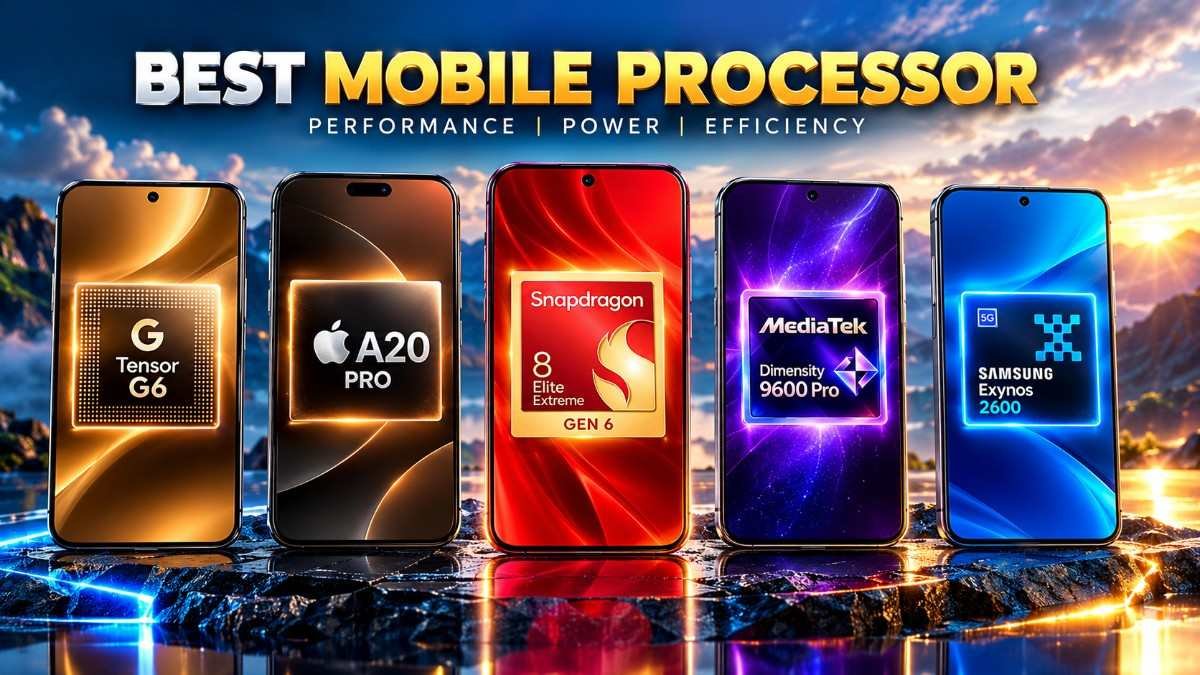
Which Is the Fastest Mobile Processor in 2026?
Snapdragon 8 Elite Gen 5 vs Dimensity 9500 vs A19 Pro vs Exynos 2600 vs Tensor G6 — with 91mobiles lab data, India prices, real BGMI thermals and the 2nm chips you need to know about.
Every year the same argument returns: “Snapdragon is faster.” “No, Apple is faster.” “Dimensity is the real value chip.” Most of the arguing is based on one AnTuTu screenshot from a phone that was probably sitting in an air-conditioned room.
The uncomfortable truth about October 2026 is that four of the five chips in this comparison are fast enough for almost everything most people do. The differences show up in sustained gaming, GPU behaviour, camera processing and price. And there is a new twist: Apple has already launched the 2nm A20 Pro in the iPhone 18 Pro, and Qualcomm has announced the 2nm Snapdragon 8 Elite Gen 6 for phones arriving later this year.
So this guide does two things. It ranks the chips you can actually buy in India today, and it explains what the new 2nm generation changes — without pretending that early leaks are the same as verified retail performance.
The short answer: Snapdragon 8 Elite Gen 5 is the fastest overall Android chip in available phones. Apple’s A20 Pro has the highest early single-core scores, but it is limited to the iPhone 18 Pro series. Dimensity 9500 is the best value and wins some GPU tests. Exynos 2600 is the most improved. Tensor G6 is an AI-first chip, not a benchmark-first chip.
Key Takeaways
- Fastest available Android chip: Snapdragon 8 Elite Gen 5 — 39,05,605 AnTuTu in the Galaxy S26 Ultra, 116.6 FPS in CODM with a 4°C rise.
- Fastest single-core: Apple A20 Pro — early Geekbench 6 scores around 4,725–4,733 single-core. A19 Pro is the previous-generation Apple chip.
- Best GPU surprise: Dimensity 9500 — 3DMark Wild Life Extreme 7,142 in the OPPO Find X9 Pro, ahead of Snapdragon’s 6,519.
- Best value: Dimensity 9500 phones like the vivo X300 Pro and OPPO Find X9 Pro at ₹1,09,999–₹1,19,999.
- Most improved: Exynos 2600 — first 2nm phone chip, 3,036/10,534 Geekbench 6 in the Galaxy S26.
- AI-first, not benchmark-first: Tensor G6 — 2,671/6,802 Geekbench 6, but strong on-device AI and camera processing.
- Wait for 2nm if: You can hold out until late 2026 or early 2027 for Snapdragon 8 Elite Gen 6 devices.
What “Fastest” Actually Means in 2026
A processor is not one thing. It is a CPU, a GPU, an NPU, an image signal processor, a modem and a memory controller on one piece of silicon. When someone says a chip is “fastest,” you have to ask: fastest at what?
| Workload | What It Stresses | Why It Matters |
|---|---|---|
| App loading, scrolling, browsing | Single-core CPU | Decides whether the phone feels snappy or sluggish |
| Gaming, video export | GPU + sustained thermals | Decides whether frames stay smooth after 20 minutes |
| Camera processing | ISP + NPU | Controls shutter lag, night mode speed and AI photo quality |
| On-device AI | NPU / TPU | Runs summarisation, translation and photo editing locally |
| Battery life | Efficiency + modem | Determines whether you charge once or twice a day |
This is why a phone can win AnTuTu and still feel slower than an iPhone in daily use. AnTuTu weights GPU and memory heavily. Geekbench single-core is closer to what you feel when you tap an app icon. Neither benchmark tells you how the phone behaves after 30 minutes of BGMI.
The 2026 Landscape: Shipping Chips vs Announced 2nm Chips
October 2026 is an awkward moment to write a processor comparison. The best phones you can buy today use 3nm chips that launched in late 2025. But the next generation has already been announced.
| Chip | Status | Devices | Should You Wait? |
|---|---|---|---|
| Snapdragon 8 Elite Gen 5 | Shipping widely | Galaxy S26 Ultra, iQOO 15, OnePlus 15, OPPO Find X9 Ultra | No — buy now if you need a phone |
| Dimensity 9500 | Shipping widely | vivo X300 Pro, OPPO Find X9 Pro | No — best value today |
| Exynos 2600 | Shipping in India | Galaxy S26, Galaxy S26+ | No — cheapest 2nm phone |
| Tensor G6 | Shipping | Pixel 11 Pro | No — buy for AI, not speed |
| Apple A19 Pro | Previous generation | iPhone 17 Pro Max | Only if discounted |
| Apple A20 Pro | Announced, shipping in iPhone 18 Pro | iPhone 18 Pro / Pro Max | Yes, if you want the fastest iPhone |
| Snapdragon 8 Elite Gen 6 / Extreme Gen 6 | Announced, phones expected late 2026 | iQOO 16, Motorola Signature 27, Xiaomi 18 Pro (expected) | Yes, if you can wait |
The key distinction is between announced and available. Qualcomm announced the Snapdragon 8 Elite Gen 6 and Extreme Gen 6 at Snapdragon Summit 2026, with phones from Honor, iQOO, Motorola, OnePlus, OPPO, Redmi, RedMagic, vivo and Xiaomi expected by the end of the year. Early benchmark figures look impressive, but they come from engineering samples and leaks, not retail units in Indian stores.
Master Comparison Table: Sourced Scores and Prices
These are the numbers we could trace to a specific device and test. Where a score is from a different benchmark version or an unreleased phone, it is labelled.
| Processor | Tested Phone | AnTuTu | GB6 Single | GB6 Multi | Key Strength | India Price | Source |
|---|---|---|---|---|---|---|---|
| Snapdragon 8 Elite Gen 5 | Galaxy S26 Ultra | 39,05,605 | 3,733 | 11,407 | Best sustained gaming + thermals | ₹1,39,999 | 91mobiles |
| Snapdragon 8 Elite Gen 5 | OPPO Find X9 Ultra | 40,33,382 | 3,522 | 10,574 | Battery life (17.1h PCMark) | ₹1,69,999 | 91mobiles |
| Snapdragon 8 Elite Gen 5 | iQOO 15 / OnePlus 15 | ~37–41 lakh | ~3,498–3,662 | ~10,645–10,842 | Value flagship performance | ₹72,999–₹85,999 | 91mobiles, cputronic |
| Apple A19 Pro | iPhone 17 Pro Max | Not like-for-like | 3,895 | 9,746 | Single-core + efficiency | ₹1,49,900 | Yahoo Tech, PhoneArena |
| Apple A20 Pro | iPhone 18 Pro (early) | 35,51,073* | 4,725–4,733 | 12,575–12,989 | Fastest single-core | ₹1,64,900 | Gadgets360, cputronic |
| Dimensity 9500 | vivo X300 Pro | 35,36,552 | 3,452 | 10,279 | All-round flagship value | ₹1,19,999 | 91mobiles |
| Dimensity 9500 | OPPO Find X9 Pro | 34,06,260 | 2,826 | 7,811 | GPU (3DMark 7,142) | ₹1,09,999 | 91mobiles, ZDNET |
| Exynos 2600 | Galaxy S26 | 31,01,654 | 3,036 | 10,534 | First 2nm phone chip | ₹87,999 launch; ₹99,999 later | ZDNET, 91mobiles |
| Tensor G6 | Pixel 11 Pro | 18,57,406 | 2,671 | 6,802 | AI + camera processing | ₹1,19,999 | PhoneWorld, Notebookcheck |
| Snapdragon 8 Elite Gen 6 | Engineering sample (early) | ~48,35,412* | ~4,327* | ~12,873* | Next-gen 2nm performance | Not yet available | Beebom (early/leaked) |
*Early or leaked figures. A20 Pro AnTuTu is not directly comparable with Android AnTuTu scores. Snapdragon 8 Elite Gen 6 figures are from an engineering sample and a leaked Geekbench listing, not a retail Indian device. Prices checked 18 October 2026.
Three caveats before you compare: (1) AnTuTu scores are not comparable across Android and iOS. (2) The same chip can score very differently in different phones — cputronic found over 30% variation in graphics tests between phones using the same Snapdragon 8 Elite Gen 5. (3) Geekbench single-core is the closest proxy for everyday snappiness; AnTuTu is closer to heavy gaming load.
Benchmarks Explained: What AnTuTu and Geekbench Actually Measure
| Benchmark | What It Measures | What It Misses |
|---|---|---|
| AnTuTu | CPU, GPU, memory and UX in one weighted score | Thermal throttling, real-game FPS, camera performance |
| Geekbench 6 single-core | One-core CPU speed — closest to app loading and scrolling | GPU, sustained load, real-world software optimisation |
| Geekbench 6 multi-core | All-core CPU throughput — video export, multitasking | Single-thread responsiveness, thermal limits |
| 3DMark Wild Life Extreme | GPU performance and stability under sustained load | CPU performance, real-game optimisation |
| PCMark battery test | Battery endurance under a fixed workload | Real-world usage mix, network conditions |
A high AnTuTu score does not guarantee a smooth BGMI session. A high Geekbench single-core score does not guarantee good battery life. This is why the rest of this article uses gaming FPS, temperature rise and battery endurance alongside synthetic scores.
What the “nm” Number Actually Means
You see “3nm” and “2nm” everywhere, but what does it actually mean? The nanometre number refers to the manufacturing process node — roughly, the size of the features etched onto the silicon. Smaller features mean more transistors in the same space, which usually means better performance or lower power consumption.
| Process Node | Chips in This Article | What It Buys You |
|---|---|---|
| 3nm (TSMC N3P) | Snapdragon 8 Elite Gen 5, Dimensity 9500, Apple A19 Pro, Tensor G6 | Mature yield, good balance of performance and efficiency |
| 2nm (Samsung GAA) | Exynos 2600 | Better density and efficiency potential |
| 2nm (TSMC) | Apple A20 Pro, Snapdragon 8 Elite Gen 6, Dimensity 9600 (expected) | Next-generation efficiency and peak performance |
The crucial caveat: process node matters, but architecture matters more. The Exynos 2600 is 2nm and still trails the 3nm Snapdragon 8 Elite Gen 5 in CPU single-core by 10–18%. That’s because Qualcomm’s custom Oryon cores are simply more efficient per clock than Samsung’s CPU design. When you buy a phone, look at the actual benchmark and real-world performance, not just the nm number.
CPU Architecture: Oryon vs Cortex vs Custom Apple
Inside every mobile CPU, there are “prime” cores designed for burst performance, “performance” cores for sustained work and “efficiency” cores for background tasks. How a chipmaker divides that work defines how the phone feels.
| Chip | Core Layout | Design Source | What It Means |
|---|---|---|---|
| Snapdragon 8 Elite Gen 5 | 2 + 6 (no little cores) | Custom Oryon | All cores are fast; excellent sustained multi-threaded performance |
| Dimensity 9500 | 1 + 3 + 4 (all big) | Arm Cortex derivative | Strong GPU pairing; efficient sustained load |
| Exynos 2600 | 1 + 3 + 6 | Samsung custom + Arm | More little cores for efficiency; CPU trails on single-thread |
| Tensor G6 | 1 + 4 + 2 | Arm Cortex derivative | Balanced CPU; heavy AI reliance |
| Apple A19 / A20 Pro | 2 + 4 | Apple custom | Highest IPC; fewer cores, but each is extremely efficient |
This is why Apple can beat the 10-core Exynos with only 6 cores. Instructions per clock (IPC) matter more than core count. Apple’s A19 Pro delivers 0.89 IPC versus 0.79 for Dimensity 9500 and 0.81 for Snapdragon 8 Elite Gen 5 — roughly 10% better than Qualcomm and 13% better than MediaTek.
GPU Deep Dive: Adreno vs Mali vs Xclipse vs PowerVR
Mobile gaming is won and lost on the GPU, not the CPU. Every flagship chip uses a different GPU architecture, and the differences matter more than the brand names suggest.
| GPU | Used By | Architecture | Strengths | Weaknesses |
|---|---|---|---|---|
| Adreno 840 | Snapdragon 8 Elite Gen 5 | Qualcomm custom | Best peak and sustained gaming FPS, hardware ray tracing, UE5 optimised | Peak performance depends heavily on phone cooling |
| Mali-G1 Ultra | Dimensity 9500 | Arm | Excellent 3DMark scores, strong ray tracing, efficient | Thermal stability lower than Snapdragon |
| Xclipse (AMD RDNA) | Exynos 2600 | AMD RDNA derivative | GPU parity with Snapdragon in benchmarks, good efficiency | Software optimisation varies more between games |
| PowerVR | Tensor G6 | Imagination Technologies | Good for AI-accelerated graphics | Throttles heavily under sustained gaming |
| Apple 6-core GPU | A19 Pro | Apple custom | Hardware ray tracing, excellent sustained performance | Only available in iPhones |
The real-world takeaway: On raw peak GPU performance, Adreno and Mali are close. On sustained thermal stability, Adreno wins with a 63.2% stability score in 3DMark versus Mali’s 54.9%. On AI graphics features, Apple’s neural-accelerated GPU cores are unmatched. If you game for more than 20 minutes at a stretch, thermal stability matters more than peak FPS.
8E G5

Why it leads: Qualcomm’s 3nm flagship pairs two 4.6GHz Oryon prime cores with six 3.62GHz performance cores and an Adreno 840 GPU with 18MB of dedicated high-performance memory. In 91mobiles’ India lab, the Galaxy S26 Ultra delivered the best combination of high FPS and low temperature rise of any phone tested.
Gaming reality: CODM at max settings averaged 116.6 FPS with only a 4°C rise after 40 minutes. BGMI at Ultra HDR and max frame rate averaged 88.8 FPS with a 2.2°C rise. That is the strongest sustained result in the 91mobiles dataset.
Weakness: It is not the fastest single-core chip — Apple wins there — and its peak performance depends heavily on the phone’s cooling. The same chip in a poorly cooled body can lose over 30% of its graphics performance.
9500
Why it matters: MediaTek’s all-big-core design uses one 4.21GHz C1-Ultra, three 3.5GHz C1-Premium and four 2.5GHz C1-Pro cores, with a Mali-G1 Ultra MC12 GPU. It is not the CPU king, but it is the value king — and in some GPU tests it beats Snapdragon.
The GPU surprise: ZDNET’s comparison found the Dimensity 9500 in the OPPO Find X9 Pro scored 7,142 in 3DMark Wild Life Extreme, ahead of Snapdragon’s 6,519 and Exynos’s 6,366. The caveat is thermal stability: its 54.9% stability was lower than the Galaxy S26 Ultra’s 63.2%.
Gaming reality: The vivo X300 Pro averaged 57.7 FPS in CODM with a 5.2°C rise, but only 39.2 FPS in BGMI with a 7°C rise — noticeably worse than Snapdragon in BGMI. The OPPO Find X9 Pro did slightly better in BGMI at 39.4 FPS and ran cooler than the vivo by at least 2°C.
Verdict: Best value flagship chip. If you want the best camera hardware for the price and you are okay with slightly weaker BGMI performance, this is the smart pick.
Sources: 91mobiles, ZDNET France, Digit (price).
2600
Why it matters: Exynos 2600 is the first smartphone chip built on a 2nm Gate-All-Around process. It is a 10-core CPU with an Xclipse GPU based on AMD RDNA. For years Exynos was the punchline of Android flagship jokes; in 2026 it is genuinely competitive.
The reality: Exynos 2600 matches Snapdragon in some GPU tests and runs cooler in long video exports, but its CPU trails by roughly 10–18% in single-core. For everyday use the difference is invisible. For heavy gamers and emulator users, Snapdragon remains safer.
Price note: The Galaxy S26 launched at ₹87,999, but Samsung later raised the price to ₹99,999 in some channels. Check current listings before buying — this is not a stable price.
Sources: ZDNET France, 91mobiles, Cashify (price hike).
G6

Why it is different: Tensor G6 is a 7-core CPU with a PowerVR GPU and Google’s fifth-generation TPU. Google has never chased benchmark crowns with Tensor, and the G6 does not change that. It is built for on-device AI and camera processing.
The reality: Tensor G6 is roughly half of Snapdragon’s AnTuTu score and its GPU trails badly in 3DMark. But the Pixel 11 Pro still offers the best on-device AI features on Android and excellent camera processing. Buy it for the AI and the camera, not for raw speed.
Sources: PhoneWorld, Notebookcheck.
PRO

A19 Pro: Apple’s previous-generation 3nm chip scores around 3,895 single-core and 9,746 multi-core in Geekbench 6. It wins single-core and efficiency, and the iPhone 17 Pro Max runs the coolest under load in 91mobiles’ tests. But it is no longer Apple’s newest chip.
A20 Pro: Announced on 9 September 2026, the A20 Pro is Apple’s first 2nm phone chip. Early Geekbench 6 scores are around 4,725–4,733 single-core and 12,575–12,989 multi-core. AnTuTu scores around 35,51,073, but that is not directly comparable with Android AnTuTu numbers. The iPhone 18 Pro starts at ₹1,64,900 in India.
What this means: If you want the fastest single-core phone, the A20 Pro is it. If you want the best value iPhone, the A19 Pro on a discounted iPhone 17 Pro Max is still excellent. Neither is an option if you want Android.
Sources: Yahoo Tech (A19 Pro), Gadgets360 (A20 Pro), FoneArena (India price).
Gaming: BGMI and CODM Therms Matter More Than Peak FPS
BGMI and CODM stress different parts of the chip. CODM tends to hit high frame rates and is better optimised; BGMI is more demanding on sustained CPU and thermal management in Indian conditions. The table below uses 91mobiles’ lab results, which tested at max settings for 30–40 minutes.
| Phone | Chip | CODM Average FPS | CODM Temp Rise | BGMI Average FPS | BGMI Temp Rise |
|---|---|---|---|---|---|
| Galaxy S26 Ultra | Snapdragon 8 Elite Gen 5 for Galaxy | 116.6 | 4.0°C | 88.8 | 2.2°C |
| OPPO Find X9 Ultra | Snapdragon 8 Elite Gen 5 | 144 (capped) | 3.2°C | ~similar | 3.0°C |
| vivo X300 Pro | Dimensity 9500 | 57.7 | 5.2°C | 39.2 | 7.0°C |
| OPPO Find X9 Pro | Dimensity 9500 | 59.9 | ~3.0°C | 39.4 | ~5.0°C |
Source: 91mobiles India lab tests, June 2026 update.
The takeaway: Snapdragon 8 Elite Gen 5 is clearly the best BGMI chip in this dataset. Dimensity 9500 is fine for CODM but struggles with BGMI thermals in the vivo X300 Pro; the OPPO Find X9 Pro does better. If BGMI is your main game, buy a Snapdragon phone with a large vapour chamber.
Battery Efficiency and Thermals: Why the Phone Matters as Much as the Chip
Efficiency is not the same as peak speed. A chip that finishes a task quickly and returns to idle can save power. But battery size, display refresh rate and software optimisation often matter more than the chip name.
| Phone | Chip | Battery | PCMark Endurance (100→20%) | Thermal Note |
|---|---|---|---|---|
| OPPO Find X9 Ultra | Snapdragon 8 Elite Gen 5 | 7,050mAh | 17.1 hours | 3.2°C rise in CODM |
| Xiaomi 17 Ultra | Snapdragon 8 Elite Gen 5 | 6,000mAh | 15.5 hours | Good sustained performance |
| vivo X300 Ultra | Snapdragon 8 Elite Gen 5 | 6,600mAh | 15.2 hours | Good |
| OPPO Find X9 Pro | Dimensity 9500 | 7,500mAh | ~16 hours | Cooler than vivo in BGMI |
Source: 91mobiles. PCMark measures 100% to 20%, not full drain.
What this means: The OPPO Find X9 Ultra lasts over 17 hours largely because of its 7,050mAh battery, not just because of Snapdragon. If battery life is your priority, look at the phone’s battery capacity and display efficiency, not only the chip.
Modem and 5G Connectivity: The Part Nobody Talks About
The modem inside a chip determines whether you get fast 5G, whether calls drop, and how much battery your phone wastes searching for signal. It is rarely mentioned in benchmarks, but it matters every day.
| Chip | Modem | 5G Support | India Bands | Notes |
|---|---|---|---|---|
| Snapdragon 8 Elite Gen 5 | Snapdragon X80 / X85 | Sub-6 + mmWave | n78, B40 — full | Best 5G modem in Android; good power efficiency |
| Dimensity 9500 | MediaTek integrated 5G | Sub-6 + mmWave | n78, B40 — full | Strong on Indian carriers; efficient |
| Exynos 2600 | Samsung integrated 5G | Sub-6 + mmWave | n78, B40 — full | Improved from previous Exynos modems |
| Tensor G6 | Samsung Exynos 5400 modem | Sub-6 + mmWave | n78, B40 — full | Good but not best-in-class for battery efficiency |
| Apple A19 Pro | Snapdragon X75 (external) | Sub-6 + mmWave | n78, B40 — full | External modem; excellent but power hungry |
The practical takeaway: All five chips in this comparison support Indian 5G bands n78 and B40. If you are buying an imported phone from the US or China, verify that your carrier’s specific bands are supported — that is a real risk with grey imports, not with Indian retail units.
AI, Photography and Everyday Performance
The CPU and GPU get the headlines, but the NPU and ISP increasingly decide how good your photos and AI features are.
| Chip | AI / ISP Strength | Best For | Caveat |
|---|---|---|---|
| Snapdragon 8 Elite Gen 5 | Hexagon NPU, strong ISP, RAW processing | Fast camera processing, gaming + AI | Some AI features rely on phone software |
| Dimensity 9500 | Dual NPU, strong GPU for AI effects | Camera-focused flagships | ISP tuning varies by brand |
| Exynos 2600 | On-device AI engine | Galaxy AI features | CPU behind Snapdragon |
| Tensor G6 | 5th-gen TPU, best on-device AI | Pixel AI, computational photography | Weakest raw performance |
| Apple A19 / A20 Pro | 16-core Neural Engine (A19), 32-core AI (A20) | iPhone AI, video, efficiency | iOS only |
Tensor G6 is the clearest example of an AI-first chip. Its benchmark scores are low, but Google’s TPU and camera pipeline are why the Pixel 11 Pro still takes excellent photos and runs AI features locally. If you mostly take photos and use AI tools, Tensor’s low AnTuTu score matters less than it looks.
Mid-Range Processor Options: Under ₹50,000
Not everyone needs a flagship chip. If you mostly use your phone for WhatsApp, YouTube, photos and casual games, a well-tuned mid-range processor is more than enough — and it saves you ₹50,000 or more.
| Chip | Used In | Rough Price Range | What You Get | What You Give Up |
|---|---|---|---|---|
| Snapdragon 7+ Gen 4 | Poco F7, iQOO Neo 10 | ₹30,000–₹40,000 | Strong multi-core, good gaming, efficient | Not flagship-level sustained FPS |
| Snapdragon 8s Gen 4 | iQOO Z10 Turbo, Poco F7 Pro | ₹35,000–₹45,000 | Flagship-derived GPU, great value | Slightly behind 8 Elite Gen 5 in CPU |
| Dimensity 8400 | Poco X7 Pro, Realme 14 Pro+ | ₹25,000–₹35,000 | Excellent efficiency, strong GPU | Weaker single-core than flagships |
| Dimensity 9300+ | iQOO Neo 9 Pro | ₹30,000–₹40,000 | Former flagship performance at mid-range price | Previous-generation efficiency |
| Snapdragon 6 Gen 4 | Redmi Note 14 Pro, realme P3 | ₹18,000–₹25,000 | Excellent battery life | Casual gaming only |
The mid-range sweet spot: The Snapdragon 8s Gen 4 and Dimensity 9300+ are the best value chips under ₹50,000. They deliver former-flagship performance at half the price. If you do not game heavily and do not need the absolute best camera, a mid-range phone with one of these chips will serve you well for 3–4 years.
Best Processor for Different Users
| If you are… | Best chip | Best phone in India | Why |
|---|---|---|---|
| Competitive BGMI / CODM player | Snapdragon 8 Elite Gen 5 | Galaxy S26 Ultra or iQOO 15 | Highest sustained FPS and best thermals |
| Everyday user who wants smoothness | Apple A19 / A20 Pro | iPhone 17 Pro Max / iPhone 18 Pro | Best single-core responsiveness |
| Camera and portrait shooter | Dimensity 9500 | vivo X300 Pro or OPPO Find X9 Pro | Strong camera hardware for the price |
| Value flagship buyer | Snapdragon 8 Elite Gen 5 | iQOO 15 or OnePlus 15 | Flagship chip at ₹73k–₹86k |
| Battery-life focused | Snapdragon 8 Elite Gen 5 | OPPO Find X9 Ultra | 7,050mAh + 17.1h PCMark |
| AI features and clean Android | Tensor G6 | Pixel 11 Pro | Best on-device AI, 7 years updates |
| Compact flagship under ₹1 lakh | Exynos 2600 | Galaxy S26 | Cheapest 2nm phone, compact body |
| Budget buyer under ₹40,000 | Snapdragon 8s Gen 4 or Dimensity 9300+ | iQOO Z10 Turbo or Poco F7 Pro | Former flagship performance at mid-range price |
Best Performance per Rupee in India
This is not a perfect metric — it uses AnTuTu, which favours GPU and memory — but it shows how much synthetic performance you get per rupee.
| Phone | Chip | Price | AnTuTu | Score per ₹1,000 |
|---|---|---|---|---|
| iQOO 15 | Snapdragon 8 Elite Gen 5 | ~₹73,000–₹84,000 | ~37–41 lakh | ~50,000+ |
| OnePlus 15 | Snapdragon 8 Elite Gen 5 | ₹77,999–₹85,999 | ~37–41 lakh | ~45,000+ |
| Galaxy S26 | Exynos 2600 | ₹87,999–₹99,999 | 31,01,654 | ~33,000 |
| vivo X300 Pro | Dimensity 9500 | ₹1,09,999–₹1,19,999 | 35,36,552 | ~30,000 |
| Galaxy S26 Ultra | Snapdragon 8 Elite Gen 5 | ₹1,39,999 | 39,05,605 | ~27,900 |
The value winners are the iQOO 15 and OnePlus 15. They deliver the same Snapdragon 8 Elite Gen 5 chip as phones costing nearly twice as much. You lose some camera refinement and software polish, but if raw performance per rupee is your priority, these are the picks.
How Long Will a 2026 Chip Stay Fast?
One of the most common questions: “Will this phone still be fast in 4 years?” The answer is yes for most flagship chips, with caveats.
| Chip | Years of Useful Performance | Software Support | Notes |
|---|---|---|---|
| Snapdragon 8 Elite Gen 5 | 4–5 years of flagship-level performance | Up to 7 years (Samsung, OnePlus 4+3) | Will handle 2029 games at medium settings |
| Dimensity 9500 | 4 years of flagship-level performance | 3–5 years (brand-dependent) | Excellent CPU headroom for future Android versions |
| Exynos 2600 | 4–5 years | 7 years (Galaxy S26) | CPU slightly behind but GPU futureproof |
| Tensor G6 | 3–4 years of smooth use | 7 years (Pixel) | AI features improve, but gaming will not age as well |
| Apple A19 / A20 Pro | 5–6 years | 6–7 years (historical) | Apple supports older devices exceptionally well |
What this means: If you keep your phone for 3 years and mostly do everyday tasks, any of these chips will stay fast throughout. If you keep it for 5+ years and game heavily, the Snapdragon 8 Elite Gen 5 or Apple A20 Pro will age best. Software support matters as much as the chip — Samsung and Google promise 7 years, which is longer than most people keep phones.
How We Researched This Comparison
What we did: We collected published benchmark scores and gaming results from 91mobiles’ India lab, Notebookcheck, ZDNET, Beebom, PhoneWorld, cputronic, Gadgets360, Digit, FoneArena and Cashify. We cross-checked prices against India retail listings and official launch announcements. We separated shipping products from announced products. We did not run our own lab tests.
What we could not do: We could not independently verify every score on a retail Indian unit. Some scores come from different benchmark versions or test conditions. Where that is the case, we say so. We did not invent first-hand testing experience.
How winners were chosen: Category winners are based on the weight of published evidence, not a single benchmark. Where evidence was mixed, we said so instead of forcing a winner.
Buying Mistakes to Avoid
| Mistake | Why It Hurts | Better Approach |
|---|---|---|
| Buying on AnTuTu alone | AnTuTu overweights GPU and memory; it does not measure sustained BGMI | Check gaming thermals and FPS for your specific game |
| Ignoring thermal throttling | The same chip can lose 30%+ performance in a poorly cooled phone | Buy phones with large vapour chambers if you game heavily |
| Comparing different benchmark versions | AnTuTu 10 and AnTuTu 11 scores are not interchangeable | Compare scores from the same benchmark version and device |
| Confusing chip capability with phone performance | A flagship chip in a hot, badly tuned phone can feel slower | Read phone-level reviews, not just chip-level benchmarks |
| Ignoring software updates | AI and camera features improve (or degrade) with updates | Check the brand’s update commitment |
| Overpaying for a chip you don’t need | A ₹1.4 lakh phone is overkill for WhatsApp and Instagram | Buy a value flagship if you don’t game heavily |
| Buying based on the nm number | 2nm is newer, but architecture matters more than process | Look at sustained performance and thermals, not just the node |
Five Processor Myths Debunked
Should You Wait for 2nm? A20 Pro vs Snapdragon 8 Elite Gen 6
The 2nm generation is arriving in two waves. Apple’s A20 Pro is already in the iPhone 18 Pro. Qualcomm’s Snapdragon 8 Elite Gen 6 and Extreme Gen 6 are announced, with Indian phones expected by the end of 2026.
| Chip | Process | Early Benchmark | Availability | Should You Wait? |
|---|---|---|---|---|
| Apple A20 Pro | TSMC 2nm | GB6 ~4,725 / ~12,575 | iPhone 18 Pro, available now | Yes, if you want the fastest iPhone |
| Snapdragon 8 Elite Gen 6 / Extreme | 2nm, up to 5GHz | Early AnTuTu ~48.3 lakh; GB6 ~4,327 / ~12,873 | Phones expected late 2026 | Yes, if you can wait and want the fastest Android chip |
| Exynos 2600 | Samsung 2nm | GB6 3,036 / 10,534 | Galaxy S26, available now | Only if you want a cheaper 2nm phone |
But wait carefully: early Snapdragon 8 Elite Gen 6 benchmarks come from engineering samples and leaked listings. They are not the same as a retail Indian phone. The A20 Pro scores are from early retail-unit tests, which is stronger evidence, but they still need to be verified across more devices. If you need a phone today, the 3nm chips in this article are already fast enough for everything most people do.
Future Outlook: What Changes in 2027
The mobile processor world is accelerating. Here is what to expect over the next 12–18 months.
| Trend | What It Means | Realistic Timeline |
|---|---|---|
| 2nm becomes mainstream | Snapdragon, Dimensity and Apple all on 2nm | Q4 2026 – Q2 2027 |
| On-device AI becomes standard | Gemini Nano, Samsung Gauss 2 run locally on more tasks | Already happening |
| Apple folds in C1 modem | Apple-made modem replaces Qualcomm in iPhones | 2027 or later |
| Silicon-carbon batteries | 7,000mAh+ batteries become normal in flagships | 2026–2027 |
| Ray tracing standard in games | Adreno, Mali and Apple GPUs all support hardware RT | 2026–2027 |
| Foldable processors | Custom chipsets optimised for foldables | 2027+ |
What this means for buying now: A 2026 flagship will be relevant through 2029–2030. The next 12 months will bring better efficiency and AI, but not a fundamental performance leap. Buy the phone that fits your needs today, not the one rumoured for next year.
Final Verdict
Buy Snapdragon 8 Elite Gen 5 if:
- You want the best available Android gaming performance
- You play BGMI seriously and need good thermals
- You want the widest choice of phones in India
- You want flagship performance from ₹73,000 (iQOO 15)
Buy Dimensity 9500 if:
- You want the best camera hardware for the price
- You play CODM more than BGMI
- You want strong GPU performance without paying Snapdragon prices
- You are okay with slightly weaker BGMI thermals
Snapdragon 8 Elite Gen 5 is the fastest processor in a phone you can buy in India today. It wins the combination of CPU multi-core, sustained gaming and thermal control. The Galaxy S26 Ultra’s 39,05,605 AnTuTu and 116.6 FPS CODM result with a 4°C rise are the strongest available evidence.
Dimensity 9500 is the value champion. It delivers around 90% of Snapdragon’s performance for less money, and it wins some GPU tests. If you are buying the vivo X300 Pro or OPPO Find X9 Pro for the camera, you are not sacrificing much.
Exynos 2600 is the most improved chip. It is not faster than Snapdragon, but it is close enough that most people will not notice, and it brings 2nm to a phone that launched at ₹87,999.
Tensor G6 is not a speed chip. Buy the Pixel 11 Pro for the AI, the camera and the software — not for the benchmark score.
Apple A20 Pro is the fastest single-core phone chip, but it is iPhone-only. If you want Android, Snapdragon 8 Elite Gen 5 is the answer until Snapdragon 8 Elite Gen 6 phones arrive.
Frequently Asked Questions
Among phones broadly available in India in October 2026, the Snapdragon 8 Elite Gen 5 is the fastest overall Android processor. The Galaxy S26 Ultra scored 39,05,605 on AnTuTu and 3,733/11,407 on Geekbench 6 in 91mobiles lab tests. Apple’s A20 Pro has higher early single-core scores but is limited to the iPhone 18 Pro series.
Snapdragon 8 Elite Gen 5 wins CPU multi-core and sustained BGMI performance. Dimensity 9500 wins some GPU tests, including 3DMark Wild Life Extreme where the OPPO Find X9 Pro scored 7,142 versus 6,519 for Snapdragon. Dimensity phones also cost less, making it the better value flagship chip.
A19 Pro wins single-core, scoring around 3,895 in Geekbench 6 versus 3,733 for the Galaxy S26 Ultra. Snapdragon wins multi-core, scoring 11,407 versus 9,746. For everyday snappiness the difference is small; for heavy multi-threaded tasks, Snapdragon has the edge.
Google prioritises AI and camera processing over raw CPU and GPU speed. Tensor G6 scores around 2,671 single-core and 6,802 multi-core in Geekbench 6, and about 1.86 million on AnTuTu. That is well behind Snapdragon and Dimensity, but the Pixel 11 Pro still offers strong AI features and camera processing.
Snapdragon 8 Elite Gen 5 is the best BGMI chip in the 91mobiles test set. The Galaxy S26 Ultra averaged 88.8 FPS at Ultra HDR and max frame rate with only a 2.2°C temperature rise after 40 minutes. The vivo X300 Pro with Dimensity 9500 averaged 39.2 FPS and rose 7°C.
Only if you can wait until late 2026 or early 2027. Snapdragon 8 Elite Gen 6 phones are expected in India by the end of 2026. Early benchmarks suggest a significant jump, but they are not yet independently verified in retail devices. The iPhone 18 Pro with A20 Pro is available now, starting at ₹1,64,900.
The iQOO 15 and OnePlus 15, both powered by Snapdragon 8 Elite Gen 5, are the strongest value picks. The iQOO 15 is listed around ₹73,000–₹84,000 depending on variant and offers, while the OnePlus 15 launched at ₹72,999 and has since been listed around ₹77,999–₹85,999.
It is much closer than before but not equal. Exynos 2600 matches Snapdragon in some GPU tests and runs cooler in long video exports, but its CPU trails by roughly 10–18% in single-core. For most users the difference is invisible; for heavy gamers, Snapdragon remains safer.
The nm number refers to the manufacturing process node. A smaller node like 2nm means more transistors per square millimetre, which usually means better performance or lower power consumption. But architecture matters more: the 2nm Exynos 2600 still trails the 3nm Snapdragon 8 Elite Gen 5 in CPU single-core performance.
A 2026 flagship chip like the Snapdragon 8 Elite Gen 5 will remain fast for at least 4–5 years for everyday tasks. Heavy gaming performance may decline slightly as newer games get more demanding, but software optimisation and thermal design matter more than chip age. Samsung, Google and Honor all promise 7 years of updates.