Most AI models are impressive in a demo. They generate clean answers, write decent code, and sound like they know what they are doing. But hand them a real, messy task — one with missing information, multiple steps, and unexpected roadblocks — and they stall. You end up rewriting the prompt five times and doing half the work yourself.
GPT-5.5 is OpenAI’s latest advanced AI model, and it is built to solve exactly that problem. But GPT-5.5 works differently — and that changes everything.
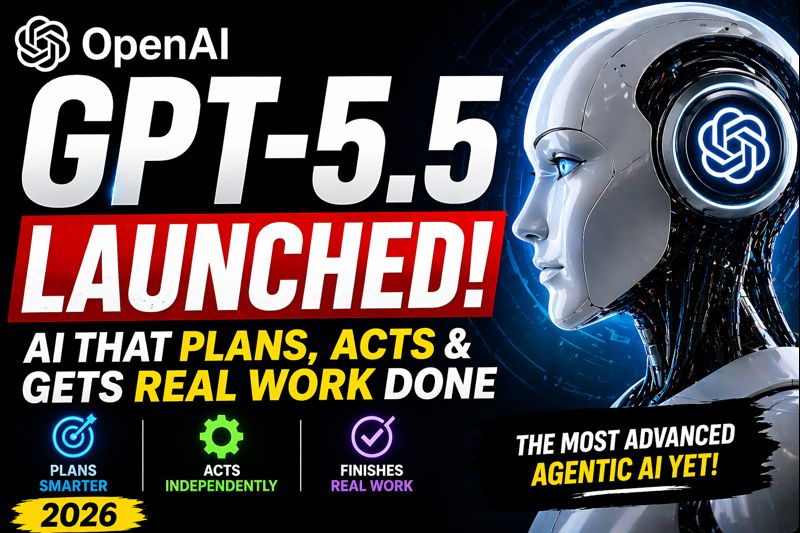
On April 23, 2026, OpenAI released GPT-5.5 — one of its most significant model upgrades to date, and the company’s strongest agentic OpenAI AI model yet. This is not a minor patch on top of GPT-5.4. It is a major architectural and capability upgrade, and the goal is simple: build an AI that actually finishes the job in many real-world tasks.
Read the official announcement directly on the OpenAI blog if you want the full technical breakdown from the source.
GPT-5.5 at a Glance — Quick Answer
What is GPT-5.5? It is OpenAI’s most capable agentic AI model released on April 23, 2026. It plans multi-step tasks, executes them using real tools, checks its own work, and keeps going until the job is done — with far less hand-holding than previous models.
Key Highlights
- GPT-5.5 scores 82.7% on Terminal-Bench 2.0, ahead of Claude Opus 4.7 at 69.4% and Gemini 3.1 Pro at 68.5%
- It matches or outperforms human professionals in 84.9% of knowledge work tasks across 44 occupations
- Available now for Plus, Pro, Business, and Enterprise users in ChatGPT and Codex
- API pricing starts at $5 per million input tokens and $30 per million output tokens
- Supports up to 1 million tokens via API and 400,000 tokens in Codex
- Over 10,000 NVIDIA employees are already using it in production
What Is GPT-5.5, and Why Does It Matter?
GPT-5.5 is designed to complete complex, multi-step computer tasks with minimal human direction. Think of it as the difference between an assistant who needs a checklist and one who understands the underlying goal and figures out the steps themselves.
So what actually changed inside GPT-5.5?
Earlier models needed careful prompting, constant supervision, and a lot of patience. Where previous models required carefully structured prompts and multi-step supervision, GPT-5.5 is designed to take a messy, multi-part task and independently plan, use tools, check its work, navigate ambiguity, and keep going until the task is finished.
That shift sounds small on paper. In practice, it changes how you actually use the product.
OpenAI president Greg Brockman called it “a new class of intelligence” and described it as “a big step towards more agentic and intuitive computing.” He also gave a concrete example: a math professor used GPT-5.5 and Codex to build an algebraic geometry app from a single prompt in 11 minutes.
That is not a chatbot moment. That is a co-worker moment.
This is the moment AI stops being a tool — and starts acting like a teammate.
To understand how far OpenAI has come, it helps to compare this against what GPT-5 introduced earlier this year — particularly its gains in agentic tool use and instruction following. GPT-5.5 builds sharply on that foundation.
GPT-5.5 vs GPT-5.4 — Who Gets Access and What Does It Cost?
OpenAI introduced GPT-5.5 to Plus, Pro, Business, and Enterprise subscribers in ChatGPT and Codex on April 23, with GPT-5.5 Pro rolling out simultaneously to higher-tier accounts. The API version is expected soon at $5 per million input tokens and $30 per million output tokens — roughly double the price of GPT-5.4 — with a 1-million-token context window.
GPT-5.5 Pro is priced at $30 and $180 per million input and output tokens respectively. In Codex, the model operates with a 400,000-token context window, while a new Fast mode generates tokens 1.5x quicker at 2.5x the cost.
Check current ChatGPT plan pricing before upgrading to see which tier fits your needs.
| Plan | Access | Context Window |
|---|---|---|
| Plus | GPT-5.5 in ChatGPT | 1M tokens (API) |
| Pro | GPT-5.5 + GPT-5.5 Pro | 1M tokens (API) |
| Business | GPT-5.5 + GPT-5.5 Pro | 1M tokens (API) |
| Enterprise | GPT-5.5 + GPT-5.5 Pro | 1M tokens (API) |
| Free | Not available | — |
| API | Coming soon | 1M tokens |
| Codex | Available now | 400K tokens |
Yes, the price went up compared to GPT-5.4. But OpenAI’s argument is that GPT-5.5 is both more intelligent and much more token efficient, delivering better results with fewer tokens than GPT-5.4 for most users — meaning the real cost per completed task may actually be lower when you factor in fewer retries and less glue code.
GPT-5.5 vs GPT-5.4 — Benchmark Numbers That Actually Tell You Something
Benchmarks get a bad reputation — and honestly, a lot of them deserve it. But a few of the numbers behind GPT-5.5 are worth paying attention to, because they test things that happen in real working environments, not controlled lab conditions.
Terminal-Bench 2.0 — Command-Line Task Execution
GPT-5.5 achieves 82.7% on Terminal-Bench 2.0, a benchmark testing complex command-line workflows. Claude Opus 4.7 lands at 69.4%, while Gemini 3.1 Pro sits at 68.5%.
| Model | Terminal-Bench 2.0 Score |
|---|---|
| GPT-5.5 | 82.7% |
| Claude Opus 4.7 | 69.4% |
| Gemini 3.1 Pro | 68.5% |
| GPT-5.4 | Lower than all above |
That is not a marginal lead. Terminal-Bench 2.0 simulates realistic developer workflows — planning, iteration, and tool coordination in real command-line environments. You can read more about how Terminal-Bench 2.0 works in OpenAI’s technical writeup.
GDPval — Knowledge Work Across 44 Real Occupations
On GDPval, which tests agents’ abilities to produce well-specified knowledge work across 44 occupations, GPT-5.5 scores 84.9%. These occupations span finance, legal research, product management, and more. The model matches or outperforms industry professionals in 84.9% of comparisons.
SWE-Bench Pro — Real GitHub Issue Resolution
GPT-5.5 resolves 58.6% of tasks end-to-end in a single pass on SWE-Bench Pro. Claude Opus 4.7 scores higher at 64.3%, though OpenAI has noted that Anthropic reported signs of memorization on a subset of those problems, which may affect the comparison.
SWE-bench is a widely respected third-party benchmark that evaluates how well AI models resolve real GitHub issues across actual open-source repositories — not toy problems.
OSWorld-Verified — Operating a Real Computer
On OSWorld-Verified, which measures whether a model can operate real computer environments on its own, GPT-5.5 reaches 78.7%.
Tau2-bench Telecom — Customer Service Workflows
On Tau2-bench Telecom, which tests complex customer-service workflows, GPT-5.5 reaches 98.0% without prompt tuning.
Full GPT-5.5 vs GPT-5.4 Benchmark Comparison
| Benchmark | GPT-5.5 | GPT-5.4 | What It Tests |
|---|---|---|---|
| Terminal-Bench 2.0 | 82.7% | Lower | Command-line planning |
| GDPval | 84.9% | Lower | Knowledge work (44 jobs) |
| SWE-Bench Pro | 58.6% | Lower | GitHub issue resolution |
| OSWorld-Verified | 78.7% | Lower | Real computer use |
| Tau2-bench Telecom | 98.0% | Lower | Customer service workflows |
| FinanceAgent | 60.0% | Lower | Financial task automation |
| Investment Banking Modeling | 88.5% | Lower | Spreadsheet modeling tasks |
| OfficeQA Pro | 54.1% | Lower | Office productivity tasks |
Four Areas Where GPT-5.5 Actually Changes Things
The gains are concentrated in four areas: agentic coding, computer use, knowledge work, and early scientific research — domains where progress depends on reasoning across context and taking action over time.
1. Agentic Coding
This is the flagship capability. GPT-5.5 excels at writing, debugging, and editing large codebases, and can build full features from natural language prompts. Early user feedback describes it as having “serious conceptual clarity” and making the building process feel like magic instead of endless trial and error.
One real-world story makes this concrete. Dan Shipper, Founder and CEO of Every, spent days debugging a post-launch issue before bringing in one of his best engineers to rewrite part of the system. To test GPT-5.5, he rewound the clock: could the model look at the broken state and produce the same kind of rewrite? GPT-5.4 could not. GPT-5.5 could.
Try agentic coding yourself through OpenAI’s Codex platform, which now runs on GPT-5.5 for all paid users.
2. Computer Use
The Codex version has been upgraded so it can interact with web apps, click through pages, test flows, capture screenshots, and iterate on what it sees until a task is complete.
GPT-5.5 is targeted at agentic computer use — it writes and debugs code, browses the web, fills out spreadsheets, and keeps working through multi-step tasks without requiring a human to supervise every move.
3. Knowledge Work
GPT-5.5 also performs strongly across other knowledge work benchmarks: 60.0% on FinanceAgent, 88.5% on internal investment-banking modeling tasks, and 54.1% on OfficeQA Pro.
Mark Chen, OpenAI’s chief research officer, said the model shows meaningful gains on scientific and technical research workflows, and could help expert scientists make progress, including in drug discovery.
For broader context on how AI and drug discovery are intersecting, this Nature piece on AI in drug development offers a solid independent perspective.
4. Scientific Research
GPT-5.5 shows a clear improvement over GPT-5.4 on GeneBench, a new evaluation focusing on multi-stage scientific data analysis in genetics and quantitative biology. These problems require models to reason about potentially ambiguous or error-prone data with minimal supervisory guidance, and in some research scenarios correspond to multi-day projects for scientific experts.
On BixBench, a benchmark designed around real-world bioinformatics and data analysis, GPT-5.5 achieved leading performance among models with published scores.
How GPT-5.5 Compares to the Competition
OpenAI is not shy about who it is competing with. Anthropic’s Claude models have been winning enterprise contracts, and OpenAI has been in what internal sources described as a “Code Red” state since at least December 2025, watching Anthropic’s ARR sprint from $9 billion to $30 billion while its own B2B positioning eroded.
GPT-5.5 is a direct response to that pressure.
| Model | Company | Notable Strength | Notable Weakness |
|---|---|---|---|
| GPT-5.5 | OpenAI | Agentic coding, computer use | Higher API price vs GPT-5.4 |
| Claude Opus 4.7 | Anthropic | SWE-Bench Pro score | Lower on Terminal-Bench 2.0 |
| Gemini 3.1 Pro | Multimodal capability | Lower on most benchmarks here | |
| GPT-5.4 | OpenAI | Lower input cost | Less capable on multi-step tasks |
For ongoing model comparisons independent of any lab, Artificial Analysis is one of the most reliable sources — they update continuously and are not affiliated with OpenAI, Anthropic, or Google.
What changed with GPT-5.5 is the product story. OpenAI has stopped selling a chat completion API and started selling an agent. The language in the announcement, the capabilities being led with, and even the example tasks are all agentic.
That is a meaningful shift in strategy — not just a GPT-5.5 vs GPT-5.4 version bump.
The Real-World Proof: NVIDIA Is Already Using It at Scale
Here is a signal that this is not just benchmark theater. Over 10,000 NVIDIA employees — across engineering, product, legal, marketing, finance, sales, HR, and operations — were given early access to GPT-5.5-powered Codex, and the results were described by one engineer as “blowing my mind.”
NVIDIA IT rolled out cloud virtual machines for every employee to run their agent safely, allowing agents to work with real company data without exposing it externally.
Read NVIDIA’s own account of this deployment on the NVIDIA official blog, including specifics on how they structured the rollout across departments.
Jensen Huang reportedly sent a company-wide email urging employees to use Codex: “Let’s jump to lightspeed. Welcome to the age of AI.”
That is not a pilot program. That is a real deployment, at real scale, inside one of the most technically sophisticated companies in the world.
What GPT-5.5 Still Cannot Do
Honesty matters here — especially when big launches generate big hype.
Like previous large language models, GPT-5.5 can still produce incorrect and overly confident outputs, especially in domains requiring precise factual accuracy like legal reasoning, financial analysis, and specialized scientific knowledge. Human oversight remains important for high-stakes applications.
It is also not available to free users. And the API pricing represents a significant jump for developers running high-volume workflows when compared directly to GPT-5.4.
OpenAI’s own safety and preparedness framework outlines how they evaluate and manage risks for each new model release — worth reading if you are deploying this in a professional or enterprise context.
The model is powerful. It is not perfect. For anything where being wrong has serious consequences — legal filings, medical decisions, financial compliance — a human still needs to be in the loop.
The Bigger Picture: Where This Is All Going
Greg Brockman framed the release as the next step toward what he and Sam Altman have described as a “superapp” — a multipurpose agent combining ChatGPT, Codex, and other tools into a single surface.
The rate of release tells its own story. Six weeks from GPT-5.4 to GPT-5.5 is not normal model release cadence. That is product-launch cadence. When a frontier lab ships that fast, it is racing to lock down a category.
The category OpenAI is racing to own: the AI that does real work, not just gives real answers.
For anyone building products on top of AI right now, the OpenAI developer documentation is the best place to stay updated on API availability and GPT-5.5 rollout details.
Frequently Asked Questions
What is GPT-5.5? GPT-5.5 is OpenAI’s latest advanced AI model, released on April 23, 2026. It is built for agentic tasks — it plans, takes actions using tools, checks its own work, and completes complex multi-step jobs with far less supervision than earlier models. Read the full official GPT-5.5 announcement for complete technical details.
Is GPT-5.5 available for free? No. GPT-5.5 is only available to paid ChatGPT users on Plus, Pro, Business, and Enterprise plans. Free-tier users do not have access at launch.
How does GPT-5.5 vs GPT-5.4 compare in real use? GPT-5.5 outperforms GPT-5.4 across nearly every benchmark tested, including Terminal-Bench 2.0, GDPval, OSWorld-Verified, and Expert-SWE. It also uses fewer tokens per completed task despite a higher per-token price, which can make it cheaper overall for complex agentic workflows.
How much does GPT-5.5 cost in the API? API pricing is $5 per million input tokens and $30 per million output tokens for standard GPT-5.5. GPT-5.5 Pro is $30 per million input and $180 per million output tokens. Check OpenAI’s API pricing page for the most current figures.
How does GPT-5.5 compare to Claude Opus 4.7? GPT-5.5 outperforms Claude Opus 4.7 on Terminal-Bench 2.0 (82.7% vs 69.4%) and GDPval. Claude Opus 4.7 scores higher on SWE-Bench Pro, though OpenAI notes possible memorization effects in those results. Track updated comparisons on Artificial Analysis.
What is the context window for GPT-5.5? GPT-5.5 supports up to 1 million tokens via the API and 400,000 tokens in Codex.
What is agentic AI? Agentic AI describes models that actively plan, use tools, make decisions, and execute multi-step tasks to reach a goal — more like a capable colleague than a search engine. The MIT Technology Review has covered this topic in depth for those who want further background.
Can GPT-5.5 operate a computer on its own? Yes. On OSWorld-Verified, GPT-5.5 scores 78.7% on real computer-use tasks. In Codex, it can interact with web apps, click through pages, capture screenshots, and iterate based on what it sees.
Will GPT-5.5 replace human workers? Not in the near term. The model still makes mistakes in high-stakes domains like legal, medical, and financial work. The World Economic Forum’s Future of Jobs Report provides solid context on how AI tools are reshaping roles rather than simply eliminating them.
Sources: OpenAI Blog | TechCrunch | Decrypt | The Next Web | NVIDIA Blog | Fortune | MarkTechPost
Read More:
Best AI Camera Smartphones in 2026 (Top 7 Tested – Which One Wins?)