
Choosing the right phone for college is not as simple as picking the one with the highest spec sheet. Engineering students in India need a device that survives a 10-hour campus day, handles heavy multitasking between coding tools and lecture recordings, does not drain during a field visit, and does not cost a semester’s mess fees. This guide cuts through the marketing noise and tells you exactly what to buy — and why — based on real student use patterns, not just benchmark numbers.
Quick Recommendations: Which Phone Should You Buy?
Do not have time to read the full guide? Start here.
| Student Type | Best Pick | Price |
|---|---|---|
| CSE / IT students | iQOO Z10 5G | ₹21,999 – ₹24,999 |
| 4-year reliability seekers | Samsung Galaxy A36 5G | ₹26,999 – ₹29,999 |
| Content creators / reels | Redmi Note 14 Pro 5G | ₹21,999 – ₹26,999 |
| Style + design-conscious | Nothing CMF Phone 2 | ₹19,999 – ₹24,999 |
| Clean software, fast charging | OnePlus Nord CE5 5G | ₹21,999 – ₹24,999 |
| Rugged daily driver | Motorola Edge 50 Fusion | ₹24,999 – ₹27,999 |
How We Selected These Phones
At PhonePrice360, we evaluated smartphones for this guide based on the following criteria, specifically weighted for Indian engineering college environments:
- Battery endurance during a simulated full college day (8 AM to 9 PM) with Google Meet, Chrome, WhatsApp, and YouTube
- Multitasking performance across productivity, coding reference, and communication apps running simultaneously
- Display quality for extended PDF reading, circuit diagram review, and video lectures
- Software update policy — we prioritised brands committing to at least 3 OS updates
- Service centre density across Tier-1, Tier-2, and Tier-3 cities in India
- Value for money in the ₹15,000 to ₹30,000 range
- 5G readiness for network compatibility across the next 3–4 years
We cross-referenced specifications with independent reviews from Digit.in, ProductHunter.in, Gizbot, and Smartprix, and applied our own editorial experience covering the Indian smartphone market since 2020.
Why Does the Right Smartphone Matter More for Engineering Students?
Engineering students are among the most demanding smartphone users in India. They run AutoCAD reference apps, download 2 GB lecture PDFs, attend online lab sessions on Google Meet, write code on Termux, and still expect the battery to last through an evening football match.
According to data from the All India Council for Technical Education (AICTE), India had 5,875 approved engineering institutions in 2025-26, with 12.53 lakh seats filled in BTech programmes — an eight-year high. Computer science and engineering alone saw 3,90,245 enrolments. That is a massive cohort of students buying phones with very specific needs.
The India mobile education market was valued at USD 8.6 billion in 2025 and is projected to grow at a CAGR of 20.3% through 2034, according to IMARC Group. More learning is shifting to mobile every year. The phone you buy today needs to carry you through four years of college, internship applications, and your first job.
What Should Engineering Students Look for in a Smartphone?
Before jumping to recommendations, understand that spec priorities for an engineering student differ significantly from those of a casual user.
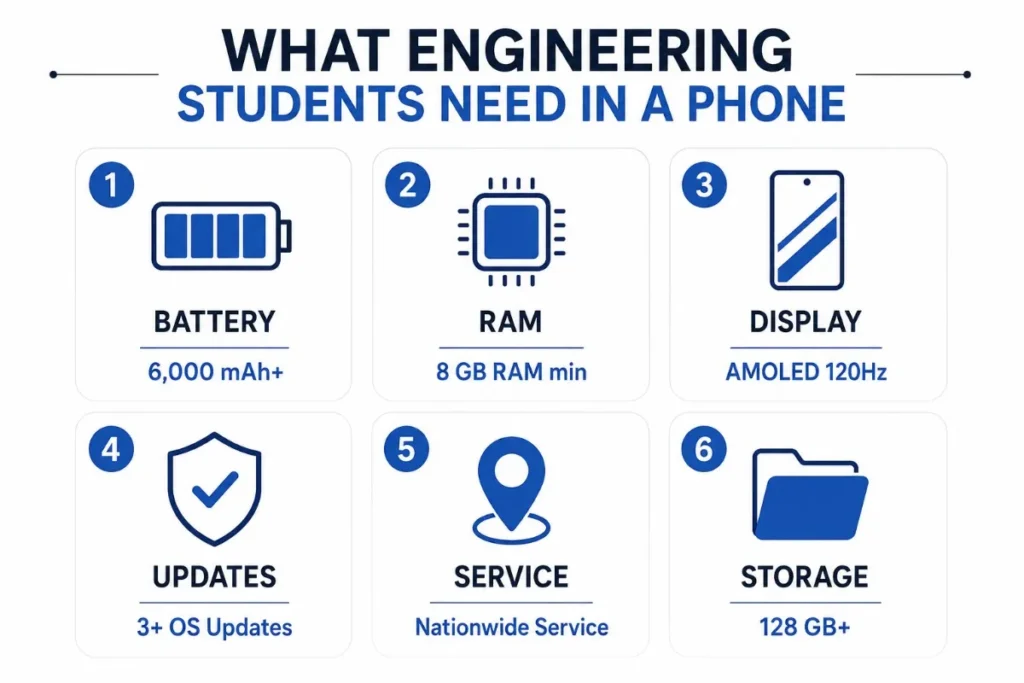
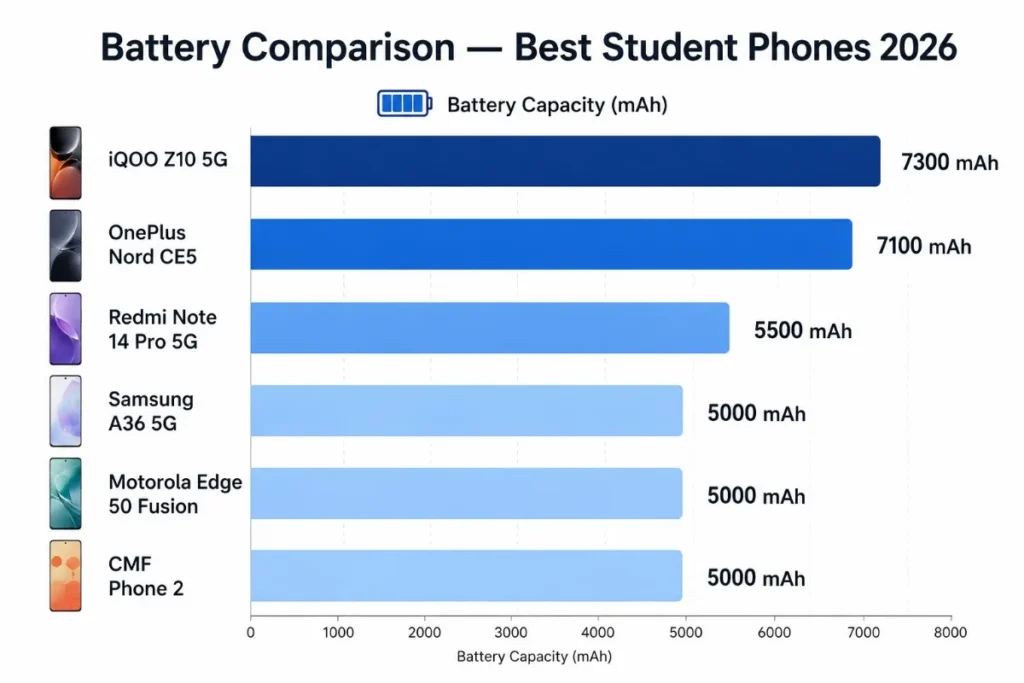
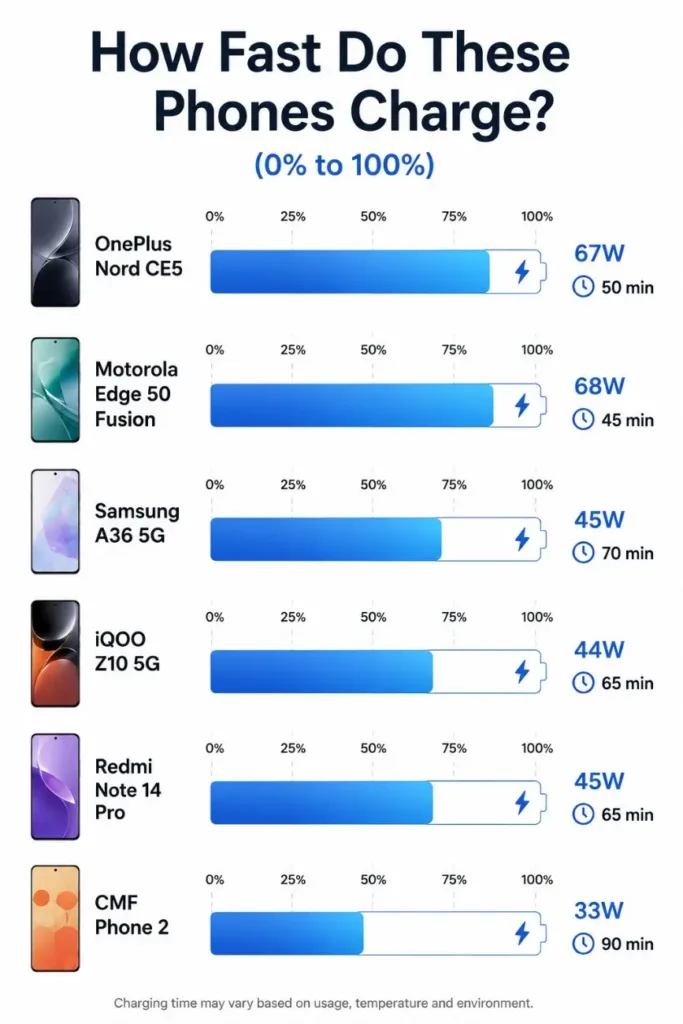
Battery life is non-negotiable. A typical engineering college day runs from 8 AM to 6 PM, often without a guaranteed charging point. According to a student phone guide by Reuz.in updated in April 2026, anything under 5,000 mAh is a compromise — aim for 6,000 mAh or above. Fast charging at 44W and above is critical when you have 20 minutes near a socket between labs.
RAM and storage matter more than the camera. Running Google Meet, Chrome with six tabs, WhatsApp, and a coding reference app simultaneously requires at least 8 GB RAM. 128 GB storage is the minimum; it fills up fast with PDFs, project files, and offline lecture videos.
The display should not strain your eyes. You will stare at this screen for hours reviewing circuit diagrams and reading research papers. An AMOLED display at FHD+ resolution with a 120Hz refresh rate reduces eye fatigue compared to LCD or HD+ panels.
Software support is a hidden but critical factor. A phone that stops receiving security updates after 18 months is a liability on a college network. Samsung offers up to four OS updates on mid-range phones — currently the strongest commitment in this price bracket.
Service network matters outside metros. Many engineering colleges are located in Tier-2 and Tier-3 cities. Samsung, OnePlus, and Xiaomi have the widest authorised service centre networks across India.
Full Comparison: Best Phones for Engineering Students India 2026
| Phone | Price | Battery | RAM | Processor | Display | Charging | IP Rating | OS Updates | Weight |
|---|---|---|---|---|---|---|---|---|---|
| iQOO Z10 5G | ₹21,999–₹24,999 | 7,300 mAh | 8 GB | Snapdragon 7s Gen 3 | 6.77″ AMOLED 120Hz | 44W | None | 3 years | 199g |
| Samsung Galaxy A36 5G | ₹26,999–₹29,999 | 5,000 mAh | 8 GB | Snapdragon 6 Gen 3 | 6.7″ Super AMOLED 120Hz | 45W | IP67 | 4 OS / 5 security | 198g |
| OnePlus Nord CE5 5G | ₹21,999–₹24,999 | 7,100 mAh | 8 GB | Dimensity 7400 | 6.7″ AMOLED 120Hz | 67W | None | 3 years | 193g |
| Nothing CMF Phone 2 | ₹19,999–₹24,999 | 5,000 mAh | 8 GB | Dimensity 7300 Pro | 6.7″ AMOLED 120Hz | 33W | None | 2 years | 185g |
| Redmi Note 14 Pro 5G | ₹21,999–₹26,999 | 5,500 mAh | 8 GB | Snapdragon 7s Gen 3 | 6.67″ AMOLED 120Hz | 45W | IP54 | 3 years | 190g |
| Motorola Edge 50 Fusion | ₹24,999–₹27,999 | 5,000 mAh | 8 GB | Snapdragon 7s Gen 2 | 6.7″ pOLED 120Hz | 68W | IP68 | 3 years | 175g |
Prices as of June 2026. Verify current pricing on Flipkart, Amazon India, or brand websites before purchase. Specifications subject to variant.
Best Phones for Engineering Students in India 2026 — Detailed Reviews
1. iQOO Z10 5G — Best Overall for Engineering Students
Who it is for: Students who want one of the fastest processors available under ₹25,000 and a battery that genuinely lasts two days.
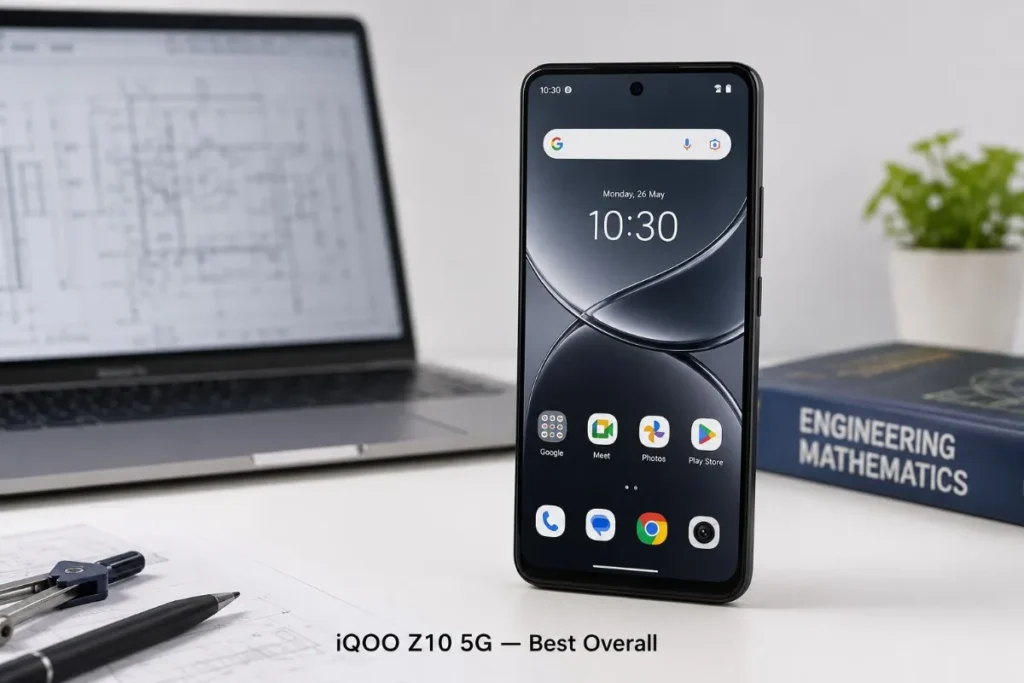
The iQOO Z10 5G is the strongest all-round performer in this price segment. It is powered by the Snapdragon 7s Gen 3 — one of the fastest chipsets available under ₹25,000 in India — and pairs it with a 7,300 mAh battery, the largest in this entire roundup.
In typical student use — Google Meet for online labs, YouTube at 1.5x speed for lecture catch-up, WhatsApp group coordination, and Chrome with several research tabs open — the iQOO Z10 comfortably runs from morning classes to late-night study sessions without needing a mid-day recharge. Based on independent analysis at ProductHunter.in, this battery delivers genuine two-day moderate use.
The 8 GB RAM, expandable virtually to 16 GB via Extended RAM, handles heavy multitasking without slowdowns. The 6.77-inch AMOLED display at 120Hz is vivid and comfortable for extended reading sessions. The 50MP camera with OIS captures clean daylight photos for project documentation and social media.
The trade-offs are worth noting: Funtouch OS carries some pre-installed bloatware, and there is no IP rating for water resistance. But for sheer performance and battery endurance at this price, it stands as one of the strongest options in the segment.
Verdict: Best phone for engineering students under ₹25,000 in India in 2026.
2. Samsung Galaxy A36 5G — Best for Long-Term Reliability
Who it is for: Students who want 4+ years of software updates and access to the widest service network in India.
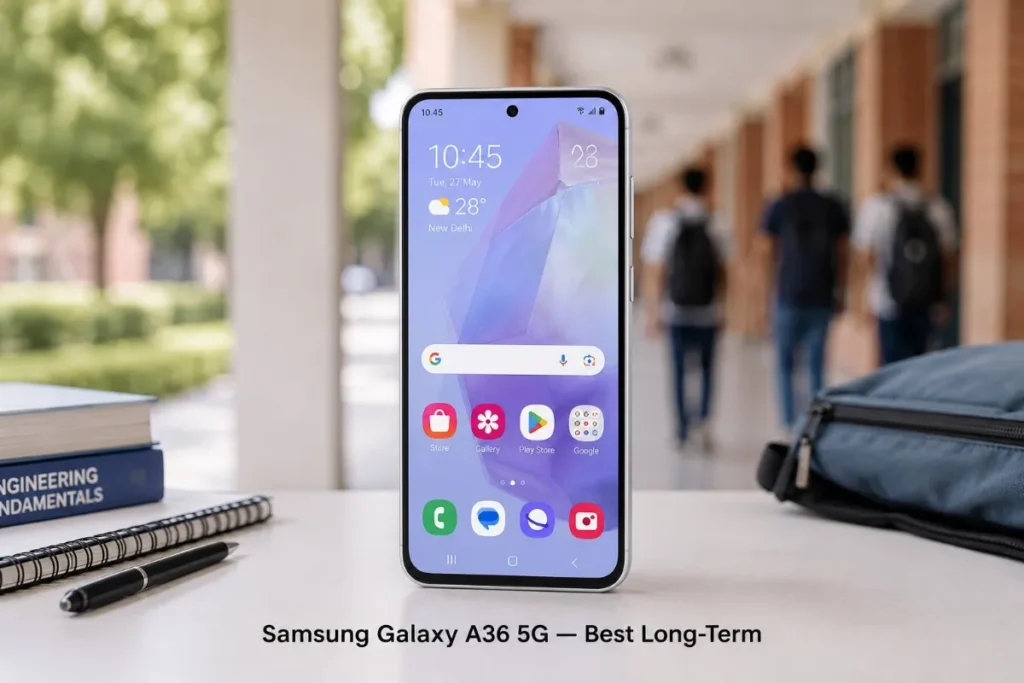
The Galaxy A36 5G brings Samsung’s most important student-friendly feature to the table: long-term support. Samsung offers four OS updates and five years of security patches on the A-series — no other brand in this price range comes close to that commitment. For a student who buys this phone in first year and expects it to last through graduation and into their first job, that matters.
The phone features a 6.7-inch FHD+ Super AMOLED display, the Snapdragon 6 Gen 3 chipset, and a 5,000 mAh battery with 45W fast charging. Samsung’s One UI is polished, regularly updated, and relatively clean for a mid-range device. The nationwide Samsung service centre network means authorised repair access whether your college is in Pune, Patna, or Palakkad.
It is not the fastest phone at this price, and the 5,000 mAh battery feels modest compared to the iQOO’s 7,300 mAh. But if longevity, trusted software support, and service centre access matter more to you than benchmark scores, the A36 is the right call.
Verdict: Best Samsung phone for engineering students in 2026; best choice for long-term value.
3. OnePlus Nord CE5 5G — Best for Clean Software and Fast Charging
Who it is for: Students who hate bloatware and need to fully charge their phone in under 50 minutes.
OxygenOS remains the cleanest near-stock Android experience in the sub-₹25,000 segment. No ads in the notification shade. No pre-installed games. No aggressive RAM management that kills background tabs mid-session. For an engineering student who wants their phone to simply work without interference, this is a meaningful difference from day one.
The Nord CE5 5G pairs a Dimensity 7400 chipset with 67W SUPERVOOC charging, which delivers a full charge in under 50 minutes. The 7,100 mAh battery is among the largest in the segment. The OnePlus alert slider — a physical switch for silent, vibrate, and ring profiles — is a small but genuinely useful feature during lectures when you need instant silent mode without unlocking the phone.
Camera quality is average for the price; the Samsung and Redmi options produce better photos. But if software cleanliness and charging speed are your priorities, this phone is difficult to beat at this price.
Verdict: Best OnePlus phone for students in 2026; best software experience under ₹25,000.
4. Nothing CMF Phone 2 — Best for Style-Conscious Students on a Budget
Who it is for: Design-conscious students who want a premium feel without paying flagship prices.
CMF by Nothing has carved out a genuine niche in the Indian college market. The CMF Phone 2 brings Nothing OS — a clean, minimal Android experience — into the ₹19,999 to ₹24,999 bracket, making it one of the most affordable paths to close-to-stock Android in India today.
The modular back design is genuinely unique. The AMOLED display is sharp and colour-accurate. Performance from the Dimensity 7300 Pro handles everyday engineering tasks — document editing, video playback, online classes — without issues, though sustained gaming benchmarks trail the Snapdragon options.
As TechnoArea.in noted in May 2026, the Nothing Phone and CMF lineup have become popular on Indian college campuses because they stand out visually without demanding a premium price. If you want something that does not look like every other Redmi in the hostel, the CMF Phone 2 earns serious consideration.
Verdict: Best phone for style-conscious engineering students under ₹25,000.
5. Redmi Note 14 Pro 5G — Best Camera and Value Under ₹25,000
Who it is for: Students who shoot photos, reels, or YouTube content alongside their studies.
The Redmi Note 14 Pro 5G has one of the most capable camera setups in its price range, with a high-resolution primary sensor, 120Hz AMOLED display, and the Snapdragon 7s Gen 3 chipset — the same processor as the iQOO Z10. The 5,500 mAh battery with fast charging handles a full day comfortably.
It is the right pick for students who create content alongside their degree — shooting technical fest coverage, building a photography portfolio, or documenting lab experiments. Pricing sits between ₹21,999 and ₹26,999 depending on the storage variant, making it competitive.
The main drawback is HyperOS, which carries more bloatware than OxygenOS or Nothing OS. Xiaomi’s update support record is also less consistent than Samsung’s.
Verdict: Best camera phone for college students under ₹25,000 in India in 2026.
6. Motorola Edge 50 Fusion — Best for Durability and Clean Android
Who it is for: Students who are hard on their devices and want near-stock Android with an IP rating.
Motorola’s near-stock Android approach and timely security patches make the Edge 50 Fusion a strong choice for students who have had bad experiences with heavily skinned software. It runs a clean Android experience with minimal interference, and at 175g it is the lightest phone in this roundup — a genuine daily-carry advantage.
The Edge 50 Fusion features the Snapdragon 7s Gen 2, a 5,000 mAh battery, and a pOLED display with 120Hz refresh. The IP68 rating means it handles rain, accidental splashes, and the odd drop near a campus water cooler without drama. At ₹24,999 to ₹27,999, it costs slightly more than the competition but justifies it through build quality and durability.
Verdict: Best rugged, clean-software phone for engineering students who are hard on their devices.
Which Phone Should You Buy Based on Your Engineering Branch?
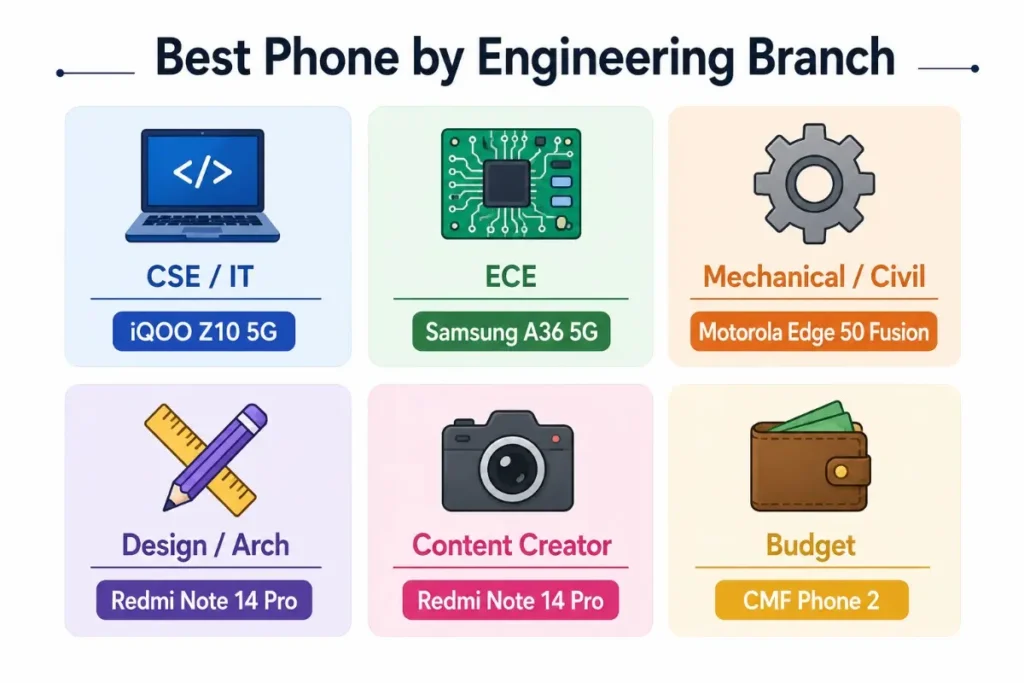
Not all engineering students have the same priorities. Here is a branch-specific breakdown.
| Branch | Primary Need | Recommended Phone |
|---|---|---|
| Computer Science / IT | Multitasking, coding tools, long battery | iQOO Z10 5G or OnePlus Nord CE5 |
| Electronics / ECE | Long battery, reliable display, service access | iQOO Z10 5G or Samsung Galaxy A36 5G |
| Mechanical / Civil Engineering | Durability, good camera for fieldwork | Motorola Edge 50 Fusion |
| Design / Architecture | Display quality, storage, camera | Redmi Note 14 Pro 5G |
| Content Creation / Media | Camera, fast charging, storage | Redmi Note 14 Pro 5G |
| Budget-conscious (any branch) | Best value, clean software | Nothing CMF Phone 2 |
Best Phone by Budget
| Budget | Best Pick | Why |
|---|---|---|
| Under ₹20,000 | Nothing CMF Phone 2 | Clean software, AMOLED display, unique design |
| Under ₹25,000 | iQOO Z10 5G | Fastest processor, largest battery in segment |
| Under ₹30,000 | Samsung Galaxy A36 5G | Best long-term support, IP67, reliable brand |
| Best Camera | Redmi Note 14 Pro 5G | High-resolution sensor, OIS, content creation |
| Best Software | OnePlus Nord CE5 5G | OxygenOS, no bloatware, alert slider |
| Most Durable | Motorola Edge 50 Fusion | IP68, lightweight, clean Android |
Phones Engineering Students Should Avoid
Not every phone sold heavily in India is suitable for a 4-year engineering degree. These categories are worth skipping entirely.
64 GB storage phones. One semester of lecture recordings, lab PDFs, project files, and WhatsApp group media will fill 64 GB. This is a false economy — the ₹1,000–₹2,000 difference to upgrade to 128 GB is paid back within weeks.
HD+ display phones. Reading circuit diagrams, PCB layouts, and academic PDFs on an HD+ screen at college is noticeably uncomfortable compared to FHD+. Eye fatigue is real, and you will spend hours on this display daily.
Phones with 18W charging. If your battery is large and you only have 20 minutes near a socket between two practicals, 18W charging is frustrating. Look for 33W at minimum; 44W and above is the standard at this price in 2026.
Phones offering fewer than 3 years of OS updates. A phone that stops receiving security patches before you finish your degree is a risk on shared college Wi-Fi networks. Some brands still offer only 2 years of updates in this price segment — read the fine print.
Entry-level chipsets (Helio G85, Snapdragon 680) for CSE students. These processors were mid-range two generations ago. Running an Android emulator, a Python environment, or a code compiler alongside Chrome and WhatsApp will show strain. CSE students specifically should aim for at least a Dimensity 7300 or Snapdragon 7s Gen 2.
What Budget Should Engineering Students Aim For?
The sweet spot for an engineering student smartphone in India in 2026 is between ₹20,000 and ₹28,000.
Below ₹15,000, you start making real compromises: slower chipsets, HD+ displays, 4G-only connectivity, and slower charging that will frustrate you within the first semester. Above ₹35,000, you are paying for flagship camera hardware and brand prestige that a student’s daily workload rarely justifies.
The ₹20,000–₹28,000 bracket in 2026 gives you 5G connectivity, AMOLED displays at 120Hz, 8 GB RAM, 128–256 GB storage, and fast charging above 44W — everything a full-time engineering student actually needs. Both Flipkart and Amazon regularly offer bank card discounts and no-cost EMI on phones in this range, bringing the effective cost down by ₹1,500–₹3,000.
Should Engineering Students Buy a Phone on EMI?
EMI makes sense when it allows you to buy the right phone rather than compromising to a lower bracket. Most banks offer zero-cost EMI (0% interest) on phones above ₹15,000 across Amazon, Flipkart, and brand websites. A ₹24,000 phone on a six-month no-cost EMI works out to ₹4,000 per month — manageable for most students.
Avoid long-tenure schemes advertised with very low monthly amounts. Always check the total payable amount for any hidden processing fees. The RBI guidelines on digital lending require lenders to disclose the Annual Percentage Rate (APR) upfront — verify it before you sign anything.
6 Things Most Student Phone Guides Do Not Tell You
1. 5G matters even if your campus does not have it yet. You will use this phone for 3–4 years. 5G coverage in India is expanding rapidly, and a 4G-only phone bought today means missing out by second or third year.
2. Software update support outlives the camera. A phone with a great camera that stops receiving security patches in 18 months is a liability on a college network. Prioritise brands that commit to multi-year updates.
3. Service centre location is underrated. If the nearest authorised service centre is 80 km away, a small hardware issue becomes a three-day ordeal. Samsung and Xiaomi have the densest service networks in non-metro India.
4. Never buy a 64 GB phone in 2026. Lecture recordings, PDFs, lab photos, and WhatsApp group media fill 64 GB within a semester. Start at 128 GB; prefer 256 GB if the price gap is under ₹2,000.
5. A bigger battery beats faster charging. 67W charging on a 4,500 mAh battery is less practical than 44W charging on a 7,300 mAh battery. You want to charge less often — not just charge faster.
6. Many students switch priorities after the first semester. Battery life and RAM end up mattering far more in practice than camera specs. Students who pick camera-first phones often regret it by second year when battery anxiety sets in.
Frequently Asked Questions
Which phone is best for engineering students under ₹20,000 in India in 2026?
The Nothing CMF Phone 2 (starting at ₹19,999) is the strongest option under ₹20,000. It offers an AMOLED display, 8 GB RAM, 5G, and Nothing OS — one of the cleanest software experiences at this price. The iQOO Z9s at around ₹18,999 is the alternative if battery capacity matters more than software polish.
Is the iQOO Z10 5G better than the Samsung Galaxy A36 5G for students?
For raw performance and battery life, the iQOO Z10 holds an edge with a faster chipset and nearly 50% larger battery. For software longevity, service centre access, IP67 water resistance, and long-term reliability over four years, the Samsung A36 5G is the stronger investment. The right answer depends on whether you prioritise performance today or durability over time.
How much RAM is enough for an engineering student’s phone in 2026?
8 GB is the comfortable minimum. 6 GB works for light use, but running Google Meet, Chrome, WhatsApp, and a coding environment simultaneously will show slowdown. Avoid anything below 6 GB. Extended RAM features (virtual RAM) help at the margins but do not replace physical RAM for sustained multitasking.
Is 256 GB storage worth it for engineering students?
Yes, if the price difference to the 256 GB variant is under ₹2,000. Project files, recorded lectures, lab photographs, and 4K video for reels fill storage faster than most students expect. Starting with 256 GB avoids cloud storage costs and the frustration of low-storage alerts during exam preparation.
Should engineering students consider a refurbished phone?
Refurbished phones from certified platforms like Cashify, Flipkart Refurbished, or Amazon Renewed can offer genuine value — particularly for flagship devices. However, verify the warranty period (minimum 6 months), return policy, and battery health certificate. For a 4-year college use case, a new phone with a full manufacturer warranty is generally the safer and more cost-effective choice over time.
Is 5G necessary for an engineering student in India right now?
Not strictly necessary right now, but strongly recommended for future-proofing. 5G coverage across Indian cities is expanding, and a phone purchased in 2026 will be in use through 2029–2030. Buying a 4G-only device today to save ₹1,000–₹2,000 is a poor trade-off given the 3-4 year usage horizon.
Which phone lasts 4 years for engineering students?
The Samsung Galaxy A36 5G is the strongest choice for a 4-year lifespan. It offers four OS updates and five years of security patches — the longest support commitment in this price range. Motorola and OnePlus offer 3-year commitments. For a student who enters college in 2026 and graduates in 2030, the A36’s update policy aligns precisely with that timeline.
Final Verdict: The Definitive Ranking
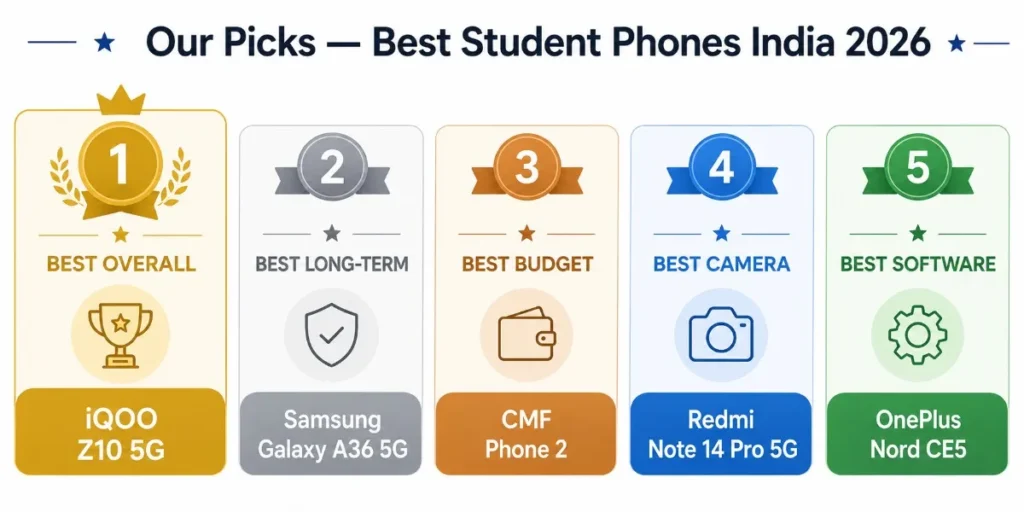
Best Overall — iQOO Z10 5G One of the fastest processors in its class, the largest battery in this segment, 8 GB RAM, and 256 GB storage at ₹24,999. For a CSE or IT student who needs sustained performance and battery that does not quit, this is the phone to buy.
Best for Long-Term Value — Samsung Galaxy A36 5G Four OS updates, five years of security patches, IP67 water resistance, and the widest service centre network in India. If you are buying a phone you want to still trust in your final year and beyond, the A36 earns that confidence.
Best Budget Pick — Nothing CMF Phone 2 Under ₹20,000, no phone gives you this combination of clean software, AMOLED display, and a design that genuinely stands out. For students who want to spend smart without compromising on the essentials, this is the call.
Best Camera — Redmi Note 14 Pro 5G For content creators, photographers, and students who document their college experience heavily, the Redmi Note 14 Pro offers the most capable camera hardware in this roundup at a competitive price.
Best Software Experience — OnePlus Nord CE5 5G OxygenOS remains the gold standard for clean, fast, ad-free Android in the mid-range. Combine that with 67W fast charging and a 7,100 mAh battery, and you have a phone built for students who value software quality above everything else.
The phones available in this price bracket in 2026 are better than they have ever been. The decision comes down to what you personally value most: raw performance, long-term software support, camera quality, or budget efficiency. Use the comparison tables above, filter by your branch and budget, and do not pay for specs your coursework will never demand.
Sources and further reading:
- AICTE BTech Admissions Data 2025-26: educationtoday.co
- India Mobile Education Market Report (IMARC Group): imarcgroup.com
- India Smartphone Market Size 2025 (IMARC Group): imarcgroup.com
- IBEF India Education Sector Report: ibef.org
- iQOO Z10 5G Independent Review: producthunter.in
- Best Phones for College Students 2026: technoarea.in
- Best Phones for Students India June 2026: gizbot.com
- Best Smartphones Under ₹30,000 India 2026: insightfulpost.com
- Student Phone Buying Guide: reuz.in
- Best Android Phones Under ₹25,000 India: smartprix.com
Read More:
- Top 15 Best Upcoming Phone Launches in July 2026: Launch Date, Expected Price & Specifications
- OnePlus Turbo 6X Unboxing and First Look: The Most Affordable OnePlus Phone Yet?
- Google Pixel 11 Leaks: Release Date, Price, Full Specs & Biggest Upgrades Revealed (2026)
- Best Smartphones for Students in India 2026 | Under ₹15K, ₹25K, ₹35K




2 thoughts on “Best Phone for College and Engineering Students in India 2026”