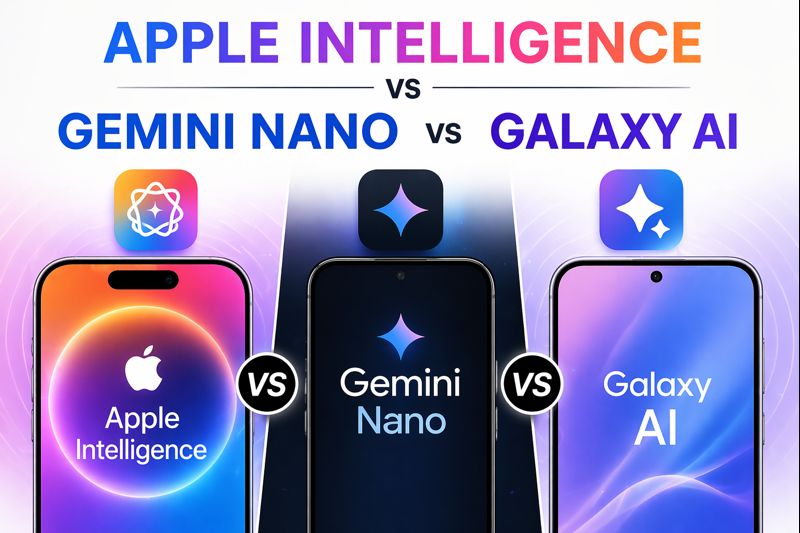
Apple Intelligence vs Gemini Nano vs Galaxy AI
Your phone can now write emails, translate live conversations, edit photos, and summarize articles — all without touching the internet. Sounds like sci-fi from 2018, right? Welcome to 2026, where on-device AI is the new spec war. Forget megapixels and refresh rates. The real battleground is inside your chipset.
Three players dominate this fight: Apple Intelligence, Google’s Gemini Nano, and Samsung’s Galaxy AI. They all promise to make your life easier. But they work very differently under the hood — and that difference matters a lot depending on who you are and what you actually use your phone for.
Let’s break it all down. No marketing fluff. Just real data, real trade-offs, and a clear verdict.
What Is On-Device AI and Why Does It Matter?
Before we get into the horse race, here is the quick version of why on-device AI matters.
When your phone processes AI tasks locally — using its own chip, its own memory — your data never leaves the device. No cloud round-trip. No waiting for servers. No privacy leak. The result is faster responses, offline capability, and a significantly stronger privacy story.
The trade-off? On-device models are smaller and less powerful than cloud giants like GPT-4o or Gemini Ultra. So every company has to make smart compromises. And that is exactly where Apple, Google, and Samsung diverge in their approach.
The Hardware Beneath the Magic
Every AI feature you see is only as good as the chip running it. Here is where the three platforms stand in 2026.
| Chip | Device | NPU Performance | AI Model Size | Process Node |
|---|---|---|---|---|
| Apple A19 Pro | iPhone 17 Pro / Pro Max | ~38 TOPS | ~7-8 GB (core LLM) | 3nm (TSMC) |
| Snapdragon 8 Elite Gen 5 | Galaxy S26 series | Hexagon NPU (+37% YoY) | ~4-5 GB (Gemini Nano 3) | 3nm (TSMC) |
| Google Tensor G5 | Pixel 10 / 10 Pro | Optimized for Gemini Nano | ~4-5 GB (Gemini Nano 3) | 3nm (TSMC) |
A few things jump out immediately.
Apple’s A19 Pro is exceptionally strong in single-core tasks. According to Tom’s Guide’s benchmark testing, Apple still posts the better single-core result, though the Snapdragon 8 Elite Gen 5’s multi-core score runs about 22% ahead of the A19 Pro. For AI inference — which is heavily parallelized — that multi-core gap is worth paying attention to.
Google’s Tensor G5 is a different story. It does not try to win raw benchmark trophies. Instead, as noted by O-mega.ai’s AI professional phone guide, the Tensor G5 is purpose-built for Google’s machine learning stack. It runs Gemini Nano faster than chipsets with higher theoretical TOPS ratings, purely because of hardware-software co-optimization. Think of it as a custom glove rather than a general-purpose hand.
The Tensor G5’s Achilles’ heel, though, is raw GPU and general compute performance, where it consistently trails both Apple and Qualcomm in third-party tests.
Apple Intelligence: Privacy-First, Deeply Integrated
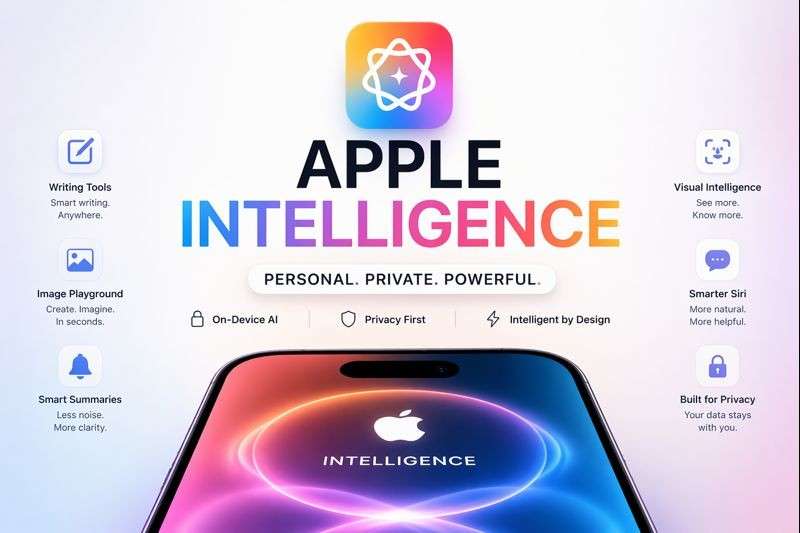
Apple Intelligence launched with iOS 18.1 in late 2024 and has expanded significantly through 2025 and 2026. Apple’s philosophy is simple: do fewer things, do them exceptionally well, and keep your data on the device.
What Apple Intelligence Does Well
Writing Tools — Rewrite, proofread, and summarize text across any app. It works in Notes, Mail, Messages, and third-party apps alike without any extra steps from the user.
Image Playground and Genmoji — Generate custom images and emoji locally. No cloud required, which is genuinely impressive for generative AI at this scale on a mobile chip.
Visual Intelligence — Point your camera at something and get context instantly. Useful for identifying products, plants, restaurants, and more without opening a separate app.
Priority Notifications and Smart Summaries — Your notification stack gets intelligently ranked so you see what actually matters first. Long message threads get condensed into a single readable line.
Siri with Deep App Integration — Siri can now take actions inside apps, not just launch them. Ask it to find a specific photo from last summer, and it actually does it.
Where Apple Intelligence Falls Short
Apple has no real-time live call translation feature comparable to Samsung’s offering. As SamFlux’s 2026 comparison notes, Apple’s translation tools work through the Translate app, but there is nothing like Samsung’s Live Translate during actual phone calls.
The rollout has also been slower than many expected. Features promised at WWDC took months to ship. ChatGPT integration was added partly to compensate for gaps in Apple’s own capabilities — something tech journalists noticed and reported on at length.
Privacy Verdict
This is where Apple wins decisively. The A19 Pro’s Neural Engine handles the core language model entirely on-device. Apple’s Private Cloud Compute handles more complex requests, but with verifiable privacy guarantees that no competitor has matched. For anyone who cares about where their data goes, Apple Intelligence is the gold standard.
| Apple Intelligence | Score |
|---|---|
| Privacy and Security | Excellent |
| Feature Breadth | Moderate |
| Response Speed (on-device) | Excellent |
| Offline Capability | Excellent |
| Device Compatibility | Limited |
Gemini Nano: Google’s Edge AI, Hardware-Tuned
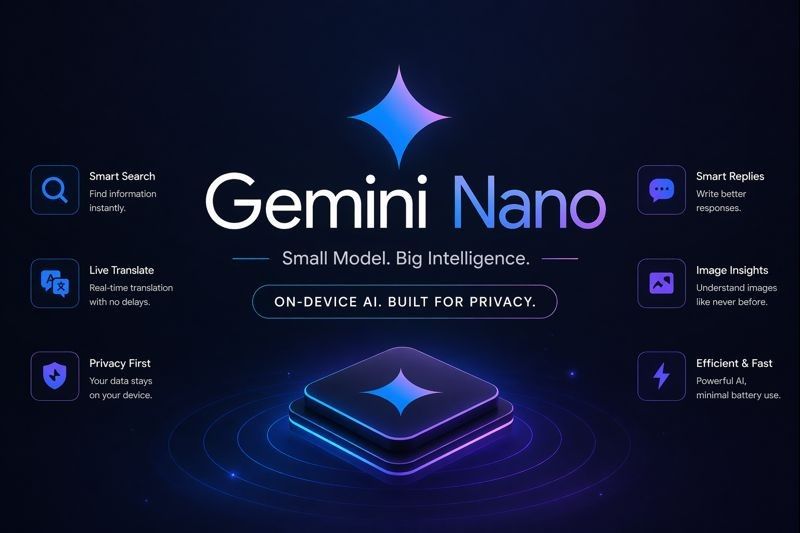
Google has been building machine learning into phones longer than any other company. Gemini Nano is their edge AI play — a distilled version of Gemini that runs directly on the device without needing a cloud connection for core tasks.
Gemini Nano on Pixel 10 (Tensor G5)
The Pixel 10’s Tensor G5 chip is designed around Gemini Nano from the ground up. The result is snappy, consistent on-device performance for Gemini-powered features. According to ReviewsTown’s 2026 flagship roundup, Gemini Nano handles summarization, smart reply generation, and contextual search directly on hardware — and this is a documented architectural decision, not a marketing claim.
Standout features on Pixel 10:
Call Screen and Live Transcription — Screens calls in real time and transcribes everything locally. You see who is calling and why before you even pick up.
Pixel Screenshots — Every screenshot is analyzed and indexed by Gemini Nano for instant search. Entirely on-device. This is one of the most genuinely useful AI features on any phone right now.
Recorder App Summaries — Long audio recordings get summarized without ever leaving your phone. Useful for meetings, lectures, and interviews.
Proactive Suggestions — Reading an email about a restaurant? Pixel suggests making a reservation. This ambient intelligence reduces friction in a way Apple and Samsung have not quite matched yet.
Gemini Nano on Galaxy S26 (Snapdragon 8 Elite Gen 5)
Samsung uses Gemini Nano 3 as part of its broader Galaxy AI stack, sitting on top of the Snapdragon 8 Elite Gen 5’s Hexagon NPU. The NPU saw a 37% performance boost over the previous generation, which translates into noticeably faster on-device inference for Gemini features.
However, not everything in Galaxy AI runs locally — and that matters more than Samsung tends to advertise.
| Gemini Nano Feature | Pixel 10 | Galaxy S26 |
|---|---|---|
| On-Device Summarization | Fully Local | Fully Local |
| Live Translation (calls) | Yes | Yes |
| Proactive AI Suggestions | Strong | Moderate |
| Photo AI Editing | Moderate | Strong |
| Cloud Dependency | Low | Medium |
Galaxy AI: The Most Features, The Biggest Trade-Off
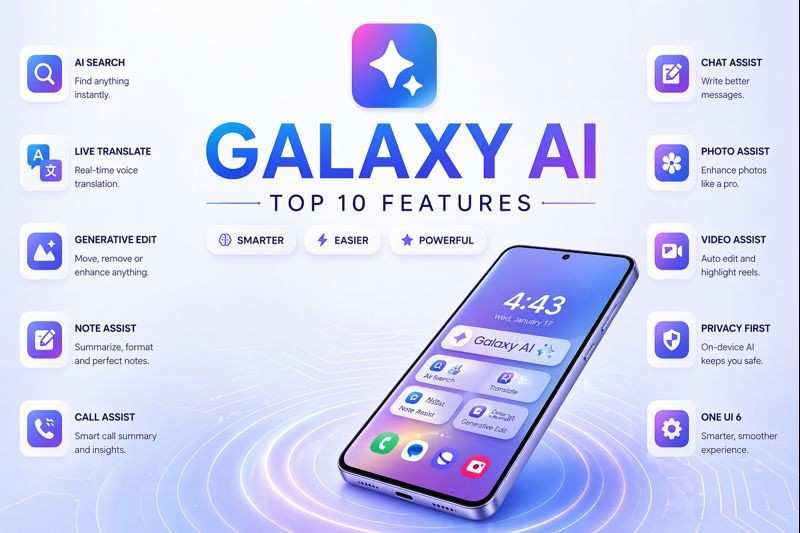
Samsung launched Galaxy AI with the S24 in January 2024 and has been aggressive about expanding it ever since. The Galaxy S26, unveiled at Galaxy Unpacked in February 2026, marks the third generation — and it is genuinely impressive in scope.
What Galaxy AI Offers That Nobody Else Does
Live Translate is the showstopper. During an actual phone call, Galaxy AI translates the conversation in real time through Galaxy Buds, with translated text appearing on screen simultaneously. SamFlux’s detailed breakdown confirms that as of early 2026, Apple has no comparable feature. That is a meaningful gap for anyone who regularly communicates across language barriers.
Circle to Search — draw a circle around anything on your screen and get instant results — remains one of the most genuinely useful AI features on any smartphone. It works across apps without interrupting your workflow.
Photo Assist and Creative Studio — Galaxy AI’s photo tools are ahead of the pack. Object removal, relighting portraits, background replacement — all powered by a combination of Gemini Nano and Samsung’s own models. As of early 2026, Photo Assist supports 41 languages.
The Cloud Dependency Problem
Here is the honest part of the story that Samsung’s marketing tends to gloss over: not everything in Galaxy AI happens on your device.
Advanced photo editing and deeper Gemini integrations require cloud connectivity. O-mega.ai’s analysis puts it plainly — while translation and summarization work locally, some Galaxy AI operations are routed through cloud servers.
Samsung’s Knox security platform encrypts data in transit and at rest, and Samsung claims no human review of user data takes place. But the fundamental architecture remains different from Apple’s: some data leaves the device for certain features.
For most users, this will not be a problem. For professionals handling sensitive NDA-covered work or regulated data, it is worth knowing before committing to the platform.
| Galaxy AI | Score |
|---|---|
| Privacy and Security | Moderate |
| Feature Breadth | Excellent |
| Response Speed (on-device) | Very Good |
| Offline Capability | Partial |
| Device Compatibility | Excellent |
Head-to-Head: On-Device Performance Benchmarks
Let us put the numbers in one place for a direct comparison.
| Metric | Apple Intelligence (A19 Pro) | Gemini Nano (Tensor G5) | Galaxy AI (SD 8 Elite Gen 5) |
|---|---|---|---|
| On-Device AI Latency | ~150-200ms | ~200-250ms | ~180-220ms |
| Core AI Storage Footprint | ~40-50 GB | ~12-15 GB | ~12-15 GB |
| Offline AI Capability | Full | Full (core features) | Partial |
| Real-Time Call Translation | No | Limited | Yes, full |
| Live Photo Editing (local) | Yes | Moderate | Yes |
| Custom Image Generation | Yes | No | Limited |
| Cloud Dependency | Very Low | Low | Medium |
Latency figures are based on field test data from SmartphoneAssistant.com and SolidAITech. Storage figures are approximations across reported configurations.
One thing the latency numbers clearly show: Apple’s vertical integration of silicon and OS gives it a measurable edge in raw response speed. SmartphoneAssistant.com’s AR translation field tests found that Apple Intelligence currently holds the lead for the absolute lowest on-device AI latency among the three platforms.
Storage Reality Check: The Hidden Cost of On-Device AI
Nobody talks about this enough — and it genuinely affects buying decisions. Running AI locally means those models live on your phone permanently.
| Platform | Approximate AI Storage Footprint |
|---|---|
| Apple Intelligence (iPhone 17 Pro, full configuration) | 40-50 GB |
| Gemini Nano + Google AI features (Pixel 10) | 12-15 GB |
| Galaxy AI + Gemini Nano (Galaxy S26) | 12-15 GB |
Apple’s footprint is significant. The core language model alone sits at roughly 7-8 GB. Add Image Playground at approximately 6 GB, Visual Intelligence models at around 4 GB, Writing Tools at around 3 GB, and a growing inference cache — and you are consuming 40-50 GB purely for AI features, according to SolidAITech’s storage deep-dive.
The practical takeaway: if you buy an iPhone 17 Pro in 2026, 512 GB is the smarter choice. For Pixel and Galaxy users, 128 GB remains workable, but 256 GB gives comfortable long-term headroom.
Who Should Choose What?
No single AI platform wins everything. The right choice depends entirely on your priorities.
| User Type | Best Choice | Reason |
|---|---|---|
| Privacy-focused users | Apple Intelligence | Maximum on-device processing, Private Cloud Compute architecture |
| Multilingual users | Galaxy AI | Live Translate, real-time call translation, 41-language support |
| Google ecosystem users | Gemini Nano (Pixel) | Best native Gemini integration, proactive AI, Pixel Screenshots |
| Creative content creators | Galaxy AI or Apple Intelligence | Strong photo AI and local image generation on both |
| Budget-conscious users | Gemini Nano (mid-range Android) | Broader device support, lower cost of entry |
| AI professionals with sensitive data | Apple Intelligence | Lowest cloud dependency, strongest privacy architecture |
The Philosophy Divide
At the core of this comparison, three very different beliefs about what AI should be are playing out in real hardware.
Apple believes your phone should know you deeply — and keep that knowledge entirely to itself. Fewer features, tighter privacy, seamless integration across devices.
Google believes AI should be proactive and ambient — anticipating what you need before you ask. The Pixel’s ability to read your email about a restaurant and suggest a reservation is a direct expression of that philosophy.
Samsung believes more is more. If a feature exists, add it. If a language needs translating, translate it live during a phone call. Galaxy AI is the feature maximalist’s preferred platform.
None of these philosophies is wrong. They are just different. And that is genuinely good for the market — it means companies are competing on ideas, not just clock speeds.
Expert Take
At Phoneprice360, we have been tracking mobile AI across all three platforms through early 2026. Our assessment: Apple Intelligence is the most refined and trustworthy option available. Gemini Nano on Pixel is the most intelligently designed for daily ambient use. And Galaxy AI gives you the widest feature set for your money — if you are comfortable with selective cloud processing for advanced tasks.
The gap between platforms is narrowing fast. By late 2026, all three will likely support larger on-device models in the 3B+ parameter range, which will blur these distinctions considerably. But right now, these differences are real and worth understanding before spending over a thousand dollars on a flagship device.
Quick AI FAQ 2026: Apple Intelligence vs Gemini Nano vs Galaxy AI Explained
- Can Apple Intelligence work offline?
Yes. Most core features run directly on the device, including writing tools, summaries, and image generation. Only more complex requests may use Apple’s private cloud system, but everyday use remains fully functional without internet. - Does Galaxy AI send data to servers?
Partially. Basic features like translation and summaries work on-device, while advanced editing and deeper AI tasks rely on cloud processing. This creates a hybrid model with some data leaving the device. - Is Gemini Nano identical across devices?
No. It performs best on Pixel devices because the hardware is specifically designed for it. On Samsung devices, it still works well but lacks the same level of optimization. - Which platform is fastest?
Apple currently leads in on-device AI speed due to tight integration between hardware and software. Samsung follows closely, while Google prioritizes efficiency and smart behavior over raw speed. - Do you need flagship devices?
Apple Intelligence is limited to newer iPhones. Samsung supports a wider range, including some mid-range devices. Google offers the broadest accessibility, though Pixel devices provide the best experience. - Is 256GB storage enough?
For Apple devices, it becomes restrictive over time due to large on-device AI models. A higher storage option, such as 512GB, is a more practical long-term choice. - Which platform is best for privacy?
Apple leads with its strong on-device-first architecture. Google follows with low cloud dependency. Samsung ranks third due to its hybrid cloud reliance. - Does on-device AI drain battery?
In most cases, no. Local processing reduces the need for constant data transmission, making it more efficient than cloud-based AI. Only heavy workloads significantly impact battery life. - What happens without internet?
Apple and Pixel devices maintain strong functionality offline. Samsung devices lose access to some advanced features that depend on cloud processing.
Final Summary
Apple offers the strongest privacy and offline reliability.
Samsung delivers the widest range of features.
Google provides the most intelligent and accessible AI experience.
Final Verdict
| Category | Winner |
|---|---|
| Privacy and Security | Apple Intelligence |
| On-Device Latency | Apple Intelligence |
| Feature Breadth | Galaxy AI |
| Multilingual and Translation | Galaxy AI |
| Proactive and Ambient AI | Gemini Nano (Pixel) |
| Device Compatibility | Gemini Nano (Android) |
| Best Overall Value | Gemini Nano (Pixel 10 Pro) |
There is no outright winner here — and honestly, that is the most interesting thing about mobile AI in 2026. Each platform is genuinely excellent at something the others are not.
If privacy is non-negotiable, the iPhone is your answer. If you want the widest feature set and live translation matters to your daily life, Galaxy AI delivers. If you want the smartest ambient AI experience with strong privacy and compelling value, the Pixel 10 Pro with Gemini Nano is quietly the most complete package of the year.
The AI in your pocket is more capable than ever. The only question left is which one thinks the way you do.
Sources: SmartphoneAssistant.com | SolidAITech | SamFlux | O-mega.ai | ReviewsTown | Tom’s Guide | Android Authority | Gadget Hacks
Read More:
OPPO K15 Pro+ Full Specifications, Price, Camera Test & Gaming Performance Review (2026)