Quick Answer
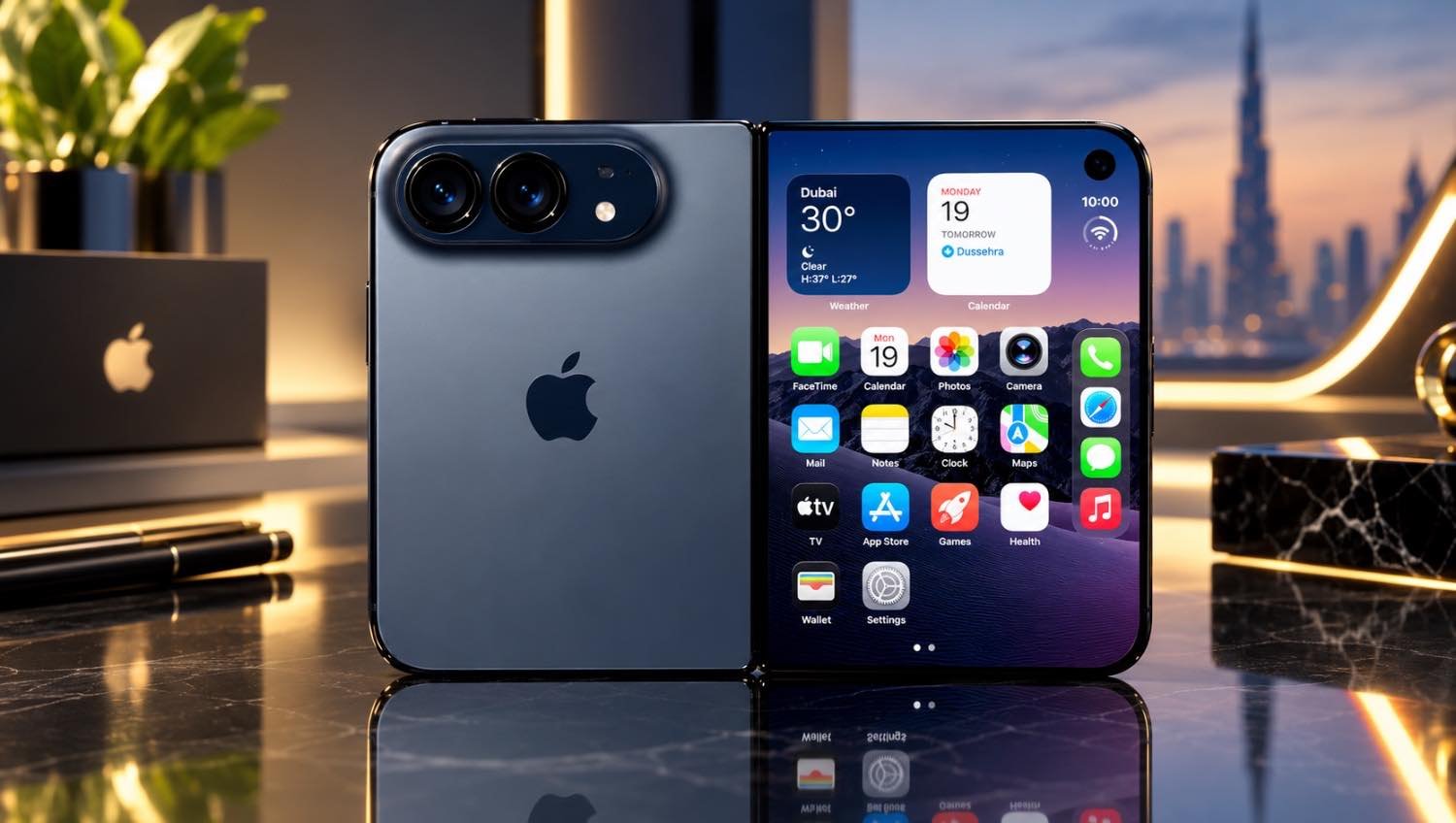
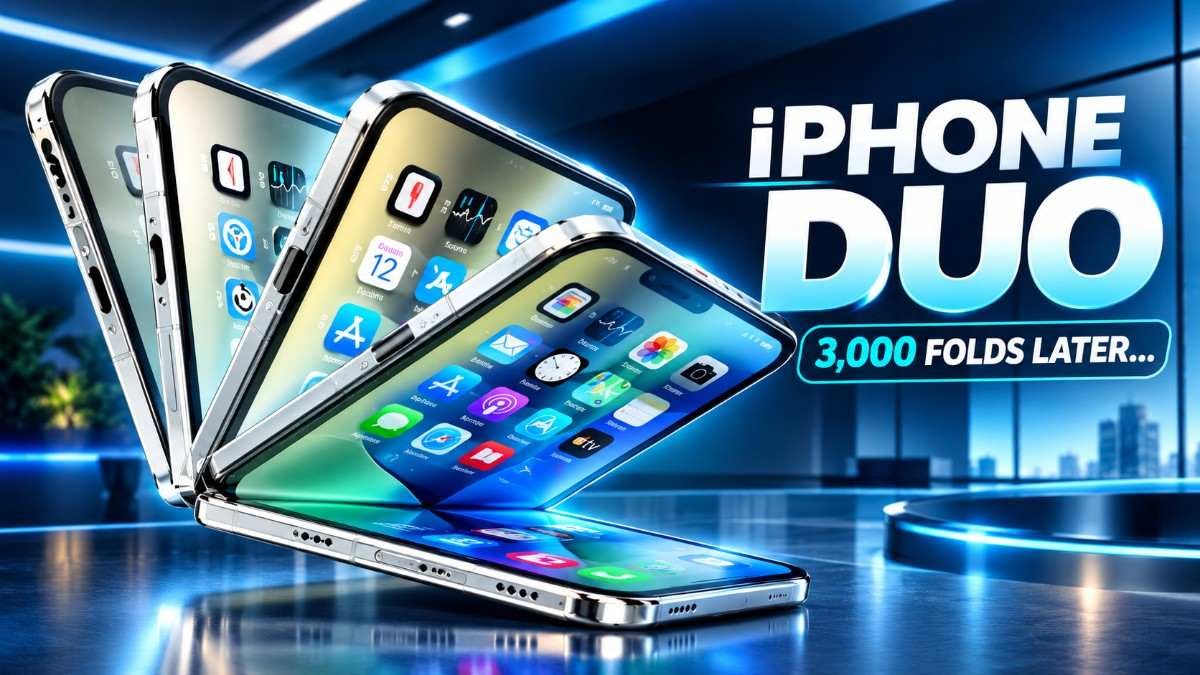
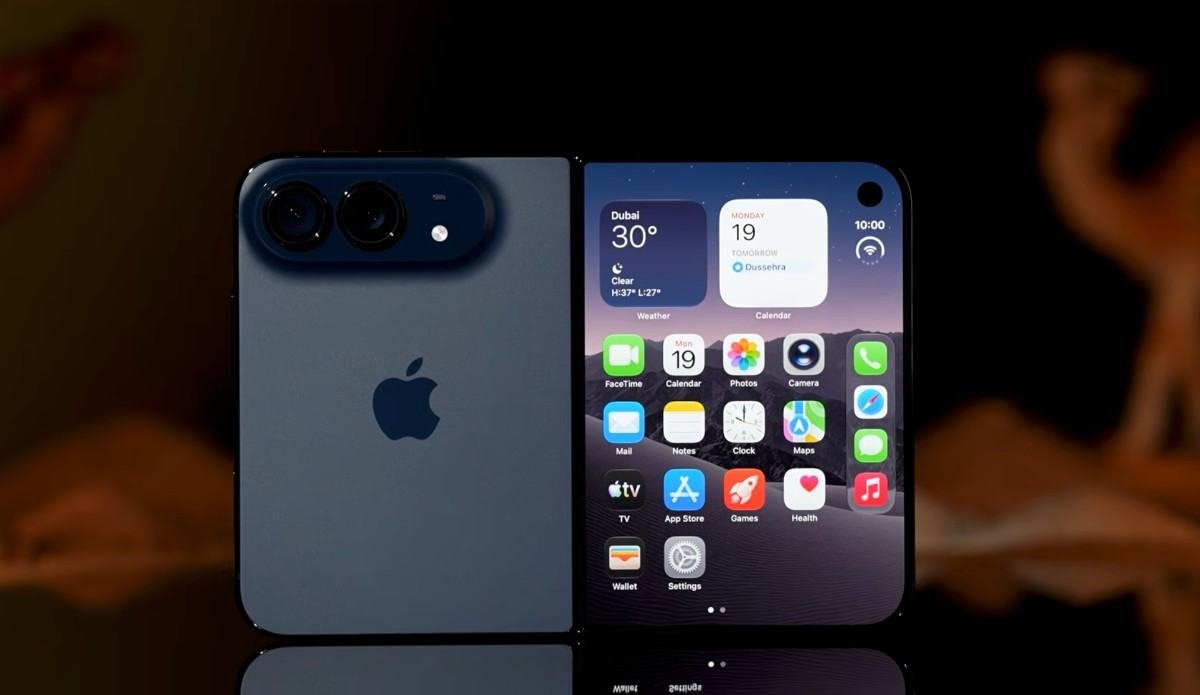
iPhone Duo after 3,000 folds: the crease deepens from 48 microns to 167 microns — roughly 3.5× — and the screen around it softens. The hinge remains excellent, but about 80% of 25 tested apps are not optimised, sustained gaming frame rates drop around 20%, charging peaks at 42W despite a 60W rating, and a small number of owners report hinge-area screen cracks within hours. India price starts at ₹2,99,900, and an out-of-warranty inner-screen repair costs ₹1,49,900. Buy it for the hardware and the ecosystem, not for mature multitasking.
Key Takeaways
- Crease: 48µm at unboxing, 167µm after 3,000 folds, slope 0.097° → 1.245°, screen noticeably softer
- Hinge: 100+ parts, titanium, 15°–165° free-stop, IP68, still smooth after 11,000 folds
- Crackgate: a small number of owners report inner-screen cracks along the hinge within hours; Apple has replaced at least one unit
- Software: ~80% of 25 tested apps not fully adapted; Split View locked to ~50/50 and breaks in portrait
- Performance: CPU matches iPhone 18 Pro, GPU about 10% lower; sustained gaming ~33fps vs 40fps+ and 46.5°C chassis
- Charging: rated 60W, peaks ~42W; 1h40 unfolded, 1h52 folded, 3h14 wireless
- India price: ₹2,99,900 to ₹4,49,900; inner screen repair ₹1,49,900; AppleCare+ ₹51,900
1. Quick Verdict: Should You Buy the iPhone Duo?
What’s Genuinely Great
- Near-invisible crease out of the box (48µm)
- Hinge feels premium and holds any angle from 15° to 165°
- A20 Pro CPU matches the iPhone 18 Pro
- 7.6-inch 120Hz OLED with 3,000 nits peak
- IP68 on a foldable is rare and genuinely useful
- Best CPU performance on any foldable today
- Apple ecosystem continuity
What’s Worrying
- Crease deepens to 167µm after 3,000 folds
- ~80% of tested apps not fully adapted
- Split View can’t be resized and breaks in portrait
- GPU throttles and chassis hits 46.5°C under load
- Charging peaks at 42W despite 60W rating
- Hinge-area screen cracks reported within hours
- ₹1,49,900 inner screen repair without AppleCare+
The one-line answer: The iPhone Duo is the best first-generation foldable Apple could have made, and it is still a first-generation foldable. Buy it for the hinge, the screen and the ecosystem — not for mature multitasking or app support. If you do buy, get AppleCare+, inspect the hinge and screen at unboxing, and treat the first year as a beta test.
| Buyer Type | Verdict | Why |
|---|---|---|
| Apple ecosystem power user | Strong fit | Best foldable hardware, seamless Continuity, iPad-like Split View in landscape |
| Mobile gamer | Strong fit | A20 Pro CPU is class-leading, GPU still ahead of Android foldables in benchmarks |
| Mobile videographer | Good fit | 48MP dual camera is good, but no telephoto and low-light processing is aggressive |
| Productivity-first buyer | Poor fit | Split View is rigid, many apps waste space, no free window resizing |
| First-time foldable buyer | Mixed | Polished hardware, but hinge-crack reports and repair costs demand caution |
| Budget-conscious buyer | Poor fit | ₹2,99,900 buys a Galaxy Z Fold 7 plus a lot of change |
2. Testing Methodology and Sources: How We Verified This
Foldable reviews are easy to fake. A photo of a crease means nothing without a measurement method, and a single owner report means nothing without context. Here is exactly what was tested, by whom, and what we could and could not verify ourselves.
The tests this guide relies on
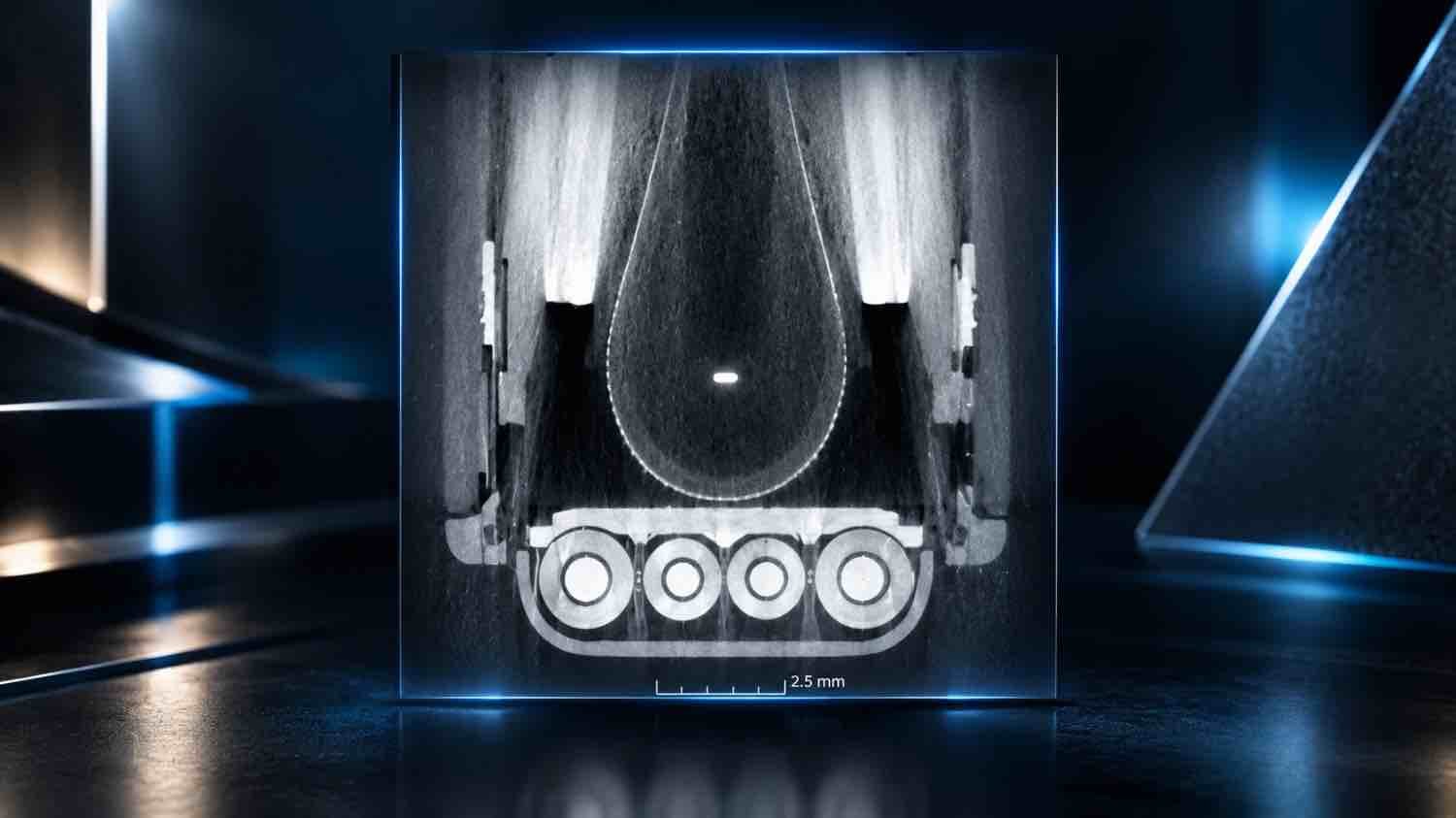
- 1.HTX Studio’s 3,000-fold rig: Measured crease depth and cross-axis slope before and after 3,000 simulated folds, and compared the result with two other foldables under the same conditions.
- 2.He Tongxue’s lab review: CT-scanned the hinge, counted components, measured the crease at 48µm and 167µm, ran Death Stranding for 30 minutes, logged chassis temperature, charging curve and battery drain. This is the source for most of the performance numbers below.
- 3.Tim Pan’s 10,000-fold rig: Ran 500 manual folds, 10,000 room-temperature folds and 1,000 folds at -4°F, and documented software twitches during folding.
- 4.MacRumors, Reddit and The Verge owner tracker: Collected hinge-crack reports, timestamps and Apple’s responses. These are anecdotal, not a failure-rate study.
- 5.Tom’s Guide and The Verge software testing: Ran a 25-app compatibility test and documented Split View behaviour across orientations.
- 6.PhoneArena spec database and Apple India support pages: Verified weight, dimensions, battery, display size and repair pricing.
What we could not verify
The failure rate for hinge cracks is unknown. Apple has not published one, and the reports are self-selected — people with cracked phones post, people with working phones usually don’t. The 3,000-fold figure is a simulation, not real-world use. It compresses months into days, which is useful for comparison but not a prediction of your specific phone. And some early crack images may involve user damage; MacRumors explicitly notes this.
Source note: The YouTube video embedded below is HTX Studio’s review, published October 21, 2026. At the time of writing it had over 3.4 million views. We reference it because it is the primary source for the 3,000-fold crease data, not because it is sponsored. Watch it directly on YouTube.
3. Crease Measurements: Before vs After 3,000 Folds
This is the number that matters most. Out of the box, the iPhone Duo’s crease has a peak-to-valley height of about 48 microns — roughly half the thickness of an A4 sheet. The cross-axis slope is 0.097°. In normal light, at normal angles, you will not see it. He Tongxue called it “industry-leading” at launch, and the measurements support that.
After 3,000 simulated folds, the peak-to-valley height rose to 167 microns, about 3.5× deeper. The cross-axis slope rose to 1.245°. HTX Studio found the same result and added that the screen around the crease becomes noticeably softer to the touch than the rest of the panel.
| Metric | Out of the Box | After 3,000 Folds | Change |
|---|---|---|---|
| Peak-to-valley crease height | ~48 microns | ~167 microns | ~3.5× deeper |
| Cross-axis slope | 0.097° | 1.245° | ~12.8× steeper |
| Screen softness around crease | Normal | Noticeably softer | — |
| Hinge feel | Smooth | Still smooth after 11,000 folds | No reported loss |
How much use is 3,000 folds? For a heavy user who opens and closes the phone 30 to 40 times a day, it is roughly two to three months. For a normal user, closer to six months. The crease will not stop the phone from working, but the “invisible crease” from the keynote is a launch-day condition, not a permanent feature.
Is it worse than the competition? At launch, no — it is among the least visible. After 3,000 folds, HTX Studio found the Duo’s crease became deeper than two other foldables tested under the same conditions. Apple starts ahead and then converges. That is important context if you are paying a premium specifically for the least visible crease.
Limitations: 3,000 folds is a lab simulation. Real-world crease growth depends on temperature, humidity, how you open the phone and whether you press on the screen. Tim Pan’s separate 10,000-fold test showed further deepening, which is expected. The exact rate at which a crease becomes visually annoying is subjective.
Sources: Notebookcheck, Gamersky / He Tongxue, and iPhone-Ticker.
4. Hinge Durability and Reported Failures: What’s Documented vs Unverified
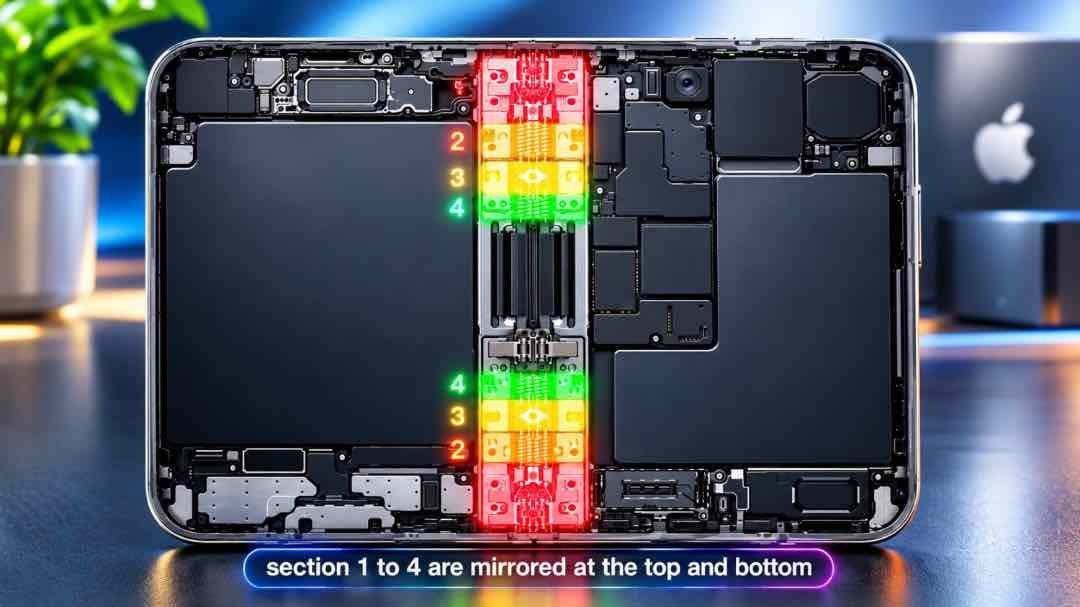
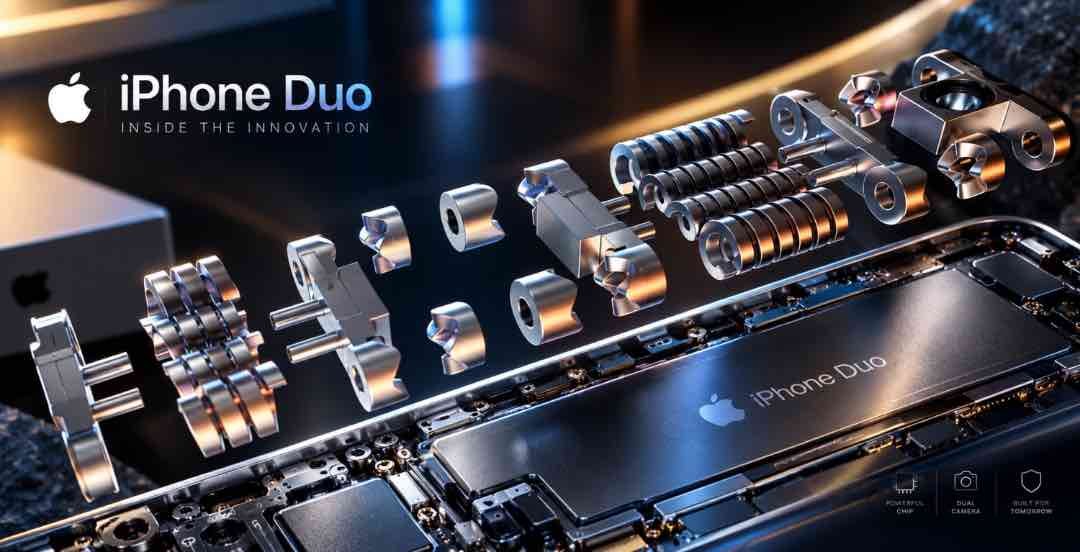
If one part of the iPhone Duo justifies the price, it is the hinge. He Tongxue put it through a CT scanner and found more than 100 individual components, including a spring-and-cam damping system that holds any angle between 15° and 165°. The shell is titanium, the whole phone is IP68, and the hinge survived 11,000 folds in one test with no noticeable loss of stiffness. A separate 32,000-fold stress test left the phone working, though the hinge stiffened slightly.
Apple also routed a graphite pipe through the hinge to move heat away from the chipset when the phone is folded. It is a clever workaround for a cramped chassis, even if it does not fully solve the thermal penalty discussed in Section 7.
What is documented about cracks
MacRumors has collected photos from Reddit and its own forums showing inner-screen cracks along the hinge. Almost all the faults are right along the fold, and most show a line of bright pixels across one side of the screen. One Australian owner said the device cracked after being opened fewer than 20 times and roughly six hours of ownership, with no visible damage beforehand. The owner visited an Apple Store, and Apple replaced the device immediately.
What is unverified
The failure rate is unknown. Apple has not published one, and the reports are self-selected. Some images from demo devices in China have an unknown backstory, and MacRumors explicitly notes that user damage is possible in some cases. Reviewers who folded the phone thousands of times did not experience cracks, but that is a small sample. It is not known whether the issue is widespread or whether complaints will increase over time.
Warranty reality: Hinge failures from normal use should be covered under the one-year warranty, and customers who received a phone on launch day also have a two-week return window. If a crack appears along the hinge without a drop, photograph it, keep the box and invoice, and push back against a “physical damage” classification. A crack that appears from normal opening is a manufacturing defect until proven otherwise.
Sources: MacRumors, Android Authority, The Verge, and Gamersky.
5. Display Quality and Everyday Usability: Bright, Matte and a Little Tricky
The iPhone Duo’s inner display is a 7.6-inch OLED with a 120Hz refresh rate, 3,000 nits peak brightness and 432 PPI. It uses a 1.4:1 aspect ratio, which Apple chose to prioritise video playback and side-by-side apps over a more square tablet shape. In practice, that makes the inner screen great for widescreen content and Split View, but it also means the outer screen is wide and harder to grip one-handed.
The nano-texture layer: clever, not a sticker
Apple’s matte nano-texture layer diffuses reflections and visually softens the crease. It works. In person, the fold is harder to see on the matte surface than on a glossy panel. But a teardown showed it can be peeled off by hand with enough force, revealing a glossy and slightly uneven surface underneath — and the crease becomes much more obvious. Apple describes the layer as a replaceable part bonded into the display stack, not a user-removable screen protector, and advises against removing it. Replacement in India costs ₹5,900.
Everyday usability
- ✦Fingerprints: easy to wipe off the matte surface, but oil, grease and some makeup can stain it more than a glossy panel.
- ✦Touch ID: some reviewers describe the side-mounted fingerprint sensor as slow compared with Face ID on a slab iPhone.
- ✦One-handed use: the outer screen is wide, and the folded body is 11.3mm thick and 254g. Reaching across the screen with one thumb is awkward.
- ✦Brightness: 3,000 nits peak is genuinely usable outdoors in Indian sunlight.
- ✦Durability: dual Ultra Thin Glass layers resist indentation up to about 15N of pressure, according to He Tongxue’s test.
Do not peel the nano-texture. It is doing real optical work. Removing it makes the crease more visible, damages the anti-reflective finish and may affect display coverage. If it starts lifting on its own, contact Apple Support rather than pulling it off.
Sources: Gadgets360, Gamersky, and Notebookcheck.
6. App Compatibility and Multitasking: The Screen Is Ready, the Apps Aren’t
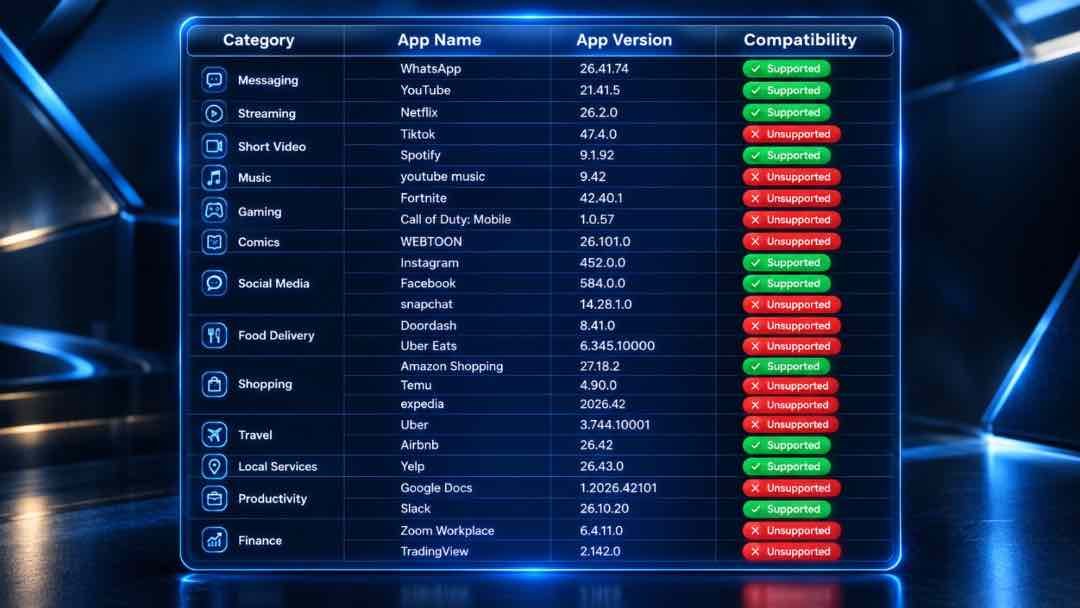
This is the part of the iPhone Duo experience that will frustrate you most, and it has nothing to do with the hardware. iOS 27.1 brings native Split View to the iPhone for the first time, and when it works, it is genuinely good. Two optimised apps side by side on a 7.6-inch canvas feel like a small iPad, and dragging content between them is smooth.
The problem is how often it doesn’t work. In a test of 25 common apps, about 80% were not fully adapted for the Duo’s 1.4:1 inner display. Some apps scale up like a giant iPhone app. Others sit in the middle of the screen with thick black bars on either side. Disney Plus and The Weather Channel were called out for large unused borders. Some games only fill about three-quarters of the display. YouTube behaves better in landscape, with comments alongside the video, but not every app is that thoughtful.
| Software Issue | What Happens | Can It Be Fixed? |
|---|---|---|
| Unoptimised apps | Scale up or leave black bars | Yes — developers need to target iOS 27.1 SDK |
| Split View resizing | Locked to ~50/50, no free drag | Unclear — may need a future iOS update |
| Portrait Split View | Collapses to one app when rotated | Possibly — Apple has not committed |
| One-handed use | Awkward controls on an 84mm-wide body | No — physical size is the constraint |
| App switching | Occasional animation twitch when folding | Yes — software polish |
The good news is that this is improving fast. Apple updated its own Support app for the Duo and iOS 27.1 within days, and developers are taking the device seriously. The bad news is that “fast” is relative. If you buy on day one, you are an early adopter, and early adopters live with rough edges. Apps built with the iOS 27.1 SDK get full-screen layouts; apps built with the iOS 27 SDK may still leave a narrower unused strip.
Before you buy: Open your five most-used apps on a demo unit. Check whether they scale, leave black bars or support Split View. If your daily workflow depends on an app that looks broken, you will be unhappy — and no software update can fix an app that the developer has not updated.
Sources: TechRepublic, MacRumors, and Gamersky.
7. Performance, Heating and Battery: The Foldable Tax Is Real
On paper, the iPhone Duo has the same A20 Pro chip as the iPhone 18 Pro. In CPU benchmarks, it is not a watered-down version. He Tongxue found CPU performance essentially identical to the 18 Pro. The difference shows up in the GPU: the Duo’s GPU score is about 10% lower, and in sustained gaming the gap is bigger.
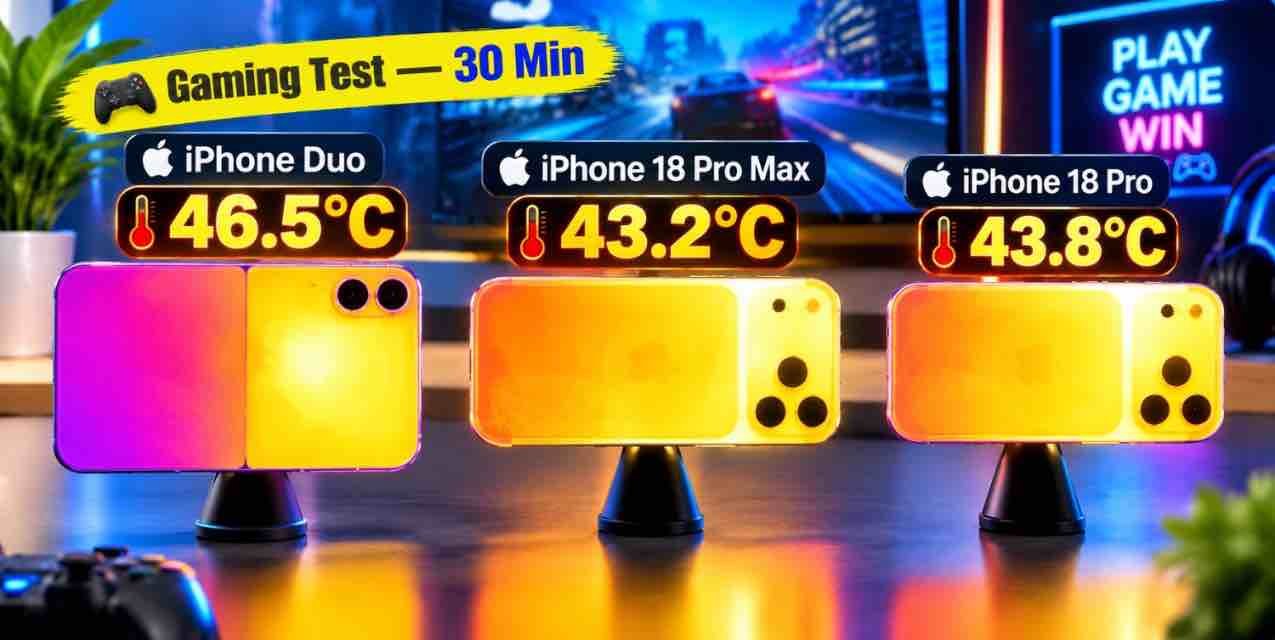
In a 30-minute Death Stranding test, the Duo averaged about 33fps, compared with 40fps+ on the iPhone 18 Pro — roughly a 20% drop. The chassis reached 46.5°C, about 3°C hotter than the 18 Pro. He Tongxue attributes this to the foldable’s thinner vapour chamber and tighter internal space. Apple did add a graphite pipe through the hinge, but physics still wins in long sessions.
| Test | iPhone Duo | iPhone 18 Pro | Difference |
|---|---|---|---|
| CPU performance | Matches 18 Pro | Reference | No meaningful gap |
| GPU benchmark | ~10% lower | Reference | ~10% |
| Death Stranding, 30 min | ~33fps | 40fps+ | ~20% lower |
| Chassis temperature | 46.5°C | ~43.5°C | ~3°C hotter |
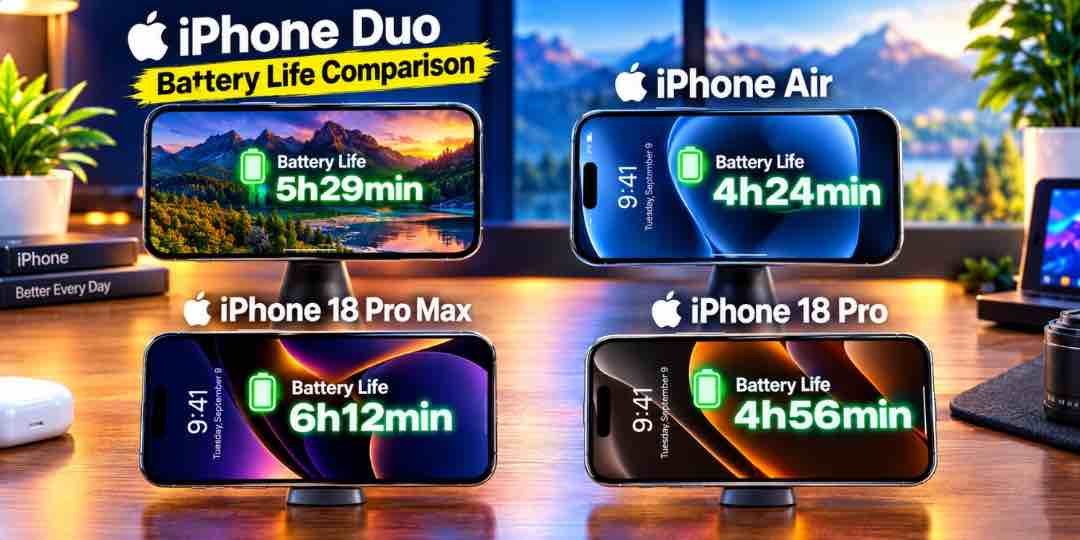
| Heavy-load battery | 5h 29m | Longer | Foldable penalty |
| Web browsing (Tom’s Guide) | 13h 20m | — | Good for a foldable |
Charging: 60W on paper, 42W in reality
Apple rates the Duo at up to 60W wired charging, but real-world peak power is around 42W. From zero to full, it takes 1 hour 40 minutes unfolded and 1 hour 52 minutes folded. The difference comes from heat: when folded, the hinge cooling has less surface area to work with, so the charging curve slows down. Wireless charging takes about 3 hours 14 minutes, and MagSafe peaks around 33W.
The battery is roughly 4,700mAh. Heavy-load battery life of 5h 29m is not a two-day phone, but Tom’s Guide’s web-browsing test at 150 nits over 5G lasted 13 hours 20 minutes, which is respectable for a foldable. Your mileage will depend on how much time you spend on the big inner screen.
What this means for you: If you play competitive games for hours, the iPhone 18 Pro Max is still the better phone. The Duo is a foldable first and a gaming phone second. For browsing, video, email and Split View, it is fast enough that you will rarely notice the thermal penalty.
Sources: Gamersky / He Tongxue, MacRumors review roundup, and iSpazio.
8. Repair Costs, Warranty and Availability in India
The iPhone Duo went on sale in India on October 23, 2026, in Star White and Night Sky. Pre-orders opened on October 16. Here is the full pricing and — more importantly — what it costs to fix.
India price
| Storage | India Price | Notes |
|---|---|---|
| 256GB | ₹2,99,900 | Base model |
| 512GB | ₹3,24,900 | Popular pre-order variant |
| 1TB | ₹3,74,900 | For heavy ProRes users |
| 2TB | ₹4,49,900 | Top-end, limited stock |
Repair costs
| Repair | Without AppleCare+ | With AppleCare+ |
|---|---|---|
| Inner folding display | ₹1,49,900 | ₹8,900 service fee |
| Outer display | ₹42,900 | ₹2,500 screen fee |
| Back glass | ₹20,900 | ₹2,500 screen fee |
| Outer display + back glass | ₹55,900 | ₹2,500 screen fee |
| Rear camera | ₹26,900 | Not listed |
| Battery service | ₹24,900 | ₹0 |
| Cover layer | ₹5,900 | ₹1,900 |
| Other damage | ₹2,24,900 | ₹8,900 |
AppleCare+ costs ₹51,900 for two years. If you pay for the plan and then need one inner-screen repair, the total outlay is about ₹60,800, versus ₹1,49,900 without coverage. The plan pays for itself after one serious accident or repeated mishaps. For context, Samsung lists the Galaxy Z Fold 8 inner-screen replacement at around ₹54,130, which is roughly a third of Apple’s out-of-warranty price.
Availability notes
MacRumors reported that Apple retail staff were told to warn against walk-in purchases on launch day because stock would be limited. Blinkit’s launch stock reportedly sold out in minutes, and Delhi’s Saket store saw queues. If you want a specific storage variant, order online rather than assuming you can pick one up in a store.
Sources: Smartprix, Croma Unboxed, MacRumors, and Gadgets360.
9. iPhone Duo vs Traditional Flagship: What You Give Up for the Fold
The iPhone Duo is not competing only with foldables. At ₹2,99,900, it is competing with the best slab phones Apple and Samsung sell. Here is the honest trade-off.
| Spec / Feature | iPhone Duo | iPhone 18 Pro Max | Galaxy S26 Ultra |
|---|---|---|---|
| India price (base) | ₹2,99,900 | ₹1,79,900 | ₹1,39,999 |
| Weight | 254g | ~240g | 214g |
| Thickness | 11.3mm folded | ~8.8mm | ~7.9mm |
| Main display | 7.6″ foldable OLED, 120Hz | 6.9″ OLED, 120Hz | 6.9″ AMOLED, 120Hz |
| Camera | 48MP + 48MP ultra-wide, no telephoto | 48MP triple with telephoto | 200MP quad with 5x zoom |
| Battery | ~4,700mAh | ~5,000mAh+ | 5,000mAh |
| Charging | 42W peak wired | Faster wired | 60W wired |
| Durability | IP68, foldable hinge | IP68, slab | IP68, slab, S Pen |
| Software support | 5+ years iOS | 5+ years iOS | 7 years OS + security |
| Repair risk | ₹1,49,900 inner screen | Lower | Lower |
What the Duo gives you
A 7.6-inch screen in a pocketable body, the best CPU performance on any foldable, IP68, and Apple’s ecosystem. If you want to read, watch video, or run two apps side by side on a bigger canvas, no slab phone can match that.
What you give up
Camera versatility: no telephoto, and low-light processing is more aggressive than the 18 Pro Max. Battery: a foldable cell is smaller, and heavy use drains it faster. Weight and thickness: 254g and 11.3mm folded is a lot compared with a 214g slab. Repair risk: one inner-screen repair costs nearly as much as an iPhone 18 Pro. Software maturity: 80% of tested apps still do not use the screen properly.
Target user: The Duo makes sense if the big screen is the product for you — reading, video, Split View, Apple ecosystem — and you accept the camera, battery and repair trade-offs. If you want the best camera, the longest battery or the lowest risk, the iPhone 18 Pro Max or Galaxy S26 Ultra is the smarter buy.
Sources: PhoneArena, 9to5Google, and Gamersky.
10. Who Should Buy the iPhone Duo — And Who Should Avoid It
Buy It If:
- You want the most polished foldable hardware available
- You are deep in the Apple ecosystem
- You mostly use optimised apps in landscape
- You will buy AppleCare+ without hesitating
- You can inspect the unit at unboxing
- You value the big screen more than camera zoom
Avoid It If:
- You need mature multitasking and window resizing
- You use apps that still show black bars
- You want the best camera or telephoto reach
- You are not prepared for ₹1,49,900 repair risk
- You want a two-day battery
- You are a first-time foldable buyer who wants zero risk
The practical move: If you can wait six months, do it. Apple will ship more iOS updates, developers will optimise more apps, and we will know whether the hinge cracks are a rare defect or a pattern. If you cannot wait, buy from Apple or Croma, inspect the unit before you leave, install iOS 27.1 immediately, and buy AppleCare+. The Duo is a brilliant first draft. Just don’t mistake it for a finished product.
Watch the Full 3,000-Fold Test
HTX Studio’s review is the primary source for the crease data in this guide. The video below loads only when you tap it — no autoplay, no tracking until you choose to play.
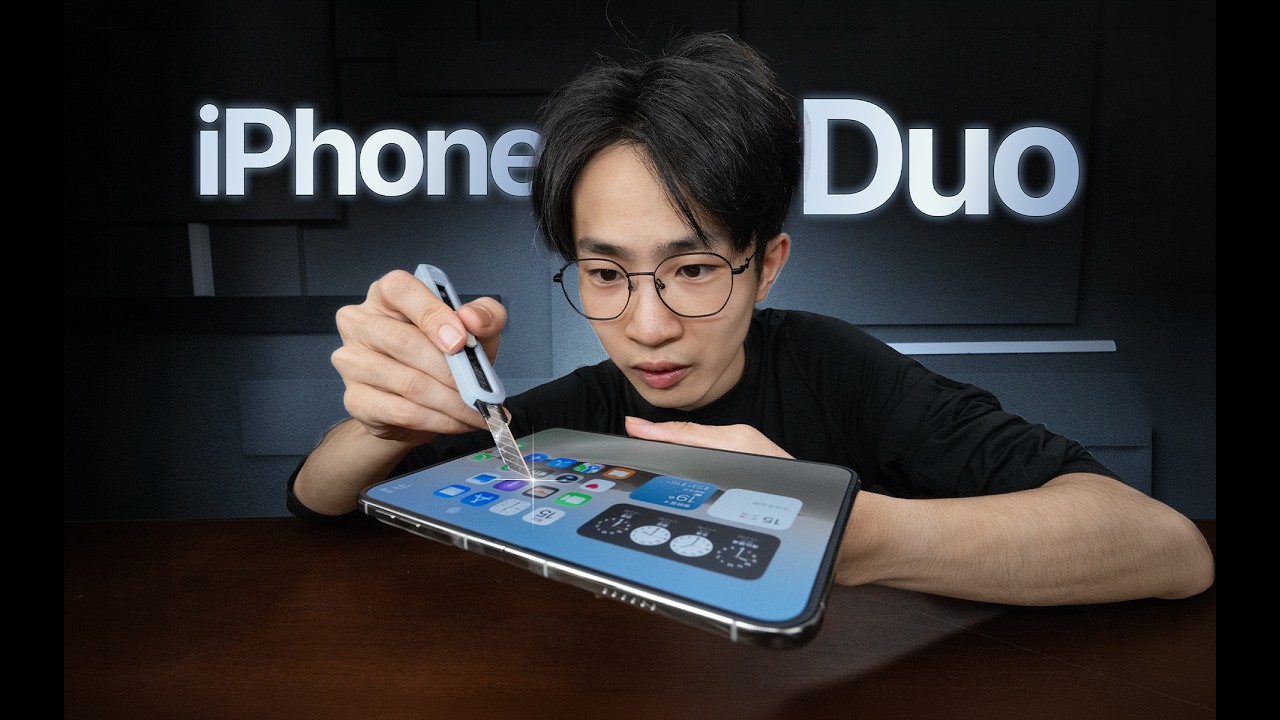
Source: HTX Studio on YouTube · 3.4M+ views · Published October 21, 2026. Tap to load the player.
Frequently Asked Questions
Out of the box, the iPhone Duo crease has a peak-to-valley height of about 48 microns and a cross-axis slope of 0.097 degrees. After 3,000 simulated folds, HTX Studio and He Tongxue measured it at about 167 microns — roughly 3.5 times deeper — with the slope rising to 1.245 degrees. The screen around the crease also becomes noticeably softer to the touch. That is roughly two to three months of heavy use.
At launch, the iPhone Duo crease is among the least visible in the industry thanks to its nano-texture layer and dual Ultra Thin Glass. After 3,000 folds, HTX Studio found the crease became deeper than two other foldables tested under the same conditions. Apple starts ahead but does not stay ahead.
Yes, a small number of owners have reported inner display cracks along the hinge within hours of ownership. One Australian buyer said the device cracked after fewer than 20 openings and about six hours, with no visible damage beforehand. Apple replaced at least one affected unit immediately. The exact failure rate is unknown, and some early images may involve user damage. Hinge failures from normal use should be covered under the one-year warranty.
The iPhone Duo launched in India at ₹2,99,900 for 256GB, ₹3,24,900 for 512GB, ₹3,74,900 for 1TB and ₹4,49,900 for 2TB. It went on sale on October 23, 2026, in Star White and Night Sky colours through Apple’s online store and authorised retailers such as Croma.
Out of warranty, Apple lists ₹1,49,900 for inner display repair, ₹42,900 for the outer display, ₹20,900 for the back glass, ₹55,900 for outer display plus back glass and ₹2,24,900 for other damage. AppleCare+ costs ₹51,900 for two years and reduces the inner screen service fee to ₹8,900. For comparison, Samsung lists the Galaxy Z Fold 8 inner screen replacement at around ₹54,130.
The iPhone Duo runs iOS 27.1 and has a 7.6-inch 1.4:1 inner display. In one test of 25 common apps, about 80% were not fully adapted and either scaled up or left large black borders. Disney Plus and The Weather Channel showed substantial side borders, some games filled only about three-quarters of the screen, and apps built for iOS 27 but not specifically for the Duo left a narrower unused strip. Developers need to target the iOS 27.1 SDK for full-screen layouts.
Not freely. Split View on the iPhone Duo is limited to a roughly 50/50 split, and you cannot drag the divider to make one app larger than the other. Split View also collapses into a single app when you rotate the device to portrait, and the original pair returns when you rotate back to landscape.
It can get warm. In sustained gaming tests, the iPhone Duo reached about 46.5°C, roughly 3°C hotter than the iPhone 18 Pro. In Death Stranding it averaged around 33fps versus 40fps+ on the 18 Pro, about a 20% drop. The GPU benchmark score was about 10% lower. Apple uses a thinner vapour chamber and a graphite pipe routed through the hinge, which helps but does not eliminate the foldable thermal penalty.
Apple rates the iPhone Duo at up to 60W wired charging, but real-world peak power is around 42W. From zero to full it takes about 1 hour 40 minutes when unfolded and about 1 hour 52 minutes when folded. Wireless charging takes roughly 3 hours 14 minutes. In Tom’s Guide’s web browsing test at 150 nits over 5G, it lasted 13 hours 20 minutes; in He Tongxue’s heavy-load test, it lasted 5 hours 29 minutes.
No. Apple describes it as a nano-textured cover layer bonded into the display stack, not a user-removable screen protector. A teardown showed it can be peeled off with force, revealing a glossy and slightly uneven surface underneath, which makes the crease more visible. Apple says it is designed to be replaceable as it wears, and replacement costs ₹5,900 in India. Apple advises against removing it yourself.
It depends on what you value. If you want the most polished foldable hardware, the best CPU performance on a foldable and you are deep in the Apple ecosystem, it is worth considering — but buy AppleCare+ and inspect the hinge and screen at unboxing. If you want mature multitasking, better app support, a lighter body and a lower price, the Samsung Galaxy Z Fold 7 or another Android foldable is the safer choice right now.
Apple has indicated that the iPhone Duo will receive Apple Pencil support in a future software update. It was not available at launch. Buyers who want stylus input should wait for the feature to actually ship before buying a Pencil.
Final Thoughts: A Brilliant First Draft, Not a Finished Product
The iPhone Duo is the most impressive first-generation foldable I have seen. The hinge is over-engineered in the best way. The crease at unboxing is genuinely hard to see. The A20 Pro makes every Android foldable look slow. And IP68 on a folding phone is a real engineering achievement.
But after 3,000 folds, the story changes. The crease deepens. The screen around it softens. The GPU throttles under sustained load. Charging is slower than the box suggests. About 80% of tested apps still do not use the screen properly. And a small number of buyers are reporting hinge-area cracks within hours.
None of that makes the Duo a bad phone. It makes it a first-generation product with first-generation problems. Apple has fixed software bugs before, and developers are already updating apps. If you buy it knowing what you are getting into — and you buy AppleCare+ — it is a genuinely exciting device. If you want a foldable that just works like a mature tablet, the Galaxy Z Fold 7 is still the safer choice.
The iPhone Duo is the future of the iPhone. It is just not the present yet.
Found This Guide Helpful?
Explore more iPhone reviews, India pricing breakdowns and foldable comparisons on PhonePrice360.
Explore Apple Guides